
Why Access to Free Family Planning Matters for Your Health and Future
Free family planning services help you take control of your reproductive health without financial stress. Here’s what you need to know:
Quick Overview: How to Access Free Family Planning
- Title X Program: Federal program offering free or low-cost contraception, STI testing, and counseling at over 3,800 clinics nationwide
- Medicaid: Covers family planning services for eligible low-income individuals, including all FDA-approved contraceptive methods
- Publicly Supported Clinics: Health departments, specialized reproductive health centers, federally qualified health centers, and community clinics provide services regardless of insurance status
- Income-Based Fees: Many clinics use sliding fee scales, so you pay only what you can afford
- Confidential Care: Services available to all ages, including adolescents, with privacy protections
In 2020, more than 7 million women received publicly supported family planning services in the United States, yet this represented only 39% of those who needed them. The direct costs of unintended pregnancies in youth alone exceed $125 million per year in Canada, while universal contraception coverage could save $320 million annually in the US. These numbers reveal a clear truth: access to free family planning isn’t just about convenience—it’s about health equity, economic security, and your fundamental right to decide if and when to start a family.
Right now, significant barriers stand between you and the care you deserve. Cost remains the single most important obstacle, especially for long-acting reversible contraceptives (LARCs) like IUDs, which have upfront costs up to $500 but are 99% effective. Geographic gaps also persist—21% of US counties have no publicly supported family planning clinic. Add concerns about confidentiality, especially for young people using private insurance, and it’s no wonder many who need services don’t receive them.
As Dr. Cheryl Twu, founder of Wellness OBGYN, I’ve spent over a decade helping women steer free family planning resources while providing comprehensive reproductive care that respects your values, lifestyle, and financial situation. My goal is to ensure you understand all your options—from publicly funded programs to community resources—so you can make informed decisions about your health without worry about cost.
Free family planning vocabulary:
Understanding the Landscape of Free Family Planning in the US
Navigating healthcare can feel like solving a puzzle, especially when it comes to reproductive services. But the good news is that in the US, there are robust programs designed to make free family planning and low-cost care accessible to millions. We believe that financial status should never be a barrier to managing your reproductive health, and that’s why we’re here to guide you through the available options.
The backbone of publicly supported family planning services in the United States rests on two major federal initiatives: the Title X program and Medicaid. These programs, alongside a diverse network of healthcare providers, work to ensure that individuals, particularly adolescents and those with low incomes, can access essential reproductive healthcare.
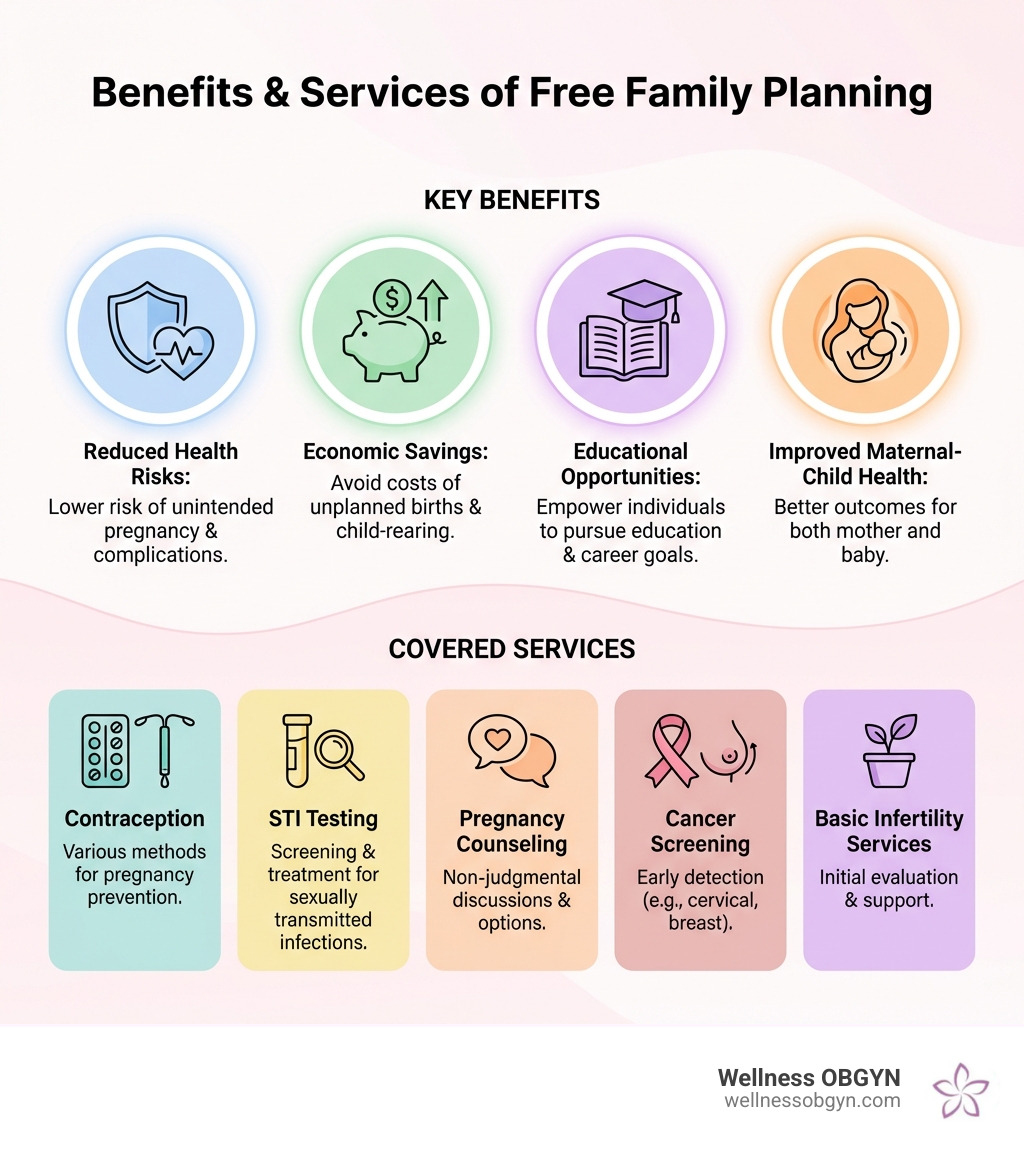
Title X Program: Established in 1970, Title X is the only federal initiative in the United States dedicated to providing affordable family planning services. It funds over 3,800 clinic sites nationwide, serving millions of patients each year. These clinics offer a comprehensive range of services, including contraceptive care, STI testing and treatment, HIV testing, pregnancy testing and counseling, and basic infertility services. A key feature of Title X is its commitment to serving everyone, regardless of financial situation or insurance status, often utilizing sliding fee scales based on income. This means you only pay what you can reasonably afford, and no one is turned away due to inability to pay. In 2023, Title X-funded clinics served 2.4 million female and 419,000 male family planning patients, providing critical services like 1.3 million chlamydia tests and 461,000 cervical cancer screenings.
Medicaid: As a state and federal program, Medicaid historically accounts for the majority of US public expenditures on domestic family planning. For eligible low-income individuals, Medicaid covers a broad spectrum of family planning services, including all FDA-approved contraceptive methods, STI screening and treatment, and pregnancy-related care. If you qualify for Medicaid, your family planning services are typically covered, alleviating significant financial stress.
Publicly Supported Clinics: Beyond these federal programs, a diverse network of publicly supported clinics forms the frontline of free family planning access. These include health departments, Federally Qualified Health Centers (FQHCs), specialized reproductive health centers, hospital outpatient facilities, and other independent clinics. In 2020, there were 9,388 such clinics providing subsidized services across the US. These clinics are vital because they often provide primary care and a range of other essential reproductive health services in addition to contraception, such as breast and cervical cancer screening. They are often equipped to offer a wider range of contraceptive methods on-site and prioritize protocols to help patients initiate and continue using methods. While the average wait for an appointment at these clinics was six days in 2022–2023, many still strive to offer same-day appointments and extended hours to accommodate diverse schedules.
We understand that you might have questions about eligibility. Generally, those with incomes below 250% of the federal poverty level or those younger than 20 years old are considered to have a likely need for publicly supported contraceptive services. The goal is to ensure that everyone, regardless of their background or ability to pay, has the opportunity to make informed decisions about their reproductive health. Our commitment at Wellness OBGYN, located right here in Honolulu, is to support your choices and provide comprehensive, personalized womens healthcare that aligns with your needs.
| Program | Primary Funding | Eligibility | Services Covered | Cost to Patient |
|---|---|---|---|---|
| Title X | Federal | All individuals, regardless of income/insurance | Contraception, STI testing & treatment, HIV testing, pregnancy testing & counseling, basic infertility services | Free or discounted based on income (sliding scale) |
| Medicaid | Federal & State | Low-income individuals (varies by state) | All FDA-approved contraceptive methods, STI testing & treatment, pregnancy-related care | Typically no cost for eligible individuals |
Essential Contraceptive Options and Their Benefits
Choosing the right contraceptive method is a deeply personal decision, and we at Wellness OBGYN are here to help you explore all your options. With so many choices available, it’s natural to feel a little overwhelmed. Our goal is to provide you with clear, comprehensive information about each method, its benefits, and how it aligns with your lifestyle and health goals. We encourage you to visit Contraception for more global insights on family planning.
When we discuss contraception, we’re talking about methods that prevent pregnancy. These methods vary widely in terms of how they work, their effectiveness, duration, and whether they protect against sexually transmitted infections (STIs). During your womens health annual exam, we can have a detailed conversation about what’s best for you.
Long-Acting Reversible Contraception (LARC) at Wellness OBGYN
Long-Acting Reversible Contraception (LARCs) are often recommended as a first-line method due to their high effectiveness and convenience. Once placed, you can often forget about them for years, offering peace of mind and excellent pregnancy prevention.
- Intrauterine Devices (IUDs): Available at Wellness OBGYN, IUDs are small, T-shaped devices inserted into the uterus.
- Hormonal IUD (e.g., Mirena, Skyla, Kyleena): These release a progestin hormone, which thickens cervical mucus, thins the uterine lining, and can suppress ovulation. They can be effective for 3 to 8 years, depending on the type, and often reduce menstrual bleeding and cramping.
- Copper IUD (Paragard): This non-hormonal option works by releasing copper ions, creating an inflammatory reaction that is toxic to sperm and eggs. It can be effective for up to 10 years and is 99% effective at preventing pregnancy. The copper IUD is also the most effective form of emergency contraception if inserted within 7 days of unprotected sex. LARCs boast a typical use failure rate of less than 1%, making them incredibly reliable. While the upfront cost can be higher (up to $500 for a hormonal IUD or $100 for a copper IUD), their long-term cost-effectiveness is significant, as they require minimal ongoing effort or expense. We offer personalized counseling to help you understand if a LARC option is right for your free family planning needs.
Short-Acting Methods for Flexible Free Family Planning
For those who prefer methods that can be started or stopped more frequently, short-acting options provide great flexibility.
- Oral Contraceptive Pills:
- Combination Pill: Contains estrogen and progestin. It works by preventing ovulation, thickening cervical mucus, and thinning the uterine lining. When taken correctly, it’s 99.7% effective. It can also help with acne, regulate periods, and lessen perimenopause symptoms.
- Progestin-Only Pill (“Mini Pill”): Contains only progestin and is a good option for those who cannot use estrogen (e.g., breastfeeding individuals, those with certain medical conditions). It’s also 99.7% effective when taken consistently.
- Birth Control Patch (Xulane): A thin, beige patch worn on the skin that releases estrogen and progestin. You change it weekly for three weeks, followed by a patch-free week. It’s 99.7% effective.
- Vaginal Ring (NuvaRing, Annovera): A flexible ring inserted into the vagina that releases estrogen and progestin. It’s worn for three weeks, then removed for a week. Like the pill, it’s 99.7% effective.
- Contraceptive Injection (Depo-Provera): An injection of progestin given every 12 weeks. It’s highly effective (99.8%) and convenient, but requires regular clinic visits.
- Contraceptive Implant (Nexplanon): A small, flexible rod inserted under the skin of the upper arm, releasing progestin. It provides up to three years of contraception and is 99.9% effective.
- Emergency Contraception (EC): Also known as the “morning-after pill” (though it can be taken up to 3-5 days after unprotected sex). We want to emphasize that EC is a backup method, not a routine form of contraception. The sooner it’s taken, the more effective it is. Levonorgestrel ECPs are 95% effective within 24 hours, while ulipristal ECPs (prescription-only) are effective for up to 5 days.
While short-acting methods require more diligent daily or weekly adherence, they offer control and can be easily discontinued if you decide to try for pregnancy. We’ll discuss all these options during your visit to help you find the perfect fit for your free family planning journey.
Overcoming Barriers to Reproductive Healthcare
Even with the availability of free family planning programs, various barriers can still make accessing reproductive healthcare a challenge. We understand these problems and are dedicated to helping you overcome them, ensuring you receive the care you need, right here in Honolulu.
One of the most significant barriers remains cost, even when programs offer free or low-cost services. The perception of cost, or the actual upfront expense for certain methods like LARCs, can deter individuals. Beyond cost, factors like confidentiality, particularly for youth, and the lack of a regular clinician can significantly impede access.
Navigating Confidentiality in Free Family Planning
Confidentiality is paramount, especially for adolescents. Youth are often particularly vulnerable to barriers related to both cost and privacy. Many young people may hesitate to seek care if they fear their parents or guardians will be notified, especially if they are covered under a parent’s private insurance plan. This can lead to them paying out-of-pocket to preserve confidentiality, or worse, forgoing contraception altogether.
At Wellness OBGYN, we prioritize confidential care for all our patients, including adolescents. We understand the importance of creating a safe and trusting environment where you can discuss your reproductive health concerns openly. Some publicly funded clinics and sexual health centers are specifically designed to offer confidential services, often with mechanisms to protect privacy even when billing insurance. We encourage you to seek out places that explicitly state their commitment to confidential care, like our adolescent gynecology honolulu services.
The Role of Pharmacists and Virtual Care
The healthcare landscape is evolving, and new avenues are emerging to bridge gaps in access to contraception.
- The role of pharmacists: In a growing trend across the US, pharmacists are playing a larger role in dispensing contraception. Some areas now allow pharmacists to provide certain hormonal contraceptives without a patient-specific prescription through statewide standing orders. Additionally, the nonprescription birth control pill (a progesterone-only pill) is becoming available over-the-counter without needing to speak with a pharmacist or requiring insurance. These developments significantly reduce barriers by making contraception more readily available and often more affordable.
- Virtual care solutions: For many, accessing a doctor, especially without an established primary care provider, can be time-consuming and difficult. Virtual care platforms have emerged as a powerful solution, offering access to licensed clinicians through telehealth. Whether you need an initial prescription, a refill, or guidance on the best method for you, virtual care can provide judgment-free, medically sound family planning advice without the wait times or travel associated with traditional clinics. This is particularly helpful for those in rural areas or with demanding schedules, ensuring that your reproductive health does not take a backseat.
These advancements are changing how we access free family planning and contraception, making it more convenient and confidential than ever before. We are committed to staying informed about these changes to best serve our community in Honolulu
Frequently Asked Questions
We know you have questions, and we’re here to provide clear, straightforward answers about free family planning.
Who is eligible for Title X services?
Title X services are specifically designed to be accessible to a wide range of individuals, ensuring that financial limitations do not prevent access to essential reproductive healthcare.
- Low-income individuals: If your income falls below a certain threshold (often 250% of the federal poverty level), you will likely be eligible for free or highly discounted services.
- Uninsured patients: If you do not have health insurance, Title X clinics are a crucial resource, as they do not require insurance for services.
- Adolescents: Youth, regardless of age or ability to pay, are eligible for confidential Title X services.
- Sliding fee scales: Clinics funded by Title X use sliding fee scales, meaning the cost of your services is adjusted based on your income and family size. This ensures you only pay what you can afford, and no one is turned away due to inability to pay.
- Universal access regardless of status: The program’s core principle is to provide services to all who need them, without discrimination based on race, age, sex, sexual orientation, national origin, disability status, or ability to pay.
Can I get birth control without a family doctor?
Absolutely. While having an ongoing primary care clinician can be helpful, it’s not required to access contraception. Options include:
- Sexual health clinics and local public health clinics: Many communities have clinics that focus on reproductive healthcare and often provide comprehensive birth control services, including prescriptions and IUD insertions. Many operate on a sliding scale or offer free family planning options.
- Virtual care platforms: Online healthcare providers may allow you to consult with a licensed clinician via video or chat to get a birth control prescription or refill. This can be convenient if you have a busy schedule or live far from a clinic.
- Walk-in clinics: Many urgent care or walk-in clinics can provide birth control prescriptions after a consultation.
- Pharmacist-prescribed options: In some areas, pharmacists are able to prescribe certain types of hormonal birth control directly. Check with your local pharmacy in Honolulu to see what options are available.
- Community health centers: Federally Qualified Health Centers (FQHCs) offer a wide range of primary and preventive health services, including family planning, often with reduced fees based on income.
Does free contraception include emergency options?
Yes, access to emergency contraception (EC) is a critical component of free family planning services.
- Morning-after pills: Many publicly funded clinics and family planning programs offer access to levonorgestrel-based morning-after pills, often at a reduced cost or for free, depending on your eligibility. These can be effective up to 72 hours after unprotected sex. Ulipristal acetate (Ella), another type of EC that can be effective up to 5 days after unprotected sex, typically requires a prescription but may also be covered by programs.
- Over-the-counter availability: Levonorgestrel EC is available over-the-counter in the US without a prescription, though the cost can vary.
- Copper IUD as emergency care: The copper IUD is the most effective form of emergency contraception. If inserted by a healthcare provider within 7 days of unprotected intercourse, it is over 99% effective at preventing pregnancy and can then serve as long-term contraception. This option is typically available through family planning clinics.
Conclusion
At Wellness OBGYN in Honolulu, we are passionate about empowering you with the knowledge and resources to make informed decisions about your reproductive health. The availability of free family planning services is a testament to the idea that everyone deserves control over their body and future, regardless of their financial circumstances. From understanding federal programs like Title X and Medicaid to exploring the diverse range of contraceptive methods and innovative solutions like virtual care, we are here to support you every step of the way.
We believe in patient-centered care and shared decision-making, ensuring that your unique needs and preferences are at the heart of your treatment plan. Whether you’re seeking guidance on contraception, exploring options for enhancing your sexual wellness or navigating female reproductive health issues, our team provides expert, compassionate care custom to you. Your well-being is our priority, and we are dedicated to helping you achieve optimal health and a fulfilling life.