
Decoding the “Ghosting”: What is Irregular Menstruation?
An irregular menstruation specialist is a medical doctor — typically an OB-GYN or reproductive endocrinologist — who diagnoses and treats abnormal period patterns. Here’s a quick snapshot of what they do and when you need one:
| What They Do | When to See One |
|---|---|
| Diagnose causes of irregular cycles | Periods missing for 3+ months |
| Order blood tests, ultrasounds, biopsies | Cycles shorter than 21 or longer than 35 days |
| Prescribe hormonal or non-hormonal treatments | Heavy bleeding soaking a pad/tampon hourly |
| Manage conditions like PCOS, fibroids, thyroid disorders | Spotting between periods or after menopause |
| Recommend lifestyle and surgical options | Severe cramping, fatigue, or pelvic pain |
Your period can feel like a mystery sometimes. One month it shows up on time. The next, it’s completely gone. Or it arrives way too early, way too heavy, or with pain that stops you in your tracks.
You’re not imagining it — and you’re not alone.
Up to 30% of women experience menstrual irregularities at some point in their lives. According to the American College of Obstetricians and Gynecologists, a healthy cycle typically falls somewhere between 24 and 35 days in length. Anything outside that window — or with no predictable pattern at all — is worth paying attention to.
Irregular periods aren’t always a sign of something serious. But they can be your body’s way of signaling that something needs attention, from hormonal imbalances and thyroid issues to conditions like PCOS that carry real long-term health risks if left unaddressed.
The good news? Most causes are very treatable — especially when caught early.
I’m Dr. Cheryl Twu, founder of Wellness OBGYN in Honolulu, Hawaiʻi, and a board-certified OB-GYN with over a decade of experience helping women decode and manage irregular menstruation through both evidence-based medicine and integrative care. As your local irregular menstruation specialist, my goal is to help you understand what your cycle is telling you — and build a care plan that actually fits your life.
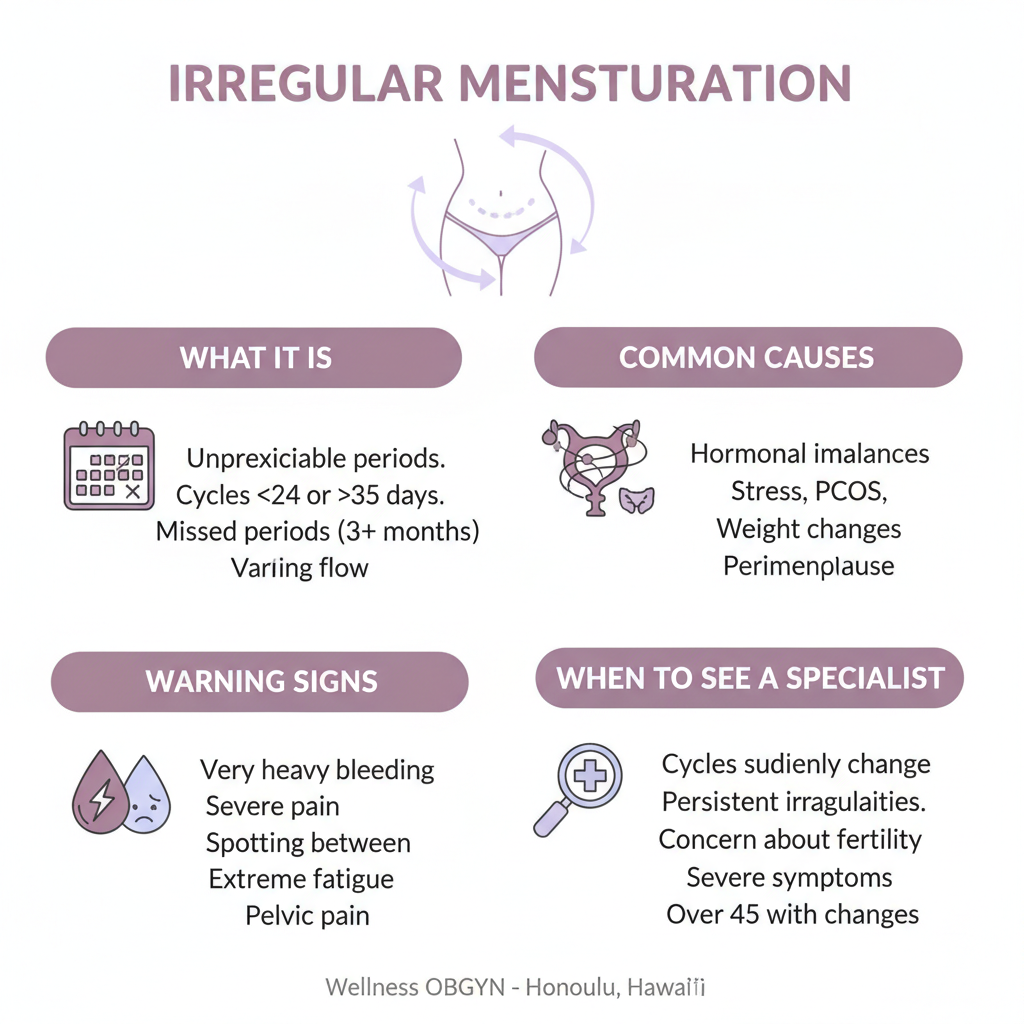
Irregular menstruation specialist terms you need:
In gynecology, “normal” is a range, not a single number. Most of us were taught that a cycle is exactly 28 days, but in reality, a normal interval between menstrual cycles is 24 to 35 days. When your period starts “ghosting” you—meaning it shows up whenever it feels like it, or doesn’t show up at all—it’s officially classified as irregular.
As an irregular menstruation specialist team here in Honolulu, we look for several specific patterns:
- Polymenorrhea: Your cycle is shorter than 21 days.
- Oligomenorrhea: Your cycles are infrequent, usually occurring more than 35 days apart.
- Amenorrhea: This is when your period goes on a long-term hiatus. Specifically, it’s defined as missing three or more periods in a row if you aren’t pregnant or breastfeeding.
- Metrorrhagia: This is the medical term for spotting or bleeding between your expected periods.
It’s also important to consider where you are in life’s journey. During menarche (the first few years after a girl starts her period) and perimenopause (the transition toward menopause), irregular cycles are quite common due to fluctuating hormones. however, even during these phases, a check-up with a gynecologist in Honolulu can help ensure those fluctuations are within a healthy range and provide relief from bothersome symptoms.
Common Culprits Behind the Disappearing Act
If your period has gone missing or is acting erratic, there is usually a “why” behind the “what.” At Wellness OBGYN, we dig deep to find the root cause. Here are the most frequent reasons your cycle might be off-track:
Polycystic Ovary Syndrome (PCOS)
PCOS is one of the most common causes of irregular periods, affecting up to 10% of women of reproductive age. It occurs when the ovaries produce higher-than-normal levels of androgens (male hormones). This hormonal imbalance can prevent an egg from being released (ovulation), leading to missed or infrequent periods. Beyond the cycle, PCOS often presents with acne, excess hair growth, and weight changes.
Thyroid Dysfunction
Your thyroid is like the master thermostat of your metabolism. If it’s overactive (hyperthyroidism) or underactive (hypothyroidism), it can throw your entire reproductive system out of whack.
Stress and Cortisol
When you are under high stress, your body produces cortisol. High levels of this “stress hormone” can tell your brain to deprioritize reproduction, effectively shutting down your menstrual cycle until the perceived “danger” has passed.
Structural Issues: Fibroids and Endometriosis
Sometimes the issue isn’t just hormonal; it’s structural. Uterine fibroids (non-cancerous growths) or endometriosis (where tissue similar to the uterine lining grows outside the uterus) can cause heavy, painful, or irregular bleeding.
Lifestyle and Weight Fluctuations
Extreme weight loss, eating disorders, or intense athletic training can cause your body to stop menstruating. On the flip side, obesity is also linked to hormonal imbalances that can lead to irregular cycles. Our Center for Women’s Wellness emphasizes looking at these lifestyle factors as part of a holistic approach to women’s health.
When to Consult an Irregular Menstruation Specialist
We often hear patients say, “I thought this was just my normal.” But you shouldn’t have to suffer through unpredictable cycles or debilitating pain. You should schedule an appointment with an irregular menstruation specialist if you experience:
- Heavy Bleeding: If you are changing a pad or tampon every hour for several consecutive hours, that is a clinical red flag for menorrhagia.
- Missing Periods: If you’ve missed three or more periods in a row and aren’t pregnant.
- Severe Pain: Period cramps shouldn’t keep you from living your life. If they do, it’s time for an evaluation.
- Post-Menopausal Bleeding: Any bleeding after you have fully transitioned through menopause needs immediate medical attention.
- Anemia Symptoms: If your periods are so heavy you feel lightheaded, fatigued, or short of breath, you may be losing too much blood.
At Wellness OBGYN, we believe in shared decision-making. We don’t just tell you what to do; we present the options and work with you to choose the path that aligns with your health goals and lifestyle. Whether you are looking for a gynecologist accepting new patients or a specialist to manage long-term infertility risks, we are here to help.
Navigating Diagnosis and Personalized Care
The journey to regular cycles starts with a clear diagnosis. We don’t guess; we test.
Diagnostic Tools Used by an Irregular Menstruation Specialist
When you visit us in Honolulu, we use a variety of tools to see what’s happening inside:
- Blood Tests: We check your LH, FSH, estrogen, and progesterone levels, along with thyroid function and blood sugar.
- Pelvic Ultrasound: This allows us to look for ovarian cysts (common in PCOS), fibroids, or polyps.
- Hysteroscopy: A tiny camera is inserted into the uterus to get a direct view of the uterine lining. This is often done right here in our office for your convenience.
- Endometrial Biopsy: A small sample of the uterine lining is taken to check for abnormal cells.
- MRI: In complex cases, such as deep endometriosis or large fibroids, an MRI provides a detailed map for our surgical team.
If you’ve recently had an abnormal Pap follow-up, we can integrate that information into your overall diagnostic picture.
How an Irregular Menstruation Specialist Restores Balance
Treatment is never one-size-fits-all. Depending on your diagnosis, we might recommend:
- Hormonal Support: This could include hormone therapy options like birth control pills, IUDs, or patches to regulate your cycle and reduce heavy bleeding.
- Minimally Invasive Surgery: If fibroids or polyps are the cause, we specialize in procedures that require minimal downtime, getting you back to your life quickly.
- Lifestyle Modifications: We work with you on diet, exercise, and stress management to support hormonal health naturally.
Frequently Asked Questions about Irregular Periods
Can PCOS cause permanent irregular periods?
While PCOS is a lifelong condition, your periods don’t have to be permanently irregular. Through a combination of managing insulin resistance, balancing androgen levels, and sometimes using hormonal support, we can often help you achieve a predictable cycle. Management is key to preventing long-term complications like Type 2 diabetes or endometrial cancer.
Is spotting between periods always a concern?
Not always, but it should be checked. Sometimes it’s just “ovulation spotting,” which is harmless. However, it can also be a sign of uterine polyps, infection, or breakthrough bleeding from hormonal contraceptives. An annual OBGYN visit is the perfect time to discuss these patterns.
How does perimenopause affect cycle regularity?
As we age, our ovaries produce less estrogen and progesterone. This ovarian aging causes the cycle to shorten, lengthen, or skip months entirely. If these symptoms are disruptive, we offer hormone replacement for menopause and holistic menopause treatment to help you navigate this transition comfortably.
Conclusion
Your menstrual health is a vital sign of your overall well-being. If your period is ghosting you, don’t wait for it to magically reappear. At Wellness OBGYN in Honolulu, we provide the expert, compassionate care you need to find answers.
Stop wondering why your cycle is off and start your journey back to balance. Schedule an appointment at our Honolulu OBGYN center today.
Need more information? Explore our local Honolulu resources: