
Why Compassionate Healthcare for Women Changes Everything
Compassionate healthcare for women means care that treats you as a whole person — not just a set of symptoms or a chart entry. Here’s what it looks like in practice:
- Being heard — your concerns are taken seriously, not dismissed
- Being seen — your cultural background, life stage, and personal values shape your care plan
- Being empowered — you’re included in decisions about your own body
- Being supported — emotionally and clinically, from your first visit through menopause and beyond
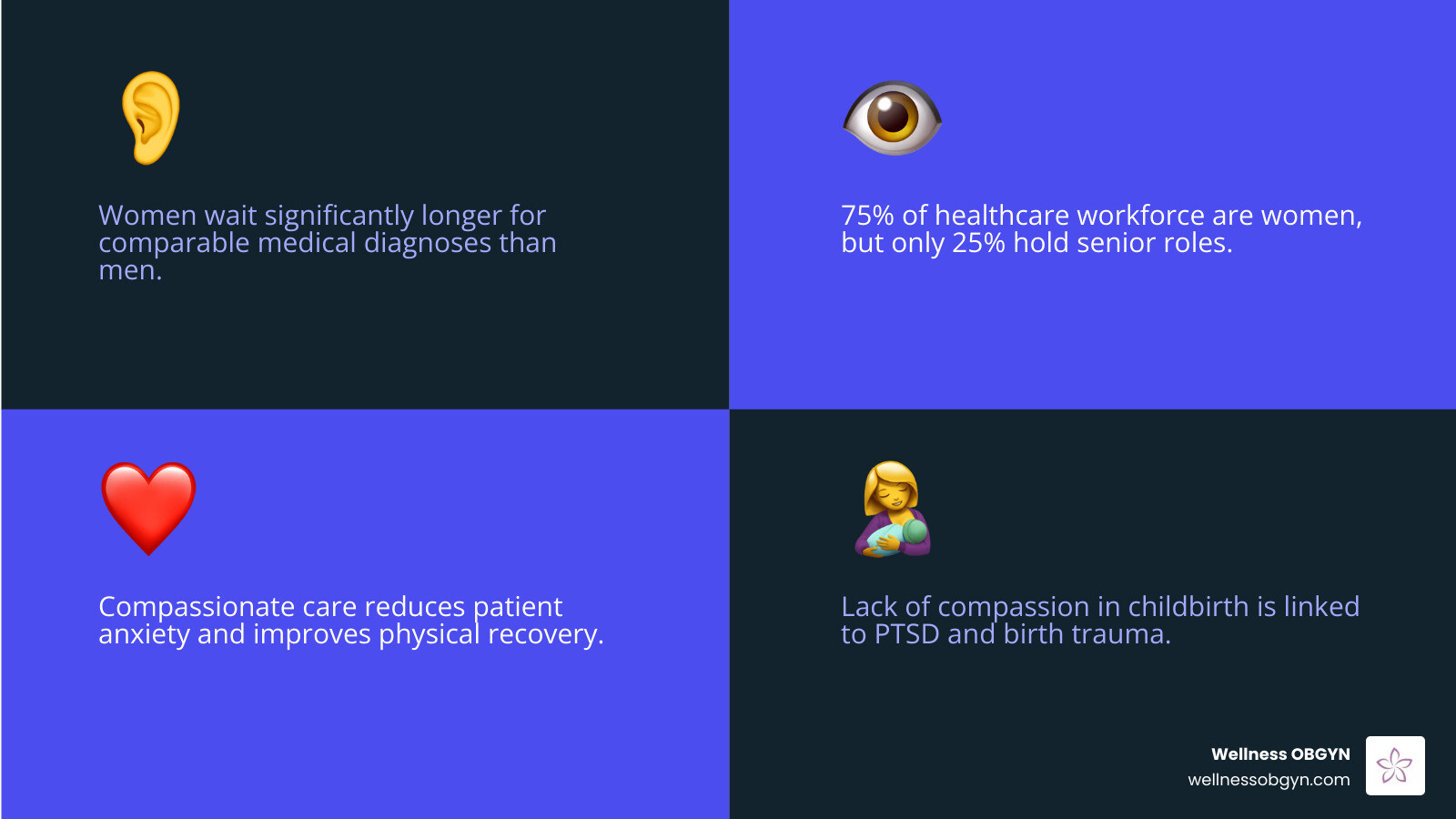
Too many women leave doctor’s appointments feeling rushed, unheard, or reduced to a diagnosis code. Research backs this up: comparable medical diagnoses take significantly longer to establish in women than in men, and conditions like fibromyalgia are sometimes used as “container diagnoses” when providers don’t have clear answers. Women also make up 75% of the healthcare workforce — yet hold only 25% of senior roles — which has real consequences for whose health priorities get attention.
This isn’t just about feeling good at your appointment. Studies show that when women receive compassionate, patient-centered care, they experience better physical recovery, less anxiety, and stronger long-term health outcomes. During childbirth alone, a lack of compassion is directly linked to birth trauma, PTSD, and depression.
This guide breaks down what compassionate care actually looks like, why it’s still the exception rather than the norm, and what you should expect from your provider.
I’m Dr. Cheryl Twu, founder of Wellness OBGYN in Honolulu — after more than a decade in high-volume hospital settings and advanced training in both Western and Eastern medicine, I’ve built my practice around delivering compassionate healthcare for women at every stage of life. Everything in this guide reflects the standard of care I believe every woman deserves.
Compassionate healthcare for women terms to learn:
Defining Compassionate Healthcare for Women

At its core, compassion is more than just a “nice to have” bedside manner. While sympathy is feeling for someone and empathy is feeling with someone, compassion is the deep awareness of another’s suffering coupled with the active desire and effort to relieve it. In a clinical setting, this means your doctor doesn’t just recognize your pain—they take personalized women’s healthcare steps to fix it.
Modern science increasingly views compassion as a fundamental skill for health professionals. According to scientific research on the definition of compassion in healthcare, it is a complex process involving respect, effective communication, and the inclusion of the patient’s family and personal context in the treatment plan. It is the bridge between technical medical knowledge and the actual human being sitting on the exam table.
Why Compassion is Essential in Maternity and Childbirth
Childbirth is one of the most vulnerable moments in a woman’s life. During labor, the body relies on a delicate hormonal balance. High levels of oxytocin (the “love hormone”) and endorphins are necessary for labor to progress and for natural pain relief. When a woman feels scared, judged, or ignored, her body produces adrenaline, which can stall labor and increase pain.
Prenatal care in Honolulu must prioritize this emotional safety. A lack of compassionate care during birth is a leading cause of birth trauma, which can lead to long-term psychological issues like postpartum PTSD and depression. When we treat a laboring woman with dignity and attunement, we aren’t just being “kind”—we are actively promoting a safer physiological environment for both mother and baby.
The “Doing” of Compassion: Actions That Matter
How do you know if your doctor is actually “doing” compassion? Qualitative scientific research on the “doing” of compassion highlights specific actions that women recognize as genuine care:
- Attuning: The provider senses the woman’s emotional state—perhaps dimming the lights or using a calming voice to create a “birth bubble.”
- Validating: Using phrases like “I hear you” or “Your feelings make sense,” which confirms the woman’s experience is real and important.
- Contextualizing: Looking at the whole picture, such as how a patient’s home life or cultural background affects her health decisions.
- Empowering: Offering praise, encouragement, and clear information that allows the woman to lead her own care.
- Small Acts of Kindness: Bringing a warm compress, offering a glass of water, or a gentle touch on the shoulder. These “minor” gestures often leave the most lasting positive impressions.
Breaking Barriers: Gender Inequality and Systemic Issues
Despite women making up the majority of the healthcare workforce, the system was largely designed by and for men. This has created systemic barriers to compassionate healthcare for women. For example, scientific research on gender inequality in healthcare shows that women often wait years longer than men for the same diagnoses.
We often see “container diagnoses”—vague labels like fibromyalgia or “stress”—given to women when medical knowledge gaps prevent a clear answer. Even natural transitions like menopause are often treated as “excessive symptoms” rather than a significant life phase requiring specialized support. These systemic issues are exacerbated by gender norms that expect women to be “caregivers” while men are the “curers.”
Empowering Women in Healthcare Leadership
One of the most effective ways to fix these disparities is to get more women into senior leadership roles. While women account for 75% of health workers globally, they hold only 25% of senior positions. By empowering our team and other female practitioners, we ensure that women’s health issues—like endometriosis, maternal mortality, and menopause—are moved to the top of the clinical agenda.
Female values like empathy, creativity, and connection are not “soft skills”; they are essential leadership traits that improve patient safety and professional satisfaction. When women lead, the healthcare environment becomes more collaborative and less hierarchical, which directly benefits the patient.
The Impact of Compassionate Healthcare for Women on Long-term Wellness
Compassion isn’t just about the “now”; it influences how we age. Globally, women live longer than men but often spend more of those years in poor health. For instance, in countries with lower socio-demographic indices, cardiovascular disease (CVD) mortality rates are shifting from men to women. Scientific research on physician empathy and clinical outcomes proves that patients of empathetic doctors have fewer complications and better management of chronic conditions like diabetes and heart disease.
Holistic Solutions for Intimate Wellness and Hormonal Balance
Many women suffer in silence with female reproductive health issues like low libido, painful sex, or vaginal atrophy. Often, these issues are dismissed as “just a part of getting older” or “normal after having kids.” We believe that sexual wellness is a vital component of your total body health and should never be a source of embarrassment.
Hormonal imbalances—whether caused by PCOS, endometriosis, or the transition into menopause—can manifest as fatigue, mood swings, and physical discomfort. Addressing these requires a holistic approach that looks at nutrition, lifestyle, and advanced medical treatments.
Addressing the “Fourth Trimester” and Beyond
The weeks and months following childbirth—often called the “Fourth Trimester”—are a critical window for a woman’s long-term health. Compassionate care during this time includes breastfeeding support, nutritional counseling, and mental health screenings.
As women move toward the later stages of life, menopause treatment in Honolulu should be equally comprehensive. We don’t just treat hot flashes; we look at bone health, cardiovascular risk, and emotional well-being to ensure you aren’t just living longer, but living better.
Measuring and Sustaining a Culture of Care
How do we ensure compassion remains the standard? It starts with measurement. Tools like the Schwartz Center Compassionate Care Scale (SCCCS) allow us to track patient perceptions of care. Scientific research on measuring compassionate care shows that when clinics use these scales, they can identify gaps in communication and improve clinician performance.
At Wellness OBGYN, we don’t just hope we’re being compassionate—we actively seek feedback to ensure our patients feel seen and heard. This data-driven approach helps us maintain a culture where empathy is rewarded and “compassion fatigue” is managed through supportive leadership.
Practical Strategies for Sustaining Compassionate Healthcare for Women
Sustaining this level of care requires organizational change. We implement several strategies to keep compassion at the forefront:
- Shared Decision-Making: We present the evidence and the options, but you make the final call. Your values are the most important factor in your care plan.
- Communication Training: We focus on active listening and “breaking bad news” with sensitivity.
- Holistic OBGYN Care: By offering holistic OBGYN care, we integrate physical, emotional, and social health into every consultation.
- Patient Education: We provide clear, easy-to-understand information so you feel confident asking questions.
Advocacy and Patient-Centered Education
We look to global standards, such as the RCOG curriculum, which emphasizes cultural sensitivity and inclusivity. This includes understanding the unique needs of transgender and non-binary individuals, as well as those with disabilities. Furthermore, National Maternity and Perinatal Audit (NMPA) data helps us benchmark our maternity services against the best in the world, ensuring that “good practice” isn’t just a goal, but a daily reality.
Frequently Asked Questions about Compassionate Care
How does compassionate care improve health outcomes?
Compassionate care isn’t just a “feel-good” metric. Scientific research on the patient-clinician relationship shows that when a patient trusts their doctor and feels cared for, they are more likely to follow treatment plans, attend follow-up appointments, and experience lower levels of cortisol (the stress hormone). This leads to faster physical recovery, reduced anxiety, and better long-term management of chronic diseases.
What are the signs of a compassionate OBGYN?
During your annual OBGYN visit, look for these signs:
- They sit down and make eye contact rather than standing by the door.
- They ask open-ended questions like, “What are your biggest concerns today?”
- They validate your pain instead of telling you it’s “normal.”
- They explain procedures before they happen and ask for your consent at every step.
- They respect your birth plan and personal health goals.
Conclusion
At Wellness OBGYN in Honolulu, we believe that compassionate healthcare for women is the only way to practice medicine. From the first gynecological exam in adolescence to the complex transitions of menopause, you deserve a partner who sees you as a human being, not just a chart.
Ready to experience a higher standard of care? Schedule your consultation for compassionate care with our team in Honolulu today.