
Why Wellness Exams for Women Are Your Most Important Annual Appointment
Wellness exams for women are annual preventive health visits that check your overall physical and reproductive health — even when you feel completely fine.
Here’s a quick summary of what they cover:
| What | Details |
|---|---|
| Who needs them | All women, from age 13 through senior years |
| How often | Once a year (some screenings less frequently) |
| What’s included | Vital signs, breast exam, pelvic exam, Pap smear, STI testing, blood pressure, cholesterol, vaccinations, and more |
| Why it matters | Early detection of cancer, chronic disease, and reproductive health issues — before symptoms appear |
| Is it covered? | Most preventive wellness visits are covered by insurance with no cost-sharing |
Nearly half of women surveyed in the U.S. haven’t seen a medical professional for a health screening in the past year. And globally, more than 2 billion women went untested for breast or any other cancer in 2021. These aren’t just statistics — they represent missed chances to catch problems early, when treatment is most effective.
Think of a wellness exam as your personal health roadmap. It’s not just a quick check-in. It’s a comprehensive, personalized visit that shifts as you age — covering everything from STI testing in your 20s to bone density scans in your 60s.
I’m Dr. Cheryl Twu, a board-certified OB-GYN and founder of Wellness OBGYN in Honolulu, and I’ve spent over a decade guiding women through every stage of life with wellness exams for women that go beyond the basics to address the whole person. In the sections ahead, I’ll walk you through exactly what to expect — by age, by health concern, and by what matters most to you.
Wellness exams for women terms to remember:
What is a Women’s Wellness Exam and Why is it Essential?

At its core, a women’s wellness exam is a clinical encounter designed to promote health throughout your lifetime. Unlike a sick visit where we address a specific ailment like a sinus infection or a twisted ankle, these exams focus on primary and secondary prevention. We aren’t just looking for what is wrong today; we are looking for what we can prevent tomorrow.
A typical visit involves a physical assessment and an evaluation of your psychosocial function. This means we talk about your body, but we also talk about your mind, your relationships, and your lifestyle. We believe in Personalized Women’s Healthcare because no two women in Honolulu have the same health history or goals.
The “why” is simple: many life-threatening conditions, such as cervical cancer or high blood pressure, often have no symptoms in their early stages. For instance, scientific research on cervical cancer screening shows that 95% of cervical cancers can be detected when a Pap smear and HPV test are used together. Without these routine checks, many women wouldn’t know they were at risk until the condition became much more difficult to treat.
Navigating Wellness Exams for Women Across Every Life Stage
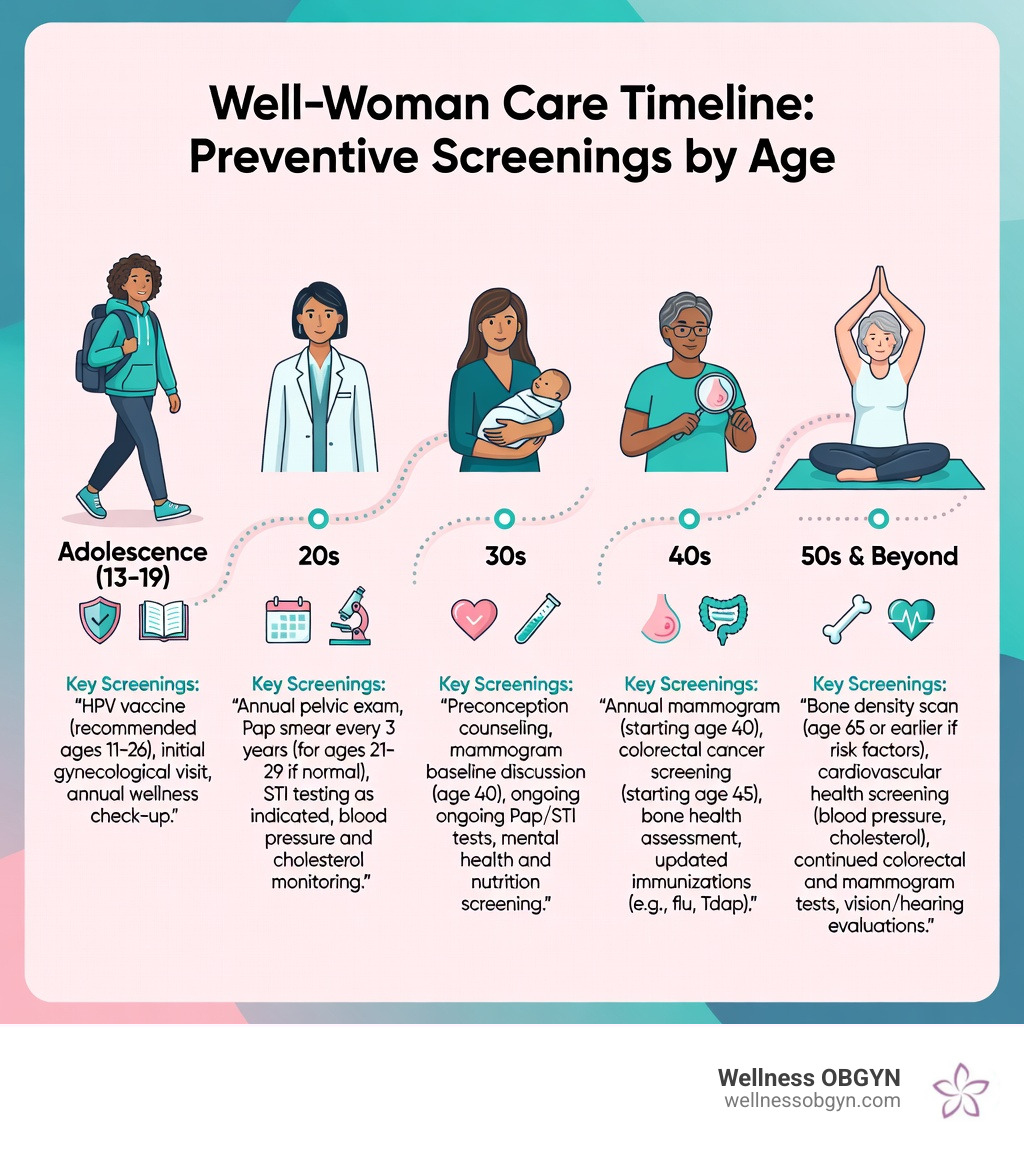
Your health needs are a moving target. What you need at 15 is vastly different from what you need at 55. This is why we view the Women’s Health Annual Exam as a dynamic process.
| Life Stage | Primary Focus | Key Screenings |
|---|---|---|
| Adolescence (13-15) | Education & Relationship Building | BMI, Menstrual cycle education, Vaccinations |
| 20s & 30s | Reproductive Health & Prevention | Pap smears, STI testing, Pregnancy planning |
| 40s & 50s | Transition & Cancer Screening | Mammograms, Colorectal screening, Menopause management |
| 60s and Beyond | Longevity & Bone Health | Bone density, Heart health, Chronic disease monitoring |
Screenings and Wellness Exams for Women in Your 20s and 30s
For women in their 20s and 30s, the OBGYN Clinic visit often centers on reproductive freedom and infectious disease prevention. This is the era where Pap smears become a staple of your care. Current guidelines recommend starting Pap tests at age 21. If your results are normal, you generally only need them every three years.
Once you hit 30, we often add HPV co-testing. Human Papillomavirus (HPV) is the most prevalent STI in the U.S., with over 42 million people currently infected. Since certain strains of HPV are directly linked to cervical cancer, knowing your status is vital.
We also prioritize STI screening for Chlamydia and Gonorrhea, especially for sexually active women under 25, as these infections can often be asymptomatic but lead to pelvic inflammatory disease (PID) or future fertility issues if left untreated. This is also the perfect time to discuss birth control, preconception health, or any irregular period concerns you might have.
Wellness Exams for Women: Transitioning Through Menopause and Beyond
As you move into your 40s and 50s, the focus of wellness exams for women shifts toward screening for age-related conditions. This is when we start discussing mammograms. While the exact age to start can vary based on your personal risk factors, most major health organizations recommend beginning annual or biennial screenings between ages 40 and 50.
Another heavy hitter in this age group is colorectal cancer. The recommendations for colorectal cancer screening have recently shifted, now suggesting that average-risk adults begin screening at age 45 rather than 50.
For our patients in their 60s and beyond, we transition into “senior health” mode. We keep a close eye on bone density to prevent osteoporosis and fractures. We also continue to monitor cardiovascular health, including cholesterol and blood pressure. Even if you have passed your reproductive years, seeing a Non-OB Gynecologist Honolulu remains essential for addressing issues like pelvic organ prolapse, urinary incontinence, and vulvovaginal health.
Preparing for Your Appointment and Overcoming Anxiety
Preparation can go a long way in making wellness exams for women feel less daunting. Here are a few practical tips:
- Track Your Cycle: Know the first day of your last period.
- Bring a List: Write down your medications, supplements, and any symptoms (like heavy bleeding or pelvic pain) you’ve noticed.
- Timing Matters: Try to schedule your exam when you aren’t on a heavy flow day of your period, as this can sometimes interfere with Pap smear results.
- Be Honest: We are a judgment-free zone. Whether you’re asking about a new partner or a weird discharge, we’ve heard it all and we are here to help.
If you have a history of trauma or are particularly nervous about the pelvic exam, please let us know. As a Gynecologist Accepting New Patients, we practice trauma-informed care. This means we can offer a chaperone, explain every step before it happens, or even use a smaller speculum to ensure your comfort. You are always in control of the exam; we can stop or pause at any time.
Frequently Asked Questions about Women’s Health Screenings
Do I need a Pap smear every year, or has that changed?
The short answer is no, most women do not need a Pap smear every single year. For women aged 21–29, it’s typically every three years. For those 30–65, it’s every three to five years depending on whether HPV testing is included. However, you still need an annual wellness exam for the breast exam, pelvic exam, and general health screening.
Are wellness exams covered by insurance without cost-sharing?
Under the Affordable Care Act, most private insurance plans must cover “well-woman” preventive visits without a co-pay or deductible. This usually includes the exam itself, Pap smears, and many routine vaccinations. It’s always a good idea to check with your specific provider to confirm your benefits.
Can my primary care doctor perform a full well-woman exam?
Many primary care providers (PCPs) can perform basic wellness exams for women, including Pap smears. However, a gynecologist has specialized training in female reproductive health and is often better equipped to handle complex issues like endometriosis, PCOS, or advanced menopause symptoms. Many women choose to see both: a PCP for general health and an OB-GYN for their reproductive “home.”
Conclusion
Your health is your most valuable asset, and wellness exams for women are the best way to protect it. At Wellness OBGYN in Honolulu, we don’t just see patients; we build partnerships. From your first visit as a teenager to managing the transition through menopause, our team is dedicated to providing expert, compassionate care tailored to your individual needs.
Take the next step in your health journey today. More info about women’s health services is just a click away. We look forward to seeing you in our Honolulu office soon!