
Why Choosing the Right Birth Control Matters
15 contraceptive methods give you real choices for preventing pregnancy—from hormonal pills you take daily to devices that last years, surgical options that are permanent, and natural approaches that require tracking your cycle. Every method works differently, costs differently, and fits differently into your life.
Here’s a quick overview of the 15 main options:
- Hormonal IUD (Mirena, Kyleena, Skyla) – lasts 3-8 years, 99.8% effective
- Copper IUD (Paragard) – lasts up to 12 years, 99% effective
- Implant (Nexplanon) – lasts 3-5 years, 99.6% effective
- Birth Control Shot (Depo-Provera) – every 3 months, 97-99.7% effective
- Combined Pill – daily, 92-99% effective
- Progestin-Only Pill – daily, 92-99% effective
- Patch (Evra) – weekly, 92-99% effective
- Vaginal Ring (NuvaRing) – monthly, 92-99% effective
- External Condoms – every time, 86-97% effective
- Internal Condoms – every time, 80-95% effective
- Diaphragm – every time, 75-96% effective
- Cervical Cap/Sponge – every time, 72-94% effective
- Spermicide/VCF – every time, 72-94% effective
- Fertility Awareness Methods – daily tracking, 78-98% effective
- Withdrawal – every time, 81-96% effective
Bonus options: Sterilization (tubal ligation or vasectomy) at 99% effective, and emergency contraception (Plan B or copper IUD) for after unprotected sex.
No single method is “best” for everyone. Your ideal choice depends on how often you have sex, whether you want kids later, your health history, how you feel about hormones, and what fits your daily routine. Some methods help with heavy periods or acne. Others require zero daily effort. Some protect against STIs—most don’t.
The research is clear: client autonomy matters most. That means you decide what’s important—whether it’s effectiveness, side effects, ease of use, or something else—and your healthcare provider helps you find the match.
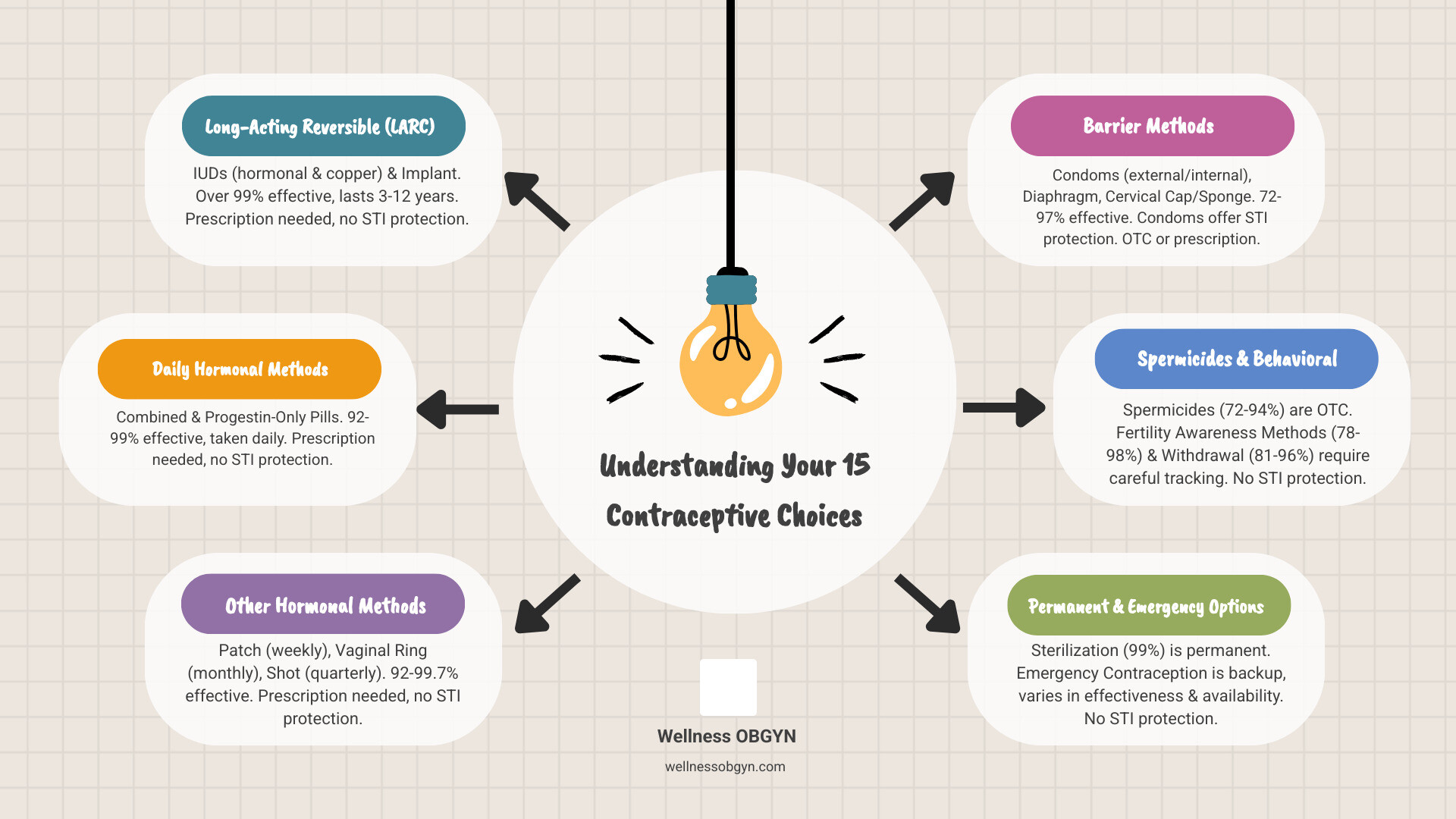
Common 15 contraceptive methods vocab:
Long-Acting Reversible Contraception (LARC)
When it comes to highly effective, long-term pregnancy prevention, Long-Acting Reversible Contraception (LARC) methods are often at the top of the list. These methods are designed to be “set it and forget it” options, requiring minimal daily effort once they’re in place, making them incredibly convenient for many individuals.
LARCs include hormonal implants and various types of intrauterine devices (IUDs). They are among the most effective birth control methods available, with success rates often exceeding 99% with typical use. This high effectiveness is largely due to the fact that user error is almost eliminated once the method is inserted by a healthcare provider. The beauty of LARCs is that they are reversible; if you decide you want to get pregnant in the future, your healthcare provider can remove the device, and your fertility typically returns quickly. This blend of high effectiveness, reversibility, and ease of use makes LARCs a fantastic option for many people in Honolulu and beyond.
Effectiveness of the 15 Contraceptive Methods
Understanding the effectiveness of any birth control method is crucial, and it’s often measured by the Pearl Index, which tells us how many pregnancies occur per 100 people per year of constant use. We also differentiate between “perfect use” (when a method is used exactly as directed, every single time) and “typical use” (how people actually use it in real life, accounting for occasional mistakes or inconsistencies).
For LARCs, the difference between perfect and typical use is minimal because, once inserted, there’s little room for user error. For example, the hormonal IUD boasts an impressive 99.8% effectiveness, while the implant is 99.6% effective. The copper IUD is also highly effective at 99%. These numbers mean that less than 1 out of 100 people using these methods will get pregnant each year. This makes them some of the most reliable choices among the 15 contraceptive methods.
We believe in empowering you with all the information you need for your family planning journey. You can find More info about family planning on our blog.
Hormonal Implants and Intrauterine Devices
Let’s explore the specific types of LARCs we offer:
- Hormonal Implants (Nexplanon): This tiny, flexible rod is about the size of a matchstick and is inserted just under the skin of your upper arm. It releases a continuous, low dose of progestin, which prevents ovulation and thickens cervical mucus to block sperm. Nexplanon can last for 3 to 5 years and is 99.6% effective. While many find it incredibly convenient, some common side effects include irregular bleeding, headaches, weight gain, or sore breasts.
- Hormonal IUDs (Mirena, Kyleena, Skyla): These small, T-shaped devices are placed inside the uterus by a healthcare provider. They release progestin, which thins the uterine lining, thickens cervical mucus, and can suppress ovulation. Depending on the brand, hormonal IUDs can last for 3 to 8 years and are 99.8% effective. Many people experience lighter periods or even no periods at all with hormonal IUDs, which can be a significant benefit. Potential side effects can include irregular bleeding initially, ovarian cysts, or changes in mood.
- Copper IUD (Paragard): Unlike its hormonal counterparts, the copper IUD is completely non-hormonal. It works by releasing copper ions, which create an inflammatory reaction in the uterus that is toxic to sperm and eggs, preventing fertilization. Paragard can last for up to 12 years and is 99% effective. Since it doesn’t use hormones, it’s a great option for those who can’t or prefer not to use hormonal birth control. However, some individuals may experience heavier periods and more cramping, especially in the first few months after insertion.
While the insertion process for IUDs and implants can cause some temporary discomfort, it’s a quick procedure performed in our office. We prioritize your comfort and ensure you’re fully informed every step of the way.
Short-Acting Hormonal 15 Contraceptive Methods
For those who prefer methods they can start and stop on a more frequent basis, short-acting hormonal birth control offers a wide range of options. These methods work by delivering hormones (estrogen, progestin, or both) to prevent ovulation, thicken cervical mucus, and/or thin the uterine lining. They require consistent adherence—whether daily, weekly, or monthly—to maintain their high effectiveness. All these methods require a prescription from a healthcare provider.

The typical use effectiveness for most short-acting hormonal methods ranges from 92-97%, meaning about 3 to 8 out of 100 people will get pregnant each year. While slightly lower than LARCs, this is still a very effective range, especially when used correctly. Common side effects across these methods can include headaches, upset stomach, sore breasts, and changes in period patterns or mood. More serious, though rare, risks like blood clots, stroke, and heart attack are associated with combined hormonal methods, especially for smokers and women over 35.
Daily and Weekly Hormonal Options
- Combined Oral Contraceptives (The Pill): These pills contain both estrogen and progestin. They work primarily by stopping ovulation, but also by thickening cervical mucus and thinning the uterine lining. Taken daily, at the same time each day, combined pills are 92-99% effective. Beyond pregnancy prevention, many people find that the pill helps regulate menstrual cycles, reduces heavy bleeding and cramping, and can even improve acne. We also offer specialized guidance on the Best Hormonal Birth Control options for you.
- Progestin-Only Pills (Mini-Pill): These pills contain only progestin. They work mainly by thickening cervical mucus and thinning the uterine lining, and sometimes by preventing ovulation. The mini-pill must be taken at the exact same time every day to be most effective (92-99%). It’s a popular choice for breastfeeding individuals or those who cannot take estrogen due to health reasons. Side effects can include irregular spotting or bleeding, weight gain, or headaches.
- The Patch (Evra): This thin, beige patch sticks to your skin and releases estrogen and progestin. You wear a new patch once a week for three weeks, followed by a patch-free week for your period. The patch is 92-99% effective. It offers the convenience of weekly application, but some users may experience skin irritation at the application site. It may also be less effective for individuals weighing 198 pounds or more.
Monthly Rings and Quarterly Injections
- Vaginal Ring (NuvaRing): This small, flexible ring is inserted into the vagina, where it continuously releases estrogen and progestin. You leave the ring in for three weeks, remove it for one week for your period, and then insert a new one. The vaginal ring is 92-99% effective. It offers monthly convenience, but some individuals might experience vaginal irritation or discharge.
- Birth Control Shot (Depo-Provera): This injection, given every three months by a healthcare provider, contains only progestin. It works by preventing ovulation. The shot is highly effective, ranging from 97-99.7% with typical use. However, it’s crucial to get your injections on time to maintain effectiveness. Side effects can include irregular bleeding, weight gain, or a decrease in bone density with long-term use. A significant consideration for the shot is that it can lead to a delay in the return of fertility after stopping, sometimes taking 10 months or longer. For more comprehensive details, you can refer to the Birth Control Methods Fact Sheet.
Barrier and Behavioral Options
For those seeking non-hormonal birth control or methods they control each time they have sex, barrier and behavioral options provide a diverse set of choices. These methods either physically block sperm from reaching the egg or rely on awareness and behavioral changes to prevent pregnancy. Many of these options are available over-the-counter, offering easy access, but some still require a prescription and fitting by a healthcare provider.
One significant advantage of some barrier methods, particularly condoms, is their unique ability to offer protection against sexually transmitted infections (STIs), a benefit that most other birth control methods do not provide. We often recommend “dual protection” – using a condom along with another highly effective birth control method – for comprehensive prevention against both pregnancy and STIs.
Comparing the 15 Contraceptive Methods
Here’s a closer look at some of the barrier methods and their typical effectiveness:
| Method | Typical Use Effectiveness | Duration/Usage | STI Protection | Notes |