
Why Postpartum Care Matters More Than You Think

Postpartum care is the medical and emotional support a new mother receives after giving birth — and it’s just as important as prenatal care.
Here’s a quick overview of what it covers:
- Physical recovery — healing from vaginal birth or C-section, managing bleeding, pain, and body changes
- Emotional health — recognizing baby blues, postpartum depression, and anxiety
- Newborn bonding — skin-to-skin contact, breastfeeding support, and infant care
- Medical follow-up — checkups at 2-3 weeks and a comprehensive visit by 12 weeks
- Long-term wellness — pelvic floor health, contraception, nutrition, and returning to activity
Most people focus so much on pregnancy and delivery that the weeks after birth get overlooked. But this period — often called the “Fourth Trimester” — is when your body is healing, your hormones are shifting dramatically, and you’re adjusting to an entirely new life.
The stakes are real. Postpartum hemorrhage affects roughly 6% of women globally and remains the leading cause of maternal mortality worldwide. Postpartum depression touches far more new mothers than most people realize. And yet, research shows that at least 40% of women never attend a single postpartum visit.
You deserve better than that.
Whether you had a vaginal birth or a C-section, whether this is your first baby or your fourth — the weeks after delivery require real attention, real support, and a care team that sees you, not just your newborn.
I’m Dr. Cheryl Twu, a board-certified OB-GYN and founder of Wellness OBGYN in Honolulu, Hawaiʻi, and over more than a decade of high-volume hospital practice — including at Kapiolani Women’s Center — I’ve supported hundreds of women through every stage of postpartum care, from the delivery room through full recovery. This guide is designed to give you clear, honest, and actionable information so you feel confident navigating the weeks ahead.
Postpartum care further reading:
Understanding the Fourth Trimester: What is Postpartum Care?
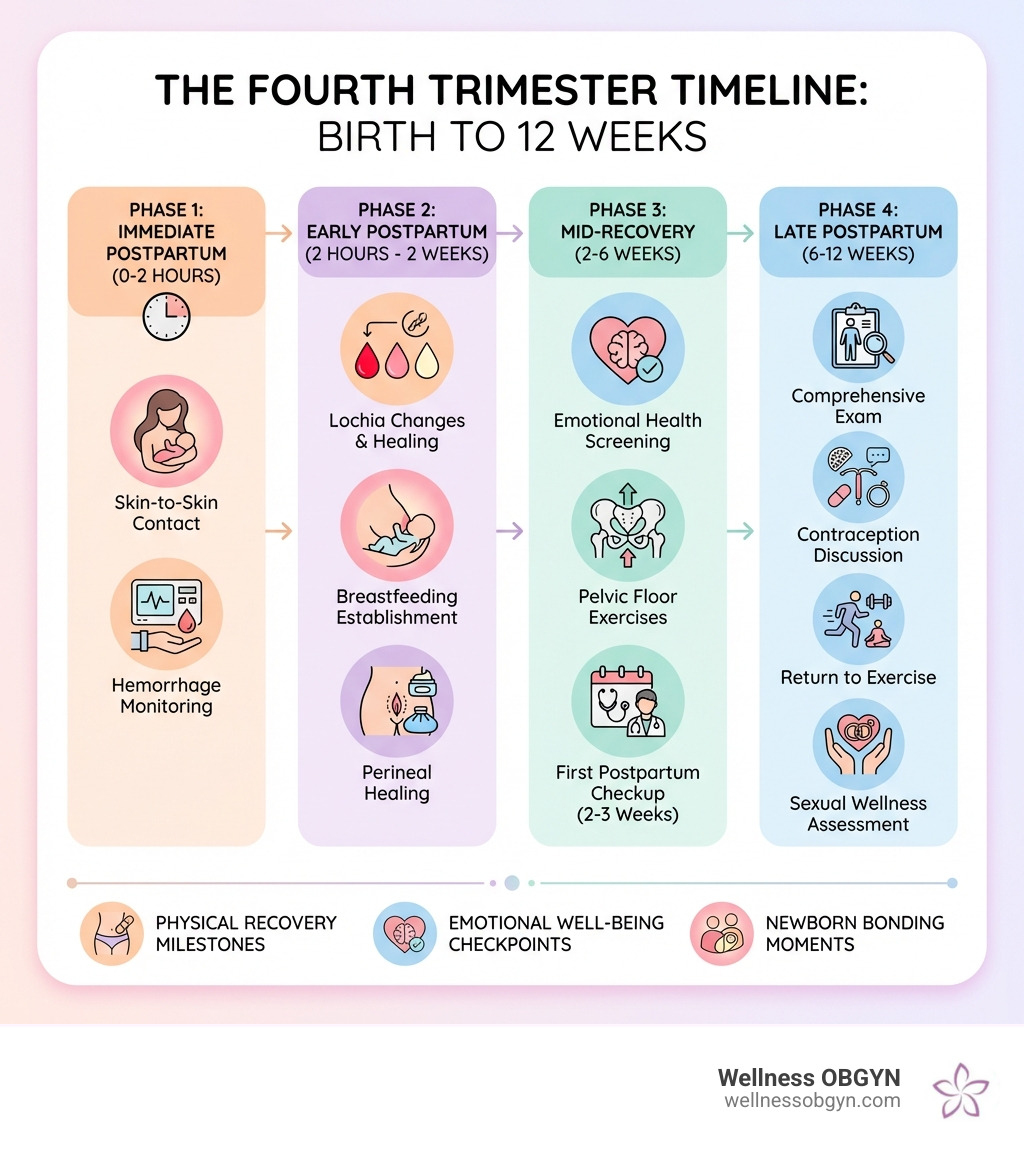
At its core, the “Fourth Trimester” is the 12-week period following childbirth. It is a time of immense physiological and psychological transition. Historically, many healthcare systems focused on a single six-week “clearance” visit, but the American College of Obstetricians and Gynecologists (ACOG) now advocates for a more comprehensive Postpartum Care of the New Mother model. This model views care as an ongoing process rather than a single event.
At Wellness OBGYN, we believe in Personalized Womens Healthcare. This means we don’t just check your stitches; we look at your social support, your mental health, and your long-term wellness. This interprofessional team coordination is vital because the US maternal mortality rate (17.4 per 100,000) is significantly higher than in other developed nations. Ongoing evaluation allows us to catch complications like hypertension or infection before they become life-threatening.
To help you understand the recommended frequency of care, consider this comparison between major health organizations:
| Contact Timing | WHO Recommendations | ACOG Recommendations |
|---|---|---|
| First 24 Hours | Essential for all births | Immediate hospital/birth center care |
| 48–72 Hours | Recommended for all | Phone or in-person check for high-risk |
| 7–14 Days | Routine follow-up contact | Screening for “baby blues” resolution |
| 3 Weeks | N/A | Initial postpartum evaluation |
| 6–12 Weeks | Comprehensive 6-week visit | Comprehensive 12-week final exam |
Physical Recovery and Healing After Delivery
Your body has just performed a marathon, and the recovery period reflects that. Whether you had a vaginal birth or a C-section, your body needs time to return to its pre-pregnant state. Immediately after delivery, most people lose about 13 pounds (6 kg), which includes the weight of the baby, placenta, and amniotic fluid.
For those who had a vaginal birth, Scientific research on genital tract trauma highlights that pain is common but manageable. If you are visiting our OBGYN Clinic, we will monitor your healing closely. For C-section births, which accounted for 28% of Canadian births in 2016/17 (a helpful benchmark for North American trends), the hospital stay is slightly longer—averaging 3.4 days compared to 2.0 days for vaginal births.
One of the most surprising parts of recovery is the “afterpains.” These are uterine contractions that help the uterus shrink back to size and prevent heavy bleeding. These pains are often intensified by breastfeeding because of the oxytocin release.
Common Physical Changes in Postpartum Care
Navigating your changing body can feel like a full-time job. Here is what to expect as a Gynecologist Honolulu expert would explain it:
- Vaginal Discharge (Lochia): This is normal and lasts 4 to 6 weeks. It starts as bright red (lochia rubra) for the first 3-4 days, then turns pinkish-brown, and eventually yellow or white (lochia alba).
- Perineal Healing: If you had a tear or episiotomy, it can take 4 to 6 weeks to heal. We recommend using a squirt bottle with warm water while urinating to prevent stinging.
- Night Sweats: Your body is shedding excess fluid from pregnancy. You might wake up soaked—this is normal as your hormones level out.
- Hair Loss and Skin Changes: During pregnancy, high estrogen levels keep your hair from falling out. Post-delivery, those hairs enter the “shedding” phase all at once. Don’t worry; it’s temporary.
Managing Discomforts and Breastfeeding Support
Discomfort in the early weeks is expected, but it shouldn’t be unbearable. Hemorrhoids and constipation are frequent complaints. We suggest a high-fiber diet, plenty of hydration, and stool softeners if you haven’t had a bowel movement within three days of delivery.
If you are looking for Prenatal Care Honolulu, we start these conversations early. Once the baby arrives, breastfeeding becomes a major focus. Breast engorgement—where the breasts feel hard, warm, and painful—usually happens when your milk “comes in” around day 3 to 5.
To manage this, we recommend:
- Frequent feeding or pumping to express milk.
- Applying cold packs between feedings to reduce swelling.
- Using lanolin cream to protect sensitive or cracked nipples.
- Wearing nursing pads to manage leakage.
Research on breastfeeding peer support shows that mothers who have a strong support network are more likely to succeed with exclusive breastfeeding. In the NICU, family-integrated care models allow parents to be primary caregivers, which improves weight gain and outcomes for preterm babies. Even for healthy babies, skin-to-skin contact for the first hour after birth helps stabilize the baby’s temperature and encourages successful latching.
Emotional Well-being and Mental Health
The “baby blues” affect up to 80% of new mothers. These are feelings of sadness, irritability, or worry that start a few days after birth and usually disappear within two weeks. However, if these feelings persist or worsen, you may be experiencing postpartum depression (PPD).
Research on postpartum depressive symptoms emphasizes that providers must have open discussions about mental health. At Wellness OBGYN, we use the Edinburgh Postnatal Depression Scale to screen our patients. If you are searching for an Obstetrician Gynecologist Near Me, ensure they take your mental health as seriously as your physical health.
We also screen for intimate partner violence using validated tools like HARK (Humiliation, Afraid, Rape, Kick) or HITS (Hurt, Insult, Threaten, Scream). The postpartum period is a vulnerable time, and your safety is our priority.
The Importance of Mental Health in Postpartum Care
Hormonal shifts are the primary driver of mood changes, but sleep deprivation and the stress of a new baby play huge roles. As a Gynecologist in Honolulu, I tell my patients that seeking professional counseling or joining a support group isn’t a sign of weakness—it’s a vital part of your recovery.
Warning Signs and Medical Checkups
While most postpartum experiences are healthy, you must know when to call us immediately. Postpartum hemorrhage is a medical emergency; seek help if you soak through a pad in an hour or pass clots larger than a golf ball.
According to the Urgent Maternal Warning Signs from the CDC, you should seek immediate care for:
- Preeclampsia Signs: Severe headache, vision changes, or swelling in the face and hands.
- Infection: A fever of 100.4°F or higher, or foul-smelling vaginal discharge.
- Thromboembolism (Blood Clots): Swelling, redness, or pain in one leg (usually the calf), or shortness of breath.
The ACOG Postpartum Toolkit suggests a check-in within 3 weeks to discuss mood and healing, followed by a comprehensive exam at 12 weeks. If you had gestational diabetes (GDM), you’ll need a follow-up glucose test. If you had thyroid issues during pregnancy, we will continue to monitor your levels, as thyroiditis can flare up postpartum.
Frequently Asked Questions about Postpartum Care
How long does postpartum bleeding last?
Normal postpartum bleeding, or lochia, typically lasts 4 to 6 weeks. It will gradually change from bright red to a yellowish-white color and decrease in flow over time. If you notice a sudden increase in bleeding after it has slowed down, it may be a sign you are overexerting yourself.
Conclusion
The journey of motherhood doesn’t end at delivery—it’s just beginning. At Wellness OBGYN, we are dedicated to providing the residents of Honolulu with compassionate, expert care through every phase of the Fourth Trimester. By focusing on personalized recovery plans and shared decision-making, we ensure that you are never alone in your postpartum care journey.
If you are ready to prioritize your health and well-being, visit our Center for Women’s Health today. We are here to support you, heal with you, and help you thrive as a new mother.