
Why Understanding Your Contraceptive Options Matters
14 methods of contraception empower you to plan your reproductive future. Whether managing a medical condition or spacing pregnancies, the right choice transforms your daily life. Here is an overview of the fourteen options:
- Contraceptive Implant – Rod under the skin, lasts 3-5 years
- Hormonal IUD – Progestin-releasing device, lasts 3-8 years
- Copper IUD – Non-hormonal, lasts up to 10 years
- Combined Oral Pill – Daily pill with estrogen and progestin
- Progestin-Only Pill – Daily hormone pill without estrogen
- Contraceptive Patch – Weekly skin patch
- Vaginal Ring – Monthly internal ring
- Contraceptive Injection – Shot every 3 months
- Male Condom – Barrier worn on the penis
- Internal Condom – Barrier inserted into the vagina
- Diaphragm – Reusable dome with spermicide
- Contraceptive Sponge – Foam device with spermicide
- Natural Family Planning – Tracking fertility signs
- Permanent Sterilization – Tubal ligation or vasectomy
Each method varies in cost, effectiveness, and lifestyle fit. Some are over 99% effective, while others offer STI protection. As Dr. Cheryl Twu at Wellness OBGYN, I combine Western medicine with holistic principles to help you find the method that matches your body and long-term health goals.
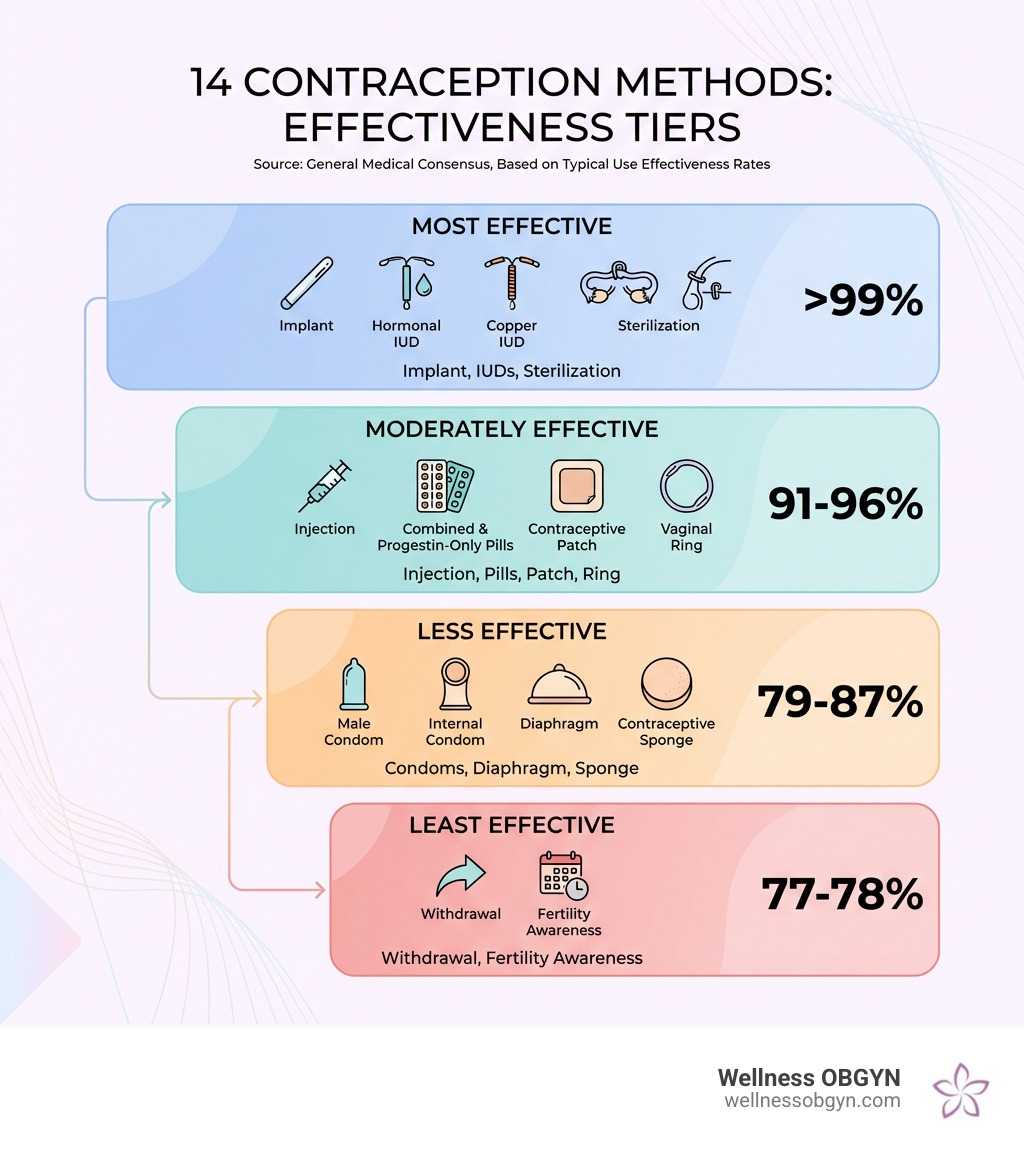
Easy 14 methods of contraception glossary:
The 14 Methods of Contraception: An Overview
Choosing the right contraceptive doesn’t have to be daunting. At Wellness OBGYN in Honolulu, we guide you through effectiveness, side effects, and lifestyle compatibility. When selecting from the 14 methods of contraception, we consider:
- Effectiveness: Comparing “perfect use” vs. “typical use.”
- Hormones: The roles of estrogen and progestin.
- Pros/Cons: Balancing benefits against potential side effects.
- Usage: Daily, weekly, monthly, or long-term.
- STI Protection: Identifying methods that offer dual protection.
- Reversibility: How quickly fertility returns after stopping.
We’re here to help you make choices that support your overall well-being. For more info about female reproductive health issues, our team is always available.

Long-Acting Reversible Contraception (LARC)
LARC methods are among the most effective forms of birth control. These “set it and forget it” options offer protection for years and are over 99% effective. Fertility returns quickly once removed. For scientific research on LARC and hormonal methods, explore trusted resources.
The Contraceptive Implant
A tiny rod inserted under the skin of the upper arm, releasing a continuous low dose of progestin.
- Effectiveness: Over 99%.
- How it works: Prevents ovulation and thickens cervical mucus.
- Usage: Lasts 3 to 5 years.
- Side effects: Irregular bleeding, headaches, or mood changes.
Intrauterine Devices (IUDs)
Small, T-shaped devices placed inside the uterus by a healthcare professional.
Hormonal IUDs (e.g., Mirena®, Kyleena®)
- How they work: Release progestin to thicken mucus and thin the uterine lining.
- Usage: Lasts 3 to 8 years.
- Advantages: Can reduce heavy periods; highly effective.
Copper IUD (e.g., Paragard®)
- How it works: Non-hormonal; copper ions prevent fertilization.
- Usage: Lasts up to 10-12 years.
- Side effects: May cause heavier periods initially.
To explore the best hormonal birth control options, we provide personalized guidance.
Short-Acting Hormonal Options
These methods require consistent attention but offer excellent prevention by stopping ovulation and thickening cervical mucus.
Oral Contraceptive Pills
Taken daily, these are a staple of the 14 methods of contraception.
- Combined Pills: Contain estrogen and progestin. 93% effective with typical use. Can improve acne and lighten periods.
- Progestin-Only Pills (Mini-Pill): Must be taken at the exact same time daily. Ideal for those who cannot use estrogen.
The Contraceptive Patch and Vaginal Ring
- The Patch: A weekly skin patch releasing hormones. 93% effective with typical use.
- The Vaginal Ring: A flexible ring inserted monthly. 93% effective with typical use; very discreet.
The Contraceptive Injection
A progestin shot (e.g., Depo-Provera®) given every 3 months. It is 96% effective with typical use. It is highly discreet but may cause a temporary decrease in bone density or weight gain.
Barrier and Natural Methods of Contraception
Barrier methods physically block sperm, while natural methods track fertility. For the latest research on birth control methods, visit official health resources.
External and Internal Condoms
Condoms are the only 14 methods of contraception that protect against STIs.
- External Condoms: 87% effective with typical use; widely available.
- Internal Condoms: 79% effective with typical use; can be inserted hours before sex.
Diaphragms, Caps, and Sponges
- Diaphragm/Cervical Cap: Silicone cups used with spermicide. Require fitting and a prescription.
- Contraceptive Sponge: Disposable foam containing spermicide; available over-the-counter.
Natural Family Planning and Withdrawal
- Natural Family Planning (NFP): Tracking basal temperature and cervical mucus. Effectiveness varies (77-98%) based on consistency.
- Withdrawal: Pulling out before ejaculation. 78% effective with typical use; high risk of human error.
Permanent, Emergency, and Postpartum Methods
Permanent Sterilization
- Tubal Ligation: Surgical blocking of fallopian tubes. Over 99% effective.
- Vasectomy: Minor procedure for men to block sperm from semen. Almost 100% effective after 3 months.
Emergency Contraception (EC)
- EC Pills: Delay ovulation; most effective when taken immediately after unprotected sex.
- Copper IUD: The most effective EC method if inserted within 5 days.
Contraception After Childbirth
- Breastfeeding: The Lactational Amenorrhea Method (LAM) is up to 98% effective if specific criteria are met.
- Progestin-only methods: Safe to start immediately after delivery as they do not impact milk supply.
Frequently Asked Questions about Contraception
Which of the 14 methods of contraception protect against STIs?
Only external and internal condoms protect against STIs. For full protection, we recommend “dual protection”—using a condom alongside a highly effective method like an IUD or the pill.
How do I choose the right birth control for my lifestyle?
Consider effectiveness, your sensitivity to hormones, and whether you prefer a daily routine or a “set and forget” method. We help patients in Honolulu steer these choices based on their future family plans.
Can I use contraception while breastfeeding?
Yes. Progestin-only methods (mini-pill, implant, injection, hormonal IUD) are preferred as they do not affect milk supply. Combined hormonal methods are usually avoided for the first few weeks postpartum.