
Understanding Your Birth Control Options
Birth control information can feel overwhelming when you’re trying to make the right choice for your body and lifestyle. If you’re searching for clear, trustworthy guidance, here’s what you need to know:
Quick Overview of Birth Control Options:
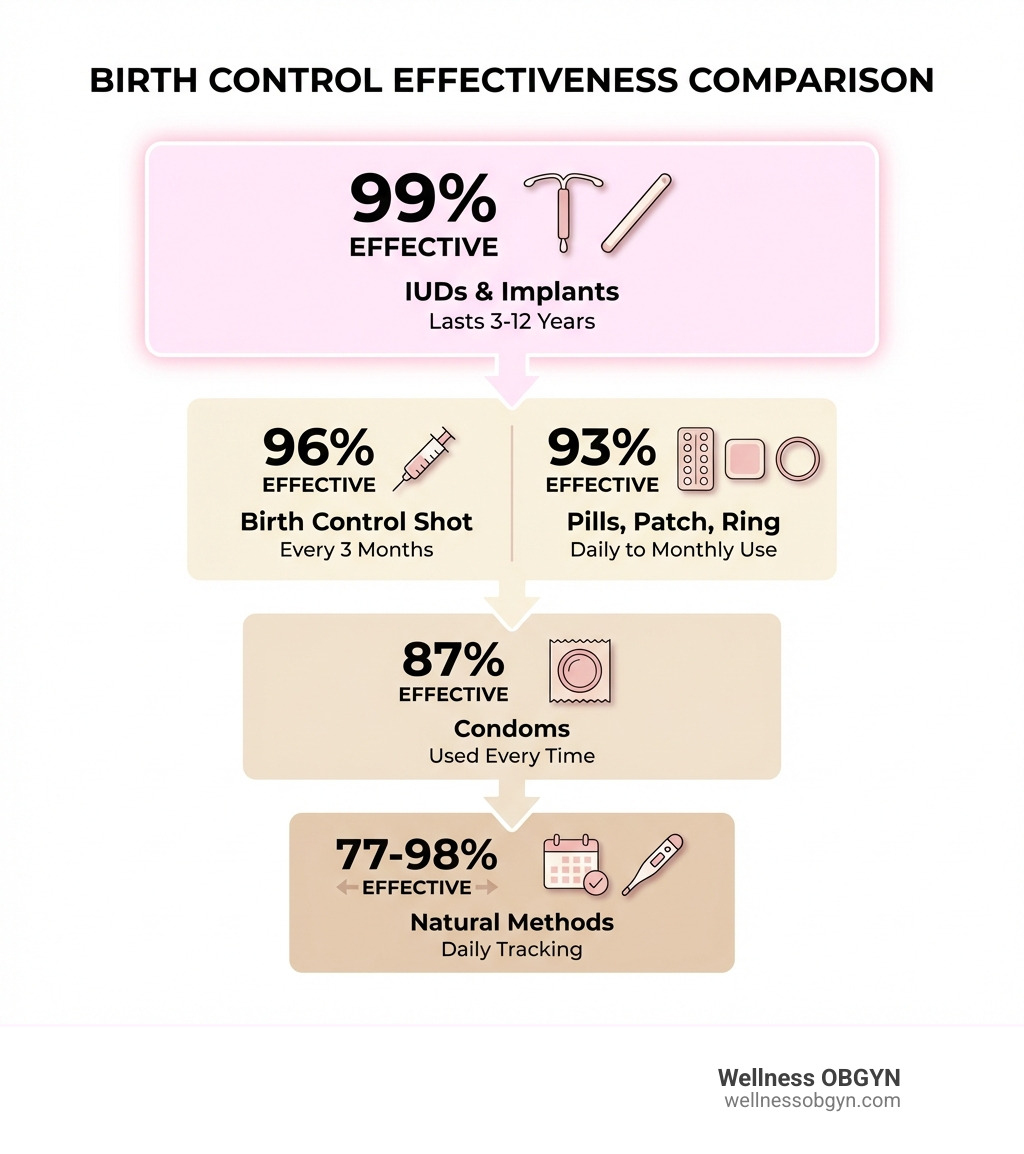
- Most Effective (99%): IUDs, implants, and sterilization—long-lasting or permanent options
- Highly Effective (93-96%): Pills, patches, rings, and shots—require consistent use
- Moderately Effective (78-87%): Condoms, diaphragms, and withdrawal—used each time
- Emergency Options: Copper IUD or morning-after pills—for unprotected sex or method failure
Birth control does more than prevent pregnancy. Some methods regulate periods, reduce acne, or help manage conditions like endometriosis. Others protect against sexually transmitted infections. And while about 85 out of 100 women who don’t use birth control will become pregnant within a year, choosing the right method—and using it correctly—can dramatically reduce that risk.
The challenge? Every woman’s health history, future plans, and daily routine are different. What works beautifully for your friend might not fit your life. You might need a method that doesn’t affect milk production if you’re breastfeeding. Or you might want something you don’t have to remember every day. Some methods require a prescription; others are available over the counter.
As Dr. Cheryl Twu, I’ve spent over a decade helping women in Honolulu steer birth control information and find methods that align with their goals, from my years at Kapiolani Women’s Center to founding Wellness OBGYN. In the sections ahead, we’ll break down how different methods work, their benefits and risks, and how to choose what’s right for you—whether you’re exploring options for the first time or considering a change.
Birth control information helpful reading:
- different birth control methods
- family planning benefit program
- what is the family planning services program
Navigating Birth Control Information: Types and Effectiveness
Choosing a birth control method is a personal decision. There are many types of contraception, each with its own mechanism, effectiveness rate, and considerations. At Wellness OBGYN, we provide clear birth control information so you can make an informed choice for your health and lifestyle.

Birth control methods are categorized by how they work:
- Long-Acting Reversible Contraception (LARC): Methods like IUDs and implants that work for years. They are over 99% effective.
- Short-Acting Hormonal Methods: Daily pills, weekly patches, or monthly rings/shots. These are about 93-96% effective with typical use.
- Barrier Methods: Condoms and diaphragms used each time you have sex. Condoms are around 87% effective.
- Natural Methods: Tracking fertility cycles to avoid pregnancy.
- Permanent Methods: Surgical procedures for those certain they do not want future pregnancies.
- Emergency Contraception (EC): A backup used after unprotected sex.
Choosing the Right Birth Control Information for Your Lifestyle
Consider factors beyond effectiveness, such as future fertility plans and health history. For example, if you plan to have children later, reversible methods are necessary. Your lifestyle also matters—can you remember a daily pill, or is a long-acting method better?
Other considerations include:
- STI Protection: Only condoms protect against STIs.
- Hormonal vs. Non-Hormonal: We offer both options based on your preference.
- Cost and Privacy: Refill ease and discretion may influence your choice.
We believe in a personalized women’s healthcare approach to find your perfect fit.
How to Obtain Birth Control
- Over-the-Counter (OTC): Condoms, sponges, and emergency pills (like Plan B) are available without a prescription.
- Prescription Required: Pills, patches, rings, and shots require a provider’s prescription.
- Clinic Visits: IUDs and implants require insertion by a professional. Our obgyn clinic services in Honolulu provide these expert services.
Hormonal Methods: Mechanisms, Benefits, and Risks
Hormonal birth control uses synthetic progestin or a combination of estrogen and progestin to prevent pregnancy. These hormones work by:
- Ovulation Suppression: Preventing the ovaries from releasing an egg.
- Cervical Mucus Thickening: Creating a barrier that stops sperm from reaching an egg.
- Uterine Lining Thinning: Making the uterus less receptive for implantation.
Benefits and Risks of the Pill
The oral contraceptive pill is a common hormonal method suitable for most healthy women.
Benefits:
- Effectiveness: 93% effective with typical use.
- Regulation: Makes periods lighter and less painful.
- Symptom Relief: Reduces PMS and acne.
- Cancer Risk Reduction: Long-term use can reduce the risk of ovarian and uterine cancers.
Risks:
Common side effects include headaches or nausea. Rare but serious risks include blood clots, especially for smokers over 35 or those with high blood pressure. The Canadian Cancer Society notes that while some studies suggest a slight increase in breast cancer risk, the benefits often outweigh the risks for healthy individuals. We discuss these factors during consultations for best hormonal birth control options.
Short-Acting Hormonal Options
- Vaginal Ring: Inserted for three weeks; 93% effective.
- Contraceptive Patch: Changed weekly for three weeks; 93% effective.
- Birth Control Shot: Given every three months; 96% effective. It may cause temporary bone density loss.
These are popular for those seeking adolescent gynecology in Honolulu services.
Birth Control and Breastfeeding
Estrogen can decrease milk production. For breastfeeding mothers, we recommend:
- Progestin-Only Pills (Minipills): Must be taken at the same time daily.
- LARC Methods: The shot, implant, and hormonal IUDs are safe for breastfeeding.
- Lactational Amenorrhea Method (LAM): Effective for six months if exclusively breastfeeding and periods haven’t returned.
We help you steer postpartum birth control to find a safe method.
Long-Acting Reversible Contraception (LARC) and Permanent Solutions
For those seeking highly effective, low-maintenance contraception, Long-Acting Reversible Contraception (LARC) methods are often an excellent choice. These methods work for several years and are easily reversible if you decide to become pregnant in the future.
LARC methods are among the most effective forms of birth control available, with over 99% effectiveness. This means less than 1 out of 100 people using these methods will get pregnant each year. Their high effectiveness is largely due to the fact that user error is virtually eliminated once they are in place. They offer a great solution for women looking to prevent pregnancy for 3 to 10 years without daily effort. Understanding your options for female reproductive health issues is key, and LARC methods can be a significant part of that conversation.
IUDs and Implants
- Intrauterine Devices (IUDs): Small, T-shaped devices inserted into the uterus by a healthcare provider. There are two main types:
- Hormonal IUDs (e.g., Mirena, Skyla, Kyleena, Liletta): Release a small amount of progestin hormone directly into the uterus. They can last for 3 to 8 years depending on the brand. Benefits often include lighter periods or no periods at all, and they can be used by breastfeeding mothers.
- Copper IUD (e.g., ParaGard): A non-hormonal option that uses copper to create an inflammatory reaction in the uterus that is toxic to sperm and eggs, preventing fertilization. It can last for up to 10-12 years. It does not affect your natural hormone cycle and can be used as emergency contraception if inserted within 7 days of unprotected sex.
IUDs are a popular choice for many women in Honolulu seeking reliable contraception. Our gynecologist in Honolulu can discuss which IUD might be right for you.
- Contraceptive Implant (e.g., Nexplanon): A tiny, flexible rod about the size of a matchstick, inserted just under the skin of your upper arm by a healthcare provider. It releases progestin hormone and works for up to 3 to 5 years. It’s discreet and highly effective, making it a favorite for many.
Both IUDs and implants are reversible; a healthcare provider can remove them at any time if you wish to become pregnant or choose a different method.
Permanent Sterilization
For individuals or couples who are certain they do not want to have any (or more) children, permanent sterilization is an option.
- Vasectomy (for men): A permanent surgical procedure to close or block the vas deferens, the tubes that carry sperm to the penis. It’s highly effective (over 99%), safer, less expensive, and less invasive than female sterilization. It’s typically done in an outpatient setting. However, it’s not immediately effective; another birth control method is needed for about three months until a sperm analysis confirms no sperm are present.
- Tubal Ligation (for women): Often called “getting your tubes tied,” this is a permanent surgical procedure where the fallopian tubes, which transport eggs from the ovaries to the uterus, are disconnected or blocked. It’s also over 99% effective. It’s a more involved surgical procedure than a vasectomy.
Sterilization is a significant decision that should be made after careful consideration and discussion with your partner and healthcare provider. At Wellness OBGYN, we provide comprehensive counseling for both male and female sterilization options. Our obgyn Honolulu Hawaii team is here to guide you through this important family planning choice.
Non-Hormonal Options and Sexual Wellness
Non-Hormonal methods are ideal for those avoiding hormones due to side effects or health conditions. They rely on physical barriers or fertility awareness.
Natural Family Planning and Emergency Backup
- Barrier Methods: Male condoms (87% effective) and female condoms (79% effective) are the only methods providing STI protection. Diaphragms (83% effective) and sponges (78-86% effective) are other options. See more in our scientific research on barrier methods section.
- Fertility Awareness-Based Methods (FAMs): Tracking cycles to identify fertile days. Effectiveness varies based on precision.
- Emergency Contraception (EC): Backup options like the morning-after pill or the Copper IUD, which is the most effective EC if inserted within 7 days of unprotected sex.
We take a holistic approach to women’s health when discussing these options.
Frequently Asked Questions about Birth Control Information
How soon does birth control start working?
- Pills: Combination pills are effective immediately if started within 5 days of your period; otherwise, wait 7 days. Minipills take 48 hours.
- Patch/Ring: Effective after 7 days.
- Shot: Effective immediately if given within the first 5 days of your period.
- IUDs/Implants: Often effective immediately depending on your cycle.
We can discuss this during your annual obgyn visit.
What should I do if I miss a birth control pill?
- Combination Pills: If you miss one, take it immediately. If you miss two or more, use backup contraception for 7 days.
- Progestin-Only Pills: If you are more than 3 hours late, use a backup method for 48 hours.
Consult your gynecologist Honolulu team if you are unsure about emergency contraception.
Are there medication interactions with birth control information?
Certain medications can reduce effectiveness:
- Antibiotics: Rifampin is a known interactor.
- Antiseizure Meds: Some speed up hormone metabolism.
- St. John’s Wort: This herbal supplement can interfere with hormonal methods.
Always inform us of your supplements as part of our services.
Conclusion
Navigating the vast amount of birth control information available can be a complex journey, but understanding your options is a powerful step towards taking control of your reproductive health. From highly effective long-acting methods to daily pills, non-hormonal choices, and emergency contraception, there’s a method designed to fit nearly every lifestyle and health need.
At Wellness OBGYN, we are committed to providing personalized, compassionate care to women in Honolulu. We believe in shared decision-making, where your preferences, health history, and future goals are at the center of every conversation. Whether you’re considering your first birth control method, thinking about a change, or exploring options for family planning, our expert team is here to guide you.
We encourage you to reach out and schedule a consultation to discuss your specific needs and find the birth control method that’s right for you. Your journey to optimal female reproductive health issues starts with informed choices.