
Understanding Partum: The Medical Term That Defines Your Birth Journey
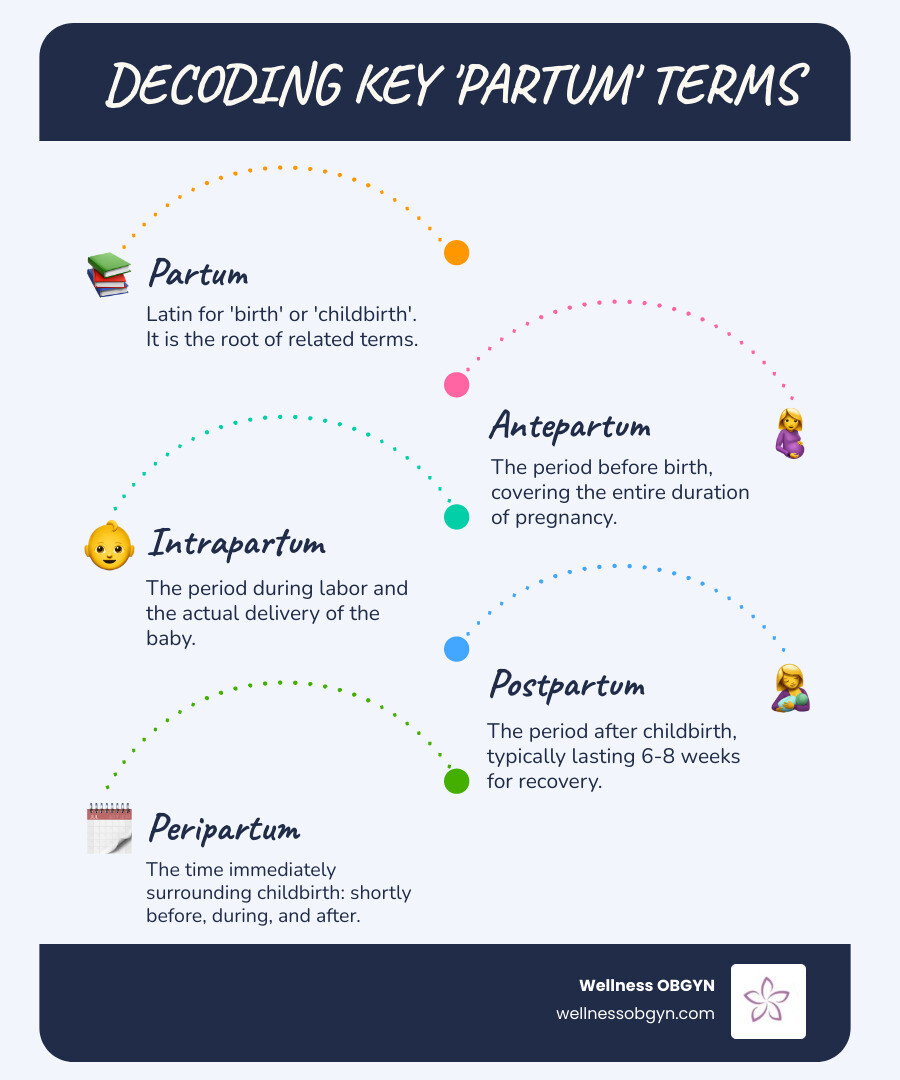
The term partum comes from the Latin word “partus,” meaning birth or delivery. Its meaning is central to the medical terms you’ll hear throughout your pregnancy and recovery.
Quick Definition:
- Partum = Latin for “birth” or “childbirth”
- Postpartum = The period after childbirth (typically 6-8 weeks)
- Antepartum = The period before birth (pregnancy)
- Intrapartum = The period during labor and delivery
- Peripartum = The time around childbirth (before, during, and shortly after)
Your healthcare team uses these terms to describe the different stages of your pregnancy and recovery journey. Understanding what “partum” means helps you steer conversations with your doctor and actively participate in your healthcare, from reading discharge instructions to scheduling follow-ups.
The postpartum period, often called the “fourth trimester,” is when your body heals and adjusts. Physical symptoms like perineal soreness can last for weeks, while emotional changes like the “baby blues” usually resolve within two weeks.
About Dr. Cheryl Twu: As a board-certified OB-GYN with over a decade of experience, I’ve guided many families through their postpartum recovery. My goal is to help new parents feel confident with the medical terms and care they’ll encounter during this transformative time.
The Linguistic Roots: Unpacking the Partum Meaning
Understanding the Latin roots of ‘partum’ can help you decode the medical terms used during your pregnancy and recovery. These ancient words provide a clear framework for the journey of childbirth.
What is the Latin Origin of ‘Partum’?
The word “partum” comes from the Latin ‘partus’, which means “birth” or “bringing forth.” When we discuss the partum meaning in medicine today, we’re drawing directly from this ancient concept. For those interested in the linguistic details, the Online Latin dictionary, Olivetti offers more insight.
Related Childbirth Terms and Their Meanings
The root ‘partum’ forms several related medical terms that describe your birth journey:
Parturition means “the action or process of giving birth”—a formal term for labor and delivery. You can find the full medical definition in the Merriam-Webster dictionary.
Parturient describes someone who is in labor or about to give birth. The term comes from a Latin phrase meaning “I am in labor.”
Peripartum covers the entire period around childbirth. The prefix “peri-” means “around,” so the term includes late pregnancy, labor, delivery, and early recovery. This is important for conditions like peripartum cardiomyopathy, which can occur during this broader timeframe. See the Medical Definition of PERIPARTUM for more details.
Knowing these terms helps you confidently steer medical conversations about your birth journey.
The Three Key Stages of Your Pregnancy Journey
Your pregnancy journey has three main chapters: antepartum, intrapartum, and postpartum. Understanding these phases, all related to the partum meaning of birth, can help you feel more confident.
Antepartum: The Period Before Birth
The antepartum period is your pregnancy. “Ante” means “before,” so this stage covers the roughly 40 weeks before birth, marked by fetal development and your body’s adaptations.
- First trimester (weeks 1-13): Often marked by morning sickness. Key milestones include your baby’s heart starting to beat (week 6) and the formation of all major organs by week 12.
- Second trimester (weeks 14-27): Often called the “honeymoon phase” as morning sickness fades and energy returns. You may feel your baby’s first movements.
- Third trimester (weeks 28-40): Your baby gains most of their birth weight. Common discomforts include heartburn and backaches as your body prepares for birth.
Regular prenatal care is vital throughout the antepartum period. At Wellness OBGYN, we guide you through each milestone.
Intrapartum: Labor and Delivery
The intrapartum stage is labor and delivery, when you finally meet your baby.
Labor begins with true contractions that become longer, stronger, and closer together. As labor progresses, your cervix dilates to 10 centimeters. For first-time mothers, this can take many hours.
Once you’re fully dilated, the pushing stage begins. You’ll work with your contractions to push your baby down the birth canal. The stage ends with the delivery of the placenta, which typically occurs within 30 minutes of birth.
Labor can last 12 to 18 hours for first-time parents, but every experience is unique. We’re here to support you throughout.
Postpartum: The “Fourth Trimester” After Birth
The postpartum period, or “fourth trimester,” begins after birth. It officially lasts 6-8 weeks, but recovery and adjustment take much longer.
Immediately after delivery, your body begins to heal. Your uterus shrinks back to its pre-pregnancy size (a process called involution), which can cause after-pains. The fourth trimester concept highlights the importance of this period, as you’re healing, your hormones are shifting, and you’re learning to care for a newborn on little sleep.
Your body begins its return to a pre-pregnancy state, a process that requires patience. Emotional adjustment is also a key part of the postpartum period. It’s normal to feel a wide range of emotions as you adapt to parenthood.
Navigating Postpartum: Physical and Emotional Recovery
The “fourth trimester” is a time of significant healing and adjustment. Your body is recovering, your hormones are shifting, and you’re learning to care for a newborn. It can be beautiful and overwhelming. The postpartum period involves major physical and emotional adjustments that can catch even the most prepared parents by surprise.

Common Physical Changes After Childbirth
- Uterine involution: Your uterus shrinks back to its original size over about six weeks, causing cramps that may be stronger while breastfeeding.
- Lochia: This is the vaginal discharge you’ll have for four to six weeks after delivery. It starts heavy and red, then gradually lightens in color and flow.
- Perineal soreness: Tearing during vaginal birth is common. Your healthcare team will provide care instructions, such as using a peri bottle and witch hazel pads.
- C-section recovery: Healing from this major surgery requires careful incision care and avoiding heavy lifting. Full healing can take up to 12 weeks.
- Breast changes: Your milk typically comes in around day three, causing breasts to feel full and tender. Nipple soreness is common initially for those who are nursing.
- Postpartum hair loss: Significant but temporary hair shedding is common around three to four months postpartum due to hormonal shifts.
- Urinary incontinence: Weakened pelvic floor muscles from pregnancy and delivery can cause leakage.
Understanding Postpartum Emotional and Mental Health
Emotional health is as important as physical recovery. Hormonal shifts after delivery can create an emotional rollercoaster.
- Baby blues: Affecting up to 80% of new parents, these feelings of sadness and anxiety are common in the first few weeks and typically resolve on their own.
- Postpartum depression (PPD): This is more serious than the baby blues, affecting 10-20% of new parents. Symptoms are more intense, last longer than two weeks, and can include severe sadness and difficulty bonding with the baby. PPD is a treatable medical condition; seeking help early is crucial.
- Postpartum anxiety: Often co-occurs with PPD and involves excessive worry, restlessness, and panic attacks.
- Postpartum psychosis: A rare but serious condition requiring immediate medical attention. Symptoms include confusion, hallucinations, and paranoia.
| Feature | Baby Blues | Postpartum Depression (PPD) |
|---|---|---|
| Symptoms | Mood swings, sadness, anxiety, irritability, crying spells, feeling overwhelmed, reduced concentration, appetite/sleep problems | More intense and persistent sadness, severe mood swings, crying too much, difficulty bonding, withdrawal, significant appetite/sleep changes, overwhelming fatigue, loss of interest, intense anger, feelings of worthlessness/guilt, thoughts of harming self/baby |
| Onset | Typically within 2-3 days after delivery | Can begin during pregnancy or up to a year after birth |
| Duration | Usually resolves within 2 weeks | Lasts longer than 2 weeks; can persist for months or even a year if untreated |
| Severity | Mild, temporary | Moderate to severe, significantly impacts daily functioning |
| When to Seek Help | Generally not needed, but can discuss with provider if concerned | Always seek medical attention if symptoms don’t fade after 2 weeks, worsen, or interfere with daily life/baby care. Immediately seek help if thoughts of harming self/baby |
Seeking help for PPD or anxiety is vital for you and your baby. Treatment is effective. The Mayo Clinic offers a detailed guide on postpartum depression.
Postpartum Care: When to Heal and When to Seek Help
The postpartum period, or “fourth trimester,” is a critical time for healing. Proper postpartum care is as essential as prenatal care. It’s a time to listen to your body and know when to seek help.

Essential Self-Care Practices for Recovery
Self-care is crucial for your recovery, even with a newborn. You can’t pour from an empty cup.
- Rest: Sleep when the baby sleeps, even for short naps. Prioritize rest over chores.
- Nutrition: Eat nutrient-dense foods to fuel your recovery. Good options include oatmeal, lean proteins, soups, and smoothies.
- Hydration: Drink plenty of water, especially if breastfeeding. Keep a water bottle nearby.
- Gentle movement: Once cleared by your provider, gentle walks can boost your mood and aid recovery.
- Ask for help: Accept offers from family and friends to help with meals, chores, or childcare. It’s a sign of wisdom, not weakness.
Recognizing Postpartum Complications and Warning Signs
Trust your instincts. While many symptoms are normal, some signal serious complications requiring immediate medical attention. Seek help for:
- Heavy bleeding: Soaking more than one pad per hour or passing large clots.
- Fever over 101°F: This can signal an infection.
- Severe headaches or vision changes: Especially with swelling, these could be signs of postpartum preeclampsia.
- Worsening pain: Severe or increasing pain that isn’t relieved by medication.
- Foul-smelling discharge: This can indicate an infection.
- Leg pain or swelling: Pain or swelling in one leg could be a blood clot (DVT).
- Chest pain or shortness of breath: These are emergency symptoms.
- Thoughts of harming yourself or your baby: This is a medical emergency. Call 911 or the 988 Suicide and Crisis Lifeline immediately.
The Cleveland Clinic offers more details on postpartum warning signs.
The Importance of the Postpartum Check-up
Your six-week postpartum check-up is a crucial appointment to assess your recovery and plan for the future.
- Physical healing assessment: We will check your C-section incision (if applicable), uterine involution, and overall physical recovery. We’ll also discuss when it’s safe to resume activities like exercise and sex.
- Mental health screening: We will discuss your emotional well-being in a safe, non-judgmental space. It’s important to talk about any feelings of anxiety or depression so we can connect you with support.
- Future planning: We will discuss contraception options that fit your lifestyle and future family plans.
This appointment is focused on your health. It’s your chance to ask questions and get the support you need for this new chapter.
Frequently Asked Questions about the Partum Meaning and Postpartum Period
At Wellness OBGYN, we often answer questions about the partum meaning and postpartum recovery. Here are some common ones:
What is the difference between peripartum and postpartum?
Postpartum specifically means “after birth.” It’s medically defined as the first 6-8 weeks, but full recovery and adjustment take longer.
Peripartum is a broader term meaning “around childbirth.” It includes late pregnancy, labor, delivery, and the early postpartum weeks. The distinction is important for conditions like peripartum cardiomyopathy, which can develop anytime within this wider window.
How long does the postpartum period really last?
While the official medical definition is six to eight weeks, real-life recovery takes much longer. True recovery can take a year or more. Physical changes like hair loss and hormonal fluctuations continue, and the emotional adjustment to parenthood is an ongoing process.
The “fourth trimester” concept acknowledges this extended period of change. Be patient with yourself as you find your new normal.
Can fathers or partners experience postpartum depression?
Yes, this is an important and often overlooked topic. Fathers and non-birthing partners can also experience postpartum depression (PPD).
Symptoms are similar to those in birthing parents, including sadness, fatigue, anxiety, and difficulty bonding with the baby. Causes include sleep deprivation, stress, and relationship changes.
Seeking help is crucial for the well-being of the entire family. A partner’s mental health affects everyone. We encourage all new parents to monitor their mental health and seek support. At Wellness OBGYN, we support all parents, so please discuss any mental health concerns with us.
Conclusion
Understanding the partum meaning—from its Latin roots to the realities of postpartum recovery—empowers you on your journey into parenthood. The terms antepartum, intrapartum, and postpartum are the chapters of your birth story, each with unique challenges and joys.
Your emotional health is just as important as your physical recovery. Whether you’re experiencing the “baby blues” or something more serious like postpartum depression, seeking help is a sign of strength. Both you and your partner deserve support.
At Wellness OBGYN in Honolulu, we provide personalized care for your unique postpartum journey. We’re here to support your physical and emotional needs and answer your questions.
The postpartum journey extends beyond six weeks. Healing takes time. Be gentle with yourself, trust your instincts, and don’t hesitate to ask for help.
We are honored to be part of your healthcare team. To learn more about our services, please visit our Center for Women’s Health.