
Understanding Osteopathic Medicine: A Holistic Approach to Healthcare
What is osteopathy? It’s a patient-centered approach to healthcare that views the body as an interconnected whole rather than a collection of separate parts. Osteopathic physicians—called Doctors of Osteopathic Medicine, or DOs—combine conventional medical training with a unique philosophy: that the body has an innate ability to heal itself when its structure and function work in harmony.
Quick Answer: What is Osteopathy
- Definition: A holistic medical system emphasizing the relationship between body structure and function
- Practitioners: Doctors of Osteopathic Medicine (DOs) are fully licensed physicians who can prescribe medication and perform surgery
- Core Principle: The body works as a unified whole, with self-healing capabilities when properly aligned
- Key Technique: Osteopathic Manipulative Treatment (OMT)—hands-on methods to diagnose and treat conditions
- Founded: 1874 by Dr. Andrew Taylor Still in the United States
- Training: Four-year medical degree plus 300+ hours of specialized manual medicine training
Osteopathy was founded more than 140 years ago as a reaction against harsh medical practices like bloodletting and toxic chemical treatments. Dr. Still believed that many illnesses stemmed from problems in the musculoskeletal system—and that gentle manipulation could activate the body’s natural repair mechanisms.
Today, this philosophy continues to guide osteopathic physicians who treat everything from back pain and migraines to complex surgical cases. In the United States, DOs practice the full scope of medicine across all specialties. They’re trained to look beyond symptoms to understand how lifestyle, environment, and emotional well-being influence physical health.
As Dr. Cheryl Twu, founder of Wellness OBGYN, I completed my Doctor of Osteopathic Medicine degree at Touro University and have integrated osteopathic principles into women’s healthcare for over a decade. Understanding what is osteopathy helps my patients appreciate why I take a whole-person approach—examining not just reproductive organs but also posture, stress, nutrition, and movement patterns that affect hormonal balance, pelvic health, and overall wellness.
Quick look at what is osteopathy:
What is Osteopathy? Defining the Practice and the Practitioner
According to the Merriam-Webster definition of osteopathy, it is a system of medical practice based on the theory that diseases are due chiefly to loss of structural integrity which can be restored by manipulation of the parts supplemented by therapeutic measures. However, in modern American medicine, it is much more than just “bone-setting.”
When asking What is a D.O. (Doctor of Osteopathic Medicine)?, it is important to realize that DOs are fully licensed physicians. We attend four years of medical school, followed by residency and fellowship training, just like our MD (Doctor of Medicine) colleagues. The difference lies in our lens. We focus heavily on the musculoskeletal system—the body’s interconnected network of nerves, muscles, and bones—and how it influences the function of every other organ system.
The Historical Roots of What is Osteopathy
The story of osteopathy begins with Andrew Taylor Still, a 19th-century American physician and Civil War surgeon. Dr. Still grew disillusioned with the “heroic medicine” of his time, which relied on arsenic, mercury, and bloodletting. After tragically losing his wife and three daughters to spinal meningitis, he searched for a more effective, less invasive way to treat the human body.
In 1874, he “flung to the breeze the banner of Osteopathy.” He believed that by correcting structural misalignments, a physician could remove obstructions to blood flow and nerve impulses, allowing the body to heal itself. In 1892, he founded the American School of Osteopathy in Kirksville, Missouri.
Osteopathic Medicine vs. Manual Osteopathy
It is vital to distinguish between a U.S.-trained osteopathic physician and “manual osteopaths” found in other parts of the world. In the United States, DOs have a full scope of practice; we prescribe medication, perform surgery, and deliver babies. In contrast, in many European or Commonwealth countries, “osteopaths” are allied health professionals who focus exclusively on manual therapy and do not hold medical degrees.
The good news for patients is that U.S. trained DOs and global recognition has reached an all-time high. U.S. DOs are recognized as MD equivalents in most of the world, reflecting the rigorous medical and surgical training we undergo.
The Core Principles and Philosophy of Osteopathic Medicine
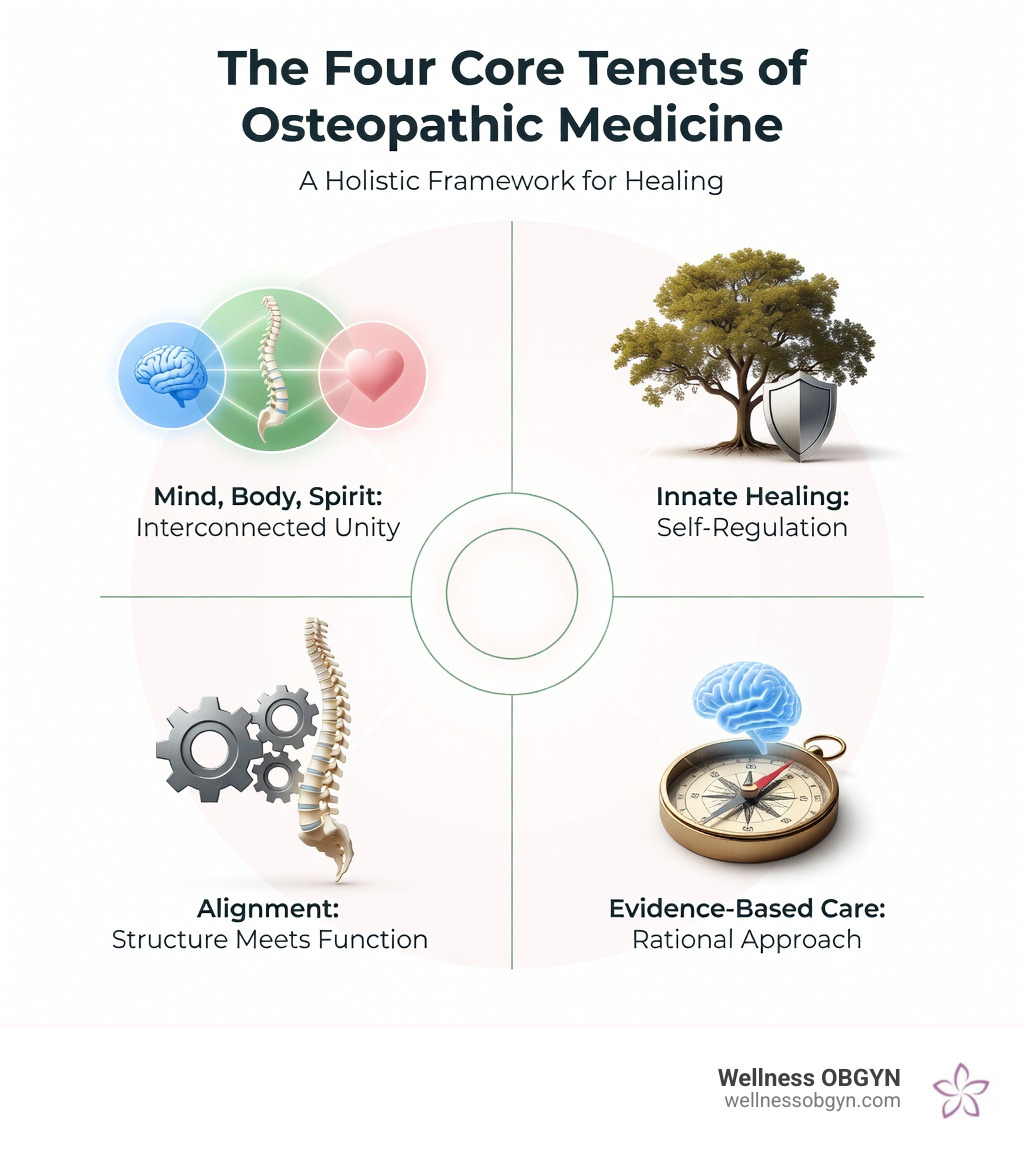
At the heart of what is osteopathy are four main tenets that guide every diagnosis and treatment plan we create at Wellness OBGYN:
- The Body is a Unit: You are not just a uterus or a pair of ovaries. You are a dynamic interaction of mind, body, and spirit.
- Structure and Function are Interrelated: If the structure of your pelvis is misaligned, the function of the organs within it (like the bladder or uterus) can be compromised.
- The Body Possesses Self-Regulatory Mechanisms: Your body is designed to fix itself. Our job as physicians is to remove the “speed bumps” preventing that healing.
- Rational Treatment: Effective medical care must be based on the first three principles.
We often look for somatic dysfunction—impaired or altered function of the skeletal, arthrodial, and myofascial structures. By using our understanding of biomechanics, we can see how a “stuck” hip might be the hidden cause of chronic pelvic pain or even headaches.
| Feature | Osteopathic Medicine (DO) | Chiropractic | Physiotherapy |
|---|---|---|---|
| Primary Focus | Whole-person medical care + OMT | Spinal alignment & nervous system | Rehabilitation & exercise |
| Training | Medical School (4 years) + Residency | Chiropractic College (4 years) | Master’s or Doctorate in PT |
| Prescriptive Authority | Yes (Full medical license) | No | No |
| Surgery | Yes (If specialized) | No | No |
Understanding Osteopathic Manipulative Treatment (OMT) Techniques
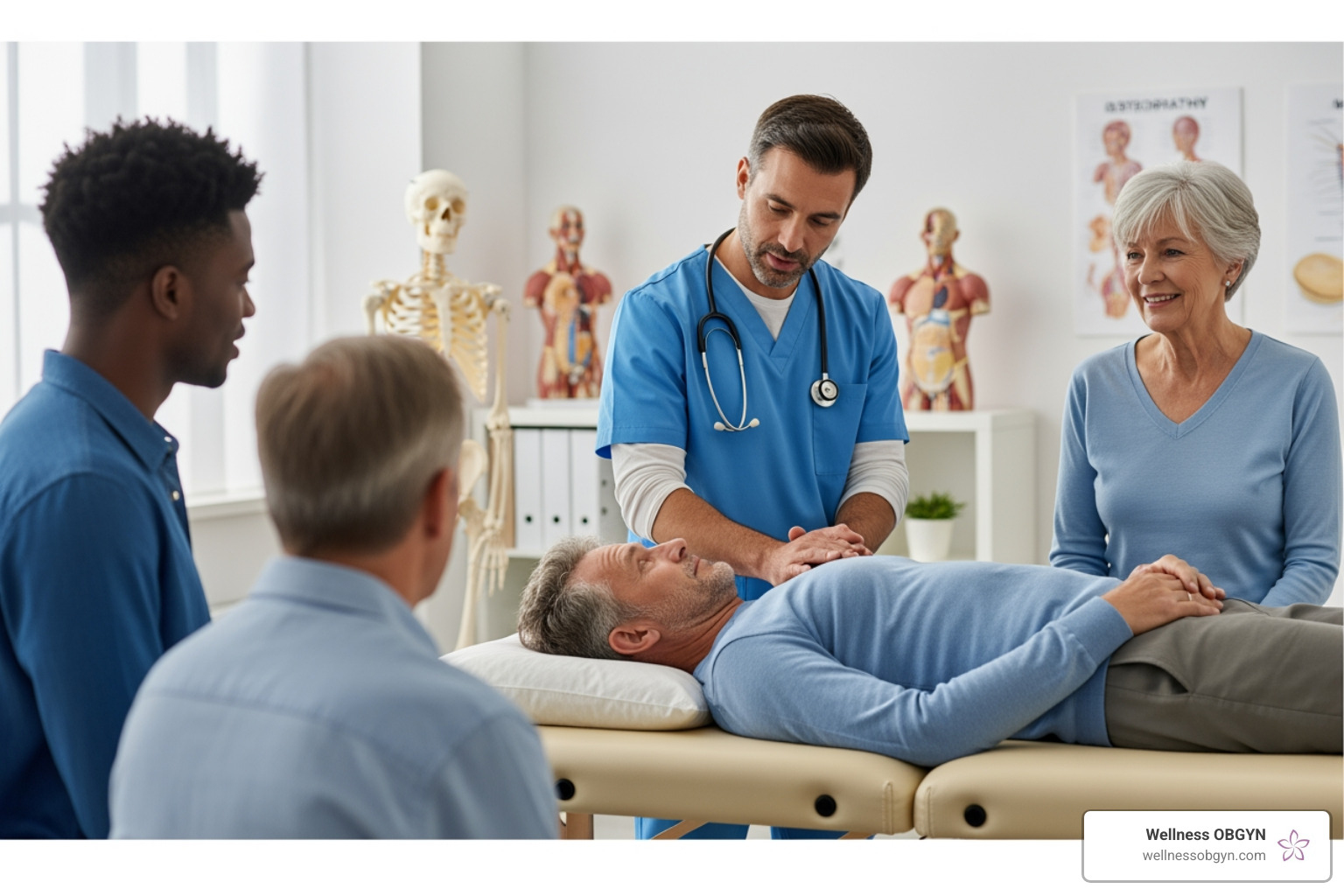
A hallmark of our practice is What is Osteopathic Manipulative Treatment (OMT)?. This involves using our hands to diagnose illness and injury and encourage your body’s natural tendency toward good health. Through palpation (a highly developed sense of touch), we can feel textures in the tissue, heat, and restricted movement that imaging like X-rays might miss.
Common OMT Modalities
We use a variety of techniques depending on a patient’s specific needs:
- High-Velocity Low-Amplitude (HVLA): A quick, targeted thrust to a joint to restore motion (often resulting in a “pop”).
- Muscle Energy Technique: The patient uses their muscles in a specific direction while the physician provides resistance.
- Myofascial Release: Gentle, sustained pressure to release restrictions in the fascia (connective tissue).
- Counterstrain: Moving a patient away from a position of pain to a position of comfort to “reset” overactive pain reflexes.
- Lymphatic Pump: Rhythmic techniques used to improve the flow of lymph, boosting the immune system and reducing swelling.
- Visceral Manipulation: Gentle manual force applied to the internal organs to improve their mobility and function.
Scientific Evidence: What is Osteopathy Effective For?
Many patients ask, Does Osteopathic Manipulative Treatment Work? The answer is a resounding yes, backed by clinical research. For instance, the NICE guidelines on manual therapy for back pain recommend manual therapy alongside exercise for managing lower back pain and sciatica.
Studies have shown that OMT is particularly effective for:
- Low Back Pain: Reducing the need for pain medication and improving mobility.
- Postpartum Recovery: Helping the body realign after the significant structural changes of pregnancy.
- Migraine Relief: Reducing the frequency and intensity of tension-type and migraine headaches.
Who Can Benefit from Osteopathic Care?
Because OMT can be so gentle, it is appropriate for people of all ages. In pediatric care, it is used for issues like infant colic or feeding difficulties. For our geriatric patients, it helps maintain mobility and manage the pain of arthritis. We also frequently treat sports injuries and provide workplace ergonomics advice to prevent repetitive strain.
Safety, Regulation, and Global Standards
Safety is our priority. While OMT is generally very safe, there are contraindications. We do not perform certain forceful manipulations on patients with severe bone disease (like advanced osteoporosis), joint infections, or certain vascular conditions. This is why a thorough medical history is the first step in every consultation.
In the U.S., DOs are regulated by state medical boards. You can Find a Physician via the AAO search to ensure your provider is board-certified. Globally, organizations like the General Osteopathic Council (UK) and the Osteopathy Board of Australia maintain high standards for manual osteopaths in their respective countries.
Frequently Asked Questions about Osteopathy
How many sessions of osteopathy are usually needed?
Every patient is unique. Some acute issues may resolve in 1–3 sessions. Chronic conditions may require a longer-term plan, perhaps once a week for several weeks, tapering off as the body stabilizes.
Is osteopathic treatment painful?
Most OMT is very gentle and relaxing. You may feel a “good stretch” or some pressure. Some patients experience mild soreness for 24–48 hours after treatment, similar to the feeling after a good workout, as the body adjusts to its new alignment.
Do I need a referral to see an osteopath?
In the U.S., you generally do not need a referral to see a DO, though your insurance plan may have specific requirements. At Wellness OBGYN, we welcome patients to book directly with us for both gynecological care and OMT.
Conclusion
At Wellness OBGYN, we are proud to offer a different kind of healthcare. Located in the heart of Honolulu, our practice is dedicated to providing personalized women’s healthcare that honors the principles of osteopathic medicine. We believe in patient empowerment and shared decision-making, ensuring you are an active participant in your healing journey.
Whether you are navigating the changes of adolescence or the transition into menopause, we are here to provide expert, compassionate care tailored to your individual needs. We invite you to experience the difference that a holistic, osteopathic lens can make for your health.
Ready to find balance? Schedule an Osteopathic Manipulative Treatment (OMT) consultation with us today and take the first step toward a healthier, more vibrant you.