
Why Osteopathic Medicine Offers a Revolutionary Approach to Healthcare
Osteopathic medicine what is – it’s a distinctive form of medical practice that treats the whole person, not just symptoms. Unlike conventional medicine that often focuses on specific ailments, osteopathic medicine views your body as an interconnected unit of mind, body, and spirit.
Quick Answer: What is Osteopathic Medicine?
- Philosophy: Whole-person approach emphasizing the body’s ability to heal itself
- Practitioners: Doctors of Osteopathic Medicine (DOs) – fully licensed physicians
- Training: Same medical education as MDs, plus 200+ extra hours in hands-on treatment
- Treatment: Combines modern medicine with Osteopathic Manipulative Treatment (OMT)
- Focus: Prevention, wellness, and treating root causes rather than just symptoms
- Scope: All medical specialties including surgery, with 57% of DOs choosing primary care
Osteopathic medicine was founded in 1874 by Dr. Andrew Taylor Still, who believed that “the body is a unit; the person is a unit of body, mind, and spirit.” This philosophy drives every aspect of osteopathic care today.
The core difference? While traditional doctors might prescribe medication for your headaches, a Doctor of Osteopathic Medicine (DO) will also examine your posture, neck tension, and stress levels. They use their hands to diagnose problems and may perform gentle manipulative treatments alongside conventional therapies.
More than 149,000 DOs currently practice in the United States, representing about 11% of all physicians. One in four medical students today is training to become a DO, making osteopathic medicine one of the fastest-growing healthcare professions in the country.
As Dr. Cheryl Twu, DO, FACOOG, I’ve spent over a decade integrating osteopathic principles with women’s healthcare, combining advanced surgical techniques with whole-person wellness approaches. My osteopathic training informs how I understand osteopathic medicine what is – a partnership between doctor and patient that honors your body’s natural healing abilities while providing the most advanced medical care available.
The Core Philosophy: History and Four Tenets of Osteopathic Medicine
Understanding osteopathic medicine what is means stepping back in time to meet a man who dared to challenge everything medicine believed. It’s a story of tragedy, determination, and ultimately, a new way of healing.
The Origins of a New Medical Philosophy
Picture this: it’s the 1800s, and doctors are treating patients with mercury, arsenic, and bloodletting. Not exactly what you’d call gentle care, right? Dr. Andrew Taylor Still lived through this harsh reality as both a physician and a heartbroken father.
Born in 1828, Still served as a surgeon during the Civil War, witnessing countless unnecessary deaths. But it was personal tragedy that truly opened his eyes. Despite having access to the best medical care of his time, Still watched helplessly as three of his children died from disease. The conventional treatments that were supposed to help had failed completely.
This devastating loss sparked something powerful in Still. He refused to accept that harsh, ineffective treatments were the only option. Instead, he began developing a completely different approach to medicine—one focused on prevention rather than just treating disease.
In 1874, Dr. Still made medical history when he “flung to the breeze the banner of osteopathy.” He wasn’t just creating a new treatment method; he was launching an entirely new philosophy of healthcare. By 1892, he had founded the first osteopathic school, the American School of Osteopathy in Kirksville, Missouri.
Still’s idea was simple yet profound: the body has an amazing ability to heal itself when given the right conditions. This marked the beginning of a medical profession that would prioritize the whole person, not just their symptoms. You can learn more about this rich history at the American Osteopathic Association.
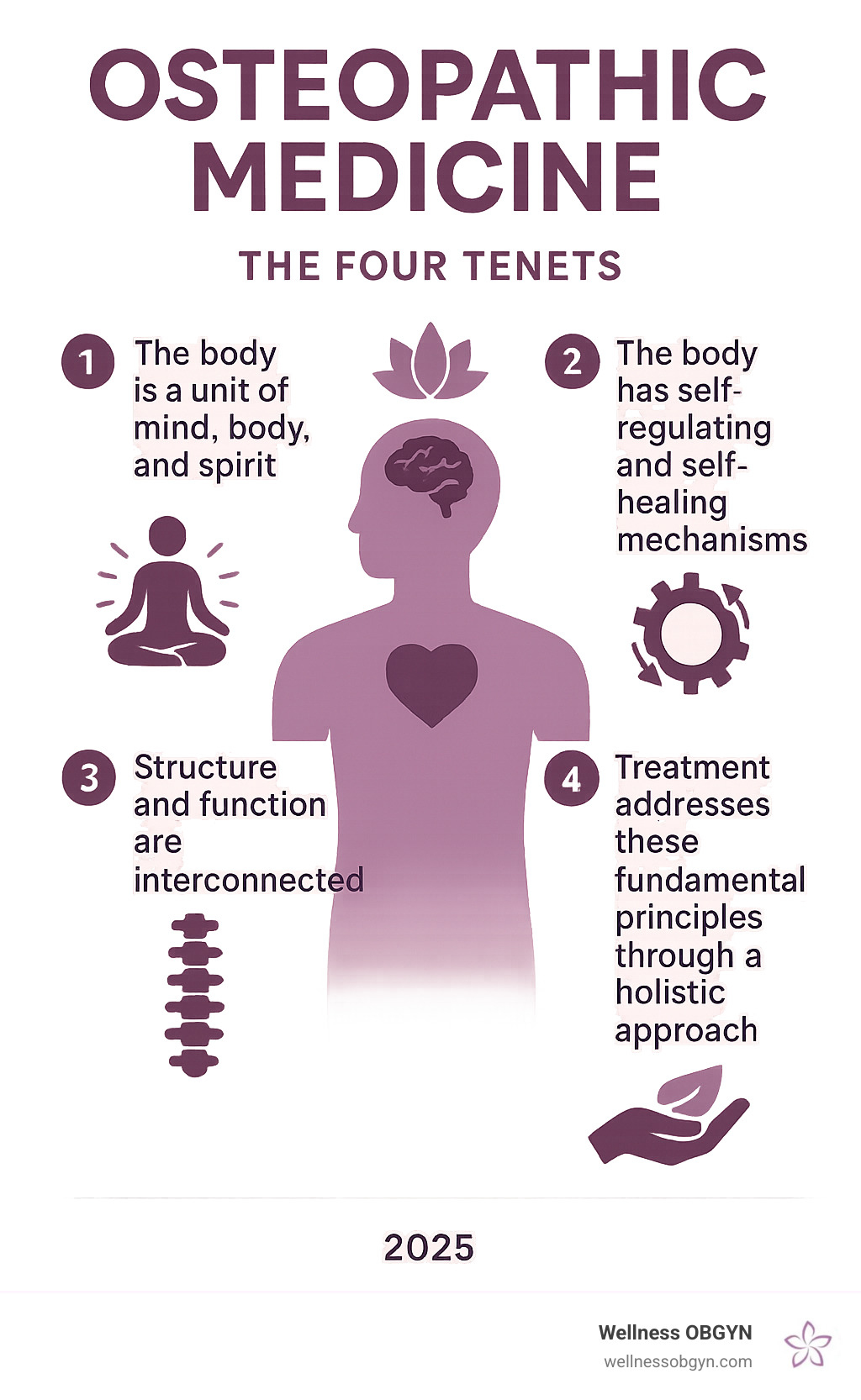
The Four Tenets: Guiding Principles of Care
When you visit a DO today, your care is guided by the same four core principles that Dr. Still established over 150 years ago. These aren’t just medical theories—they’re the foundation of how we understand osteopathic medicine what is and how it can transform your health:
The body is a unit means we see you as a complete person, not a collection of separate parts. Your physical health, emotions, and even your spiritual well-being are all connected. When you come to me with back pain, I’m not just looking at your spine—I’m considering how your stress levels, sleep quality, and daily activities might all be contributing to your discomfort.
The body is capable of self-regulation and self-healing reflects our deep respect for your body’s natural wisdom. Your body already knows how to heal cuts, fight infections, and repair damaged tissues. As your DO, my job is to remove the obstacles that might be preventing this natural healing process from working at its best.
Structure and function are reciprocally interrelated sounds fancy, but it’s actually quite straightforward. Simply put, how your body is built affects how it works, and how it works affects how it’s built. Poor posture can lead to headaches, and chronic pain can change the way you move and stand.
Rational treatment is based on these principles means every treatment plan we create takes into account your body’s unity, its healing abilities, and the connection between structure and function. We’re not just masking symptoms—we’re working with your body’s natural processes to restore balance and health.
This mind-body-spirit connection isn’t just a nice idea; it’s the practical foundation of how DOs approach every aspect of your care. Whether you’re dealing with chronic pain, preparing for surgery, or working on preventive health, these principles guide everything we do together.
The DO Difference: How Osteopathic Physicians (DOs) Compare to MDs
When people ask, “osteopathic medicine what is?”, a common follow-up question is, “How is it different from traditional medicine?” Let’s clarify the distinction between Doctors of Osteopathic Medicine (DOs) and Medical Doctors (MDs).
Here’s the simple truth: both DOs and MDs are fully licensed physicians who can practice in any medical specialty, prescribe medications, and perform surgery. The key differences lie in their training philosophy and approach to patient care.
| Feature | Doctors of Osteopathic Medicine (DOs) | Medical Doctors (MDs) |
|---|---|---|
| Medical School | 4 years + 200+ hours of hands-on manipulative treatment training | 4 years of traditional medical education |
| Philosophy | Whole-person, holistic approach emphasizing prevention and body’s self-healing ability | Disease-focused, symptom-based treatment approach |
| Licensing Exams | COMLEX-USA (can also take USMLE) | USMLE (United States Medical Licensing Examination) |
| Treatment Methods | Modern medicine + Osteopathic Manipulative Treatment (OMT) | Primarily medications, procedures, and surgery |
| Patient Interaction | Emphasis on doctor-patient partnership and lifestyle counseling | Traditional doctor-patient relationship |
| Specialty Distribution | 57% choose primary care specialties | Higher percentage in surgical and specialized fields |
Training and Licensing: A Parallel Path
Both DOs and MDs complete four years of medical school followed by residency training in their chosen specialty. The major difference? Osteopathic medical students receive an additional 200+ hours of training in hands-on diagnosis and treatment techniques.
DOs take the COMLEX-USA licensing exams, though many also take the USMLE that MDs take. This dual qualification means DOs can complete residencies at both osteopathic and traditional medical programs. Once licensed, DOs have identical practice rights to MDs—they can prescribe medication, perform surgery, and specialize in any field of medicine from family practice to neurosurgery.
For more detailed information about osteopathic medical training, you can read What is a D.O. (Doctor of Osteopathic Medicine)?.
The Philosophical Approach: Allopathic vs. Osteopathic Medicine
The real difference between osteopathic medicine what is and traditional allopathic medicine (practiced by MDs) lies in the fundamental approach to healthcare.
Allopathic medicine typically focuses on diagnosing and treating specific diseases or symptoms. If you have high blood pressure, you get blood pressure medication. If you have back pain, you might get pain relievers or referred for imaging studies.
Osteopathic medicine takes a broader view. A DO treating your high blood pressure will also consider your stress levels, sleep patterns, diet, exercise habits, and even your work environment. They understand that your blood pressure doesn’t exist in isolation—it’s connected to your entire life and health picture.
This holistic philosophy means DOs often spend more time with patients, asking questions about lifestyle factors and environmental influences that might affect your health. They’re trained to see patterns and connections that might not be immediately obvious.
The patient-centered care approach emphasizes partnership rather than a traditional doctor-knows-best relationship. As a DO, I work with my patients to develop treatment plans that fit their lives, values, and goals. This collaborative approach often leads to better long-term health outcomes because patients feel more invested in their care.
Prevention is another cornerstone of osteopathic medicine. Rather than waiting for problems to develop, DOs focus on maintaining health and catching issues early when they’re easier to address. This proactive approach aligns perfectly with women’s healthcare, where preventive care can make a tremendous difference in long-term health and quality of life.