
The Revolution of Gentle Medicine in Hawaii
Minimally invasive procedure specialists are physicians with advanced training in performing surgeries and interventions through tiny incisions, often using specialized tools and imaging technology. These experts help patients experience less pain, shorter recovery times, and fewer complications compared to traditional open surgery.
What to know about minimally invasive procedure specialists in Hawaii:
- Most procedures use incisions the size of an IV needle (1-2 cm)
- Patients typically go home the same day
- Recovery is 2-4 times faster than traditional surgery
- Hawaii has specialists across multiple disciplines (gynecology, spine, vascular)
- Many procedures have success rates exceeding 85-95%
When you’re facing a health challenge that might require surgery, the thought of large incisions, extended hospital stays, and lengthy recovery periods can be daunting. Fortunately, medical advances have revolutionized how many conditions are treated, with minimally invasive approaches now the gold standard for numerous procedures.
These specialized techniques use tiny instruments, fiber-optic cameras, and advanced imaging to treat conditions that once required major surgery. For Hawaii residents, this means less disruption to your island lifestyle and a quicker return to the activities you love.
The benefits are substantial – most patients walk within an hour after certain spine procedures, experience significantly less post-operative pain, and return to work in just 1-2 weeks. Additionally, these techniques often preserve normal anatomy and function better than traditional approaches.
As Dr. Cheryl Twu, I specialize in minimally invasive gynecologic procedures including laparoscopic and robotic surgeries at Wellness OBGYN in Honolulu, bringing over a decade of experience as one of Hawaii’s leading minimally invasive procedure specialists with advanced training in da Vinci® robotic techniques.

What Makes a Procedure Minimally Invasive?
When patients hear the term “minimally invasive,” many wonder what exactly that means. At its core, minimally invasive procedures represent a fundamental shift in surgical philosophy—treating conditions with the smallest possible disruption to the body’s natural state.
Minimally invasive procedure specialists use techniques that dramatically reduce the physical impact of surgery. Instead of large incisions that expose entire areas of the body, these procedures rely on tiny “keyhole” openings—often just the size of an IV catheter or smaller.
“Many of our procedures are performed through incisions the size of an IV, allowing for faster recovery and significantly less pain compared to traditional surgery,” explains Dr. Twu. “For our Hawaii patients, this means getting back to enjoying island life much sooner.”
The approach leverages advanced imaging technology that allows surgeons to see inside the body without opening it up. This image-guided approach is fundamental to minimally invasive success, providing exceptional precision while minimizing tissue disruption.
Defining the Approach vs. Traditional Surgery
The differences between minimally invasive and traditional open surgery are substantial:
| Aspect | Traditional Surgery | Minimally Invasive Approach |
|---|---|---|
| Incision size | 3-12+ inches | 0.5-2 cm (size of IV or smaller) |
| Tissue disruption | Significant cutting of muscle and tissue | Minimal tissue displacement |
| Blood loss | Often substantial | Typically minimal |
| Anesthesia | General anesthesia | Often local anesthesia with sedation |
| Hospital stay | Multiple days | Usually outpatient or overnight |
| Recovery time | Weeks to months | Days to weeks |
| Scarring | Visible, permanent | Minimal or nearly invisible |
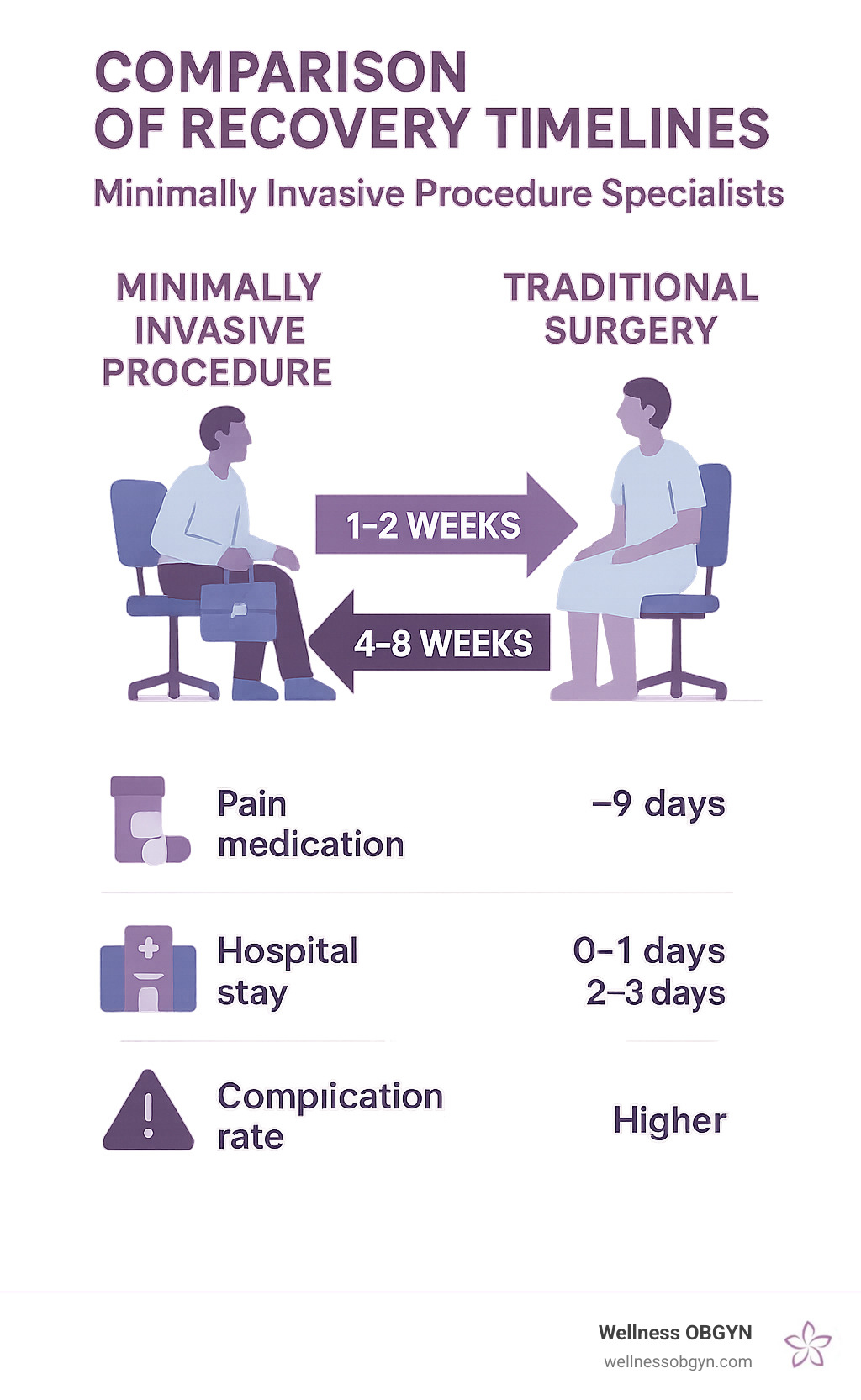
“When we perform a minimally invasive hysterectomy at Wellness OBGYN,” notes Dr. Twu, “patients typically go home the same day and can return to most normal activities within 1-2 weeks, compared to 6-8 weeks with traditional approaches.”
Core Benefits for Island Patients
For residents of Hawaii, the advantages of minimally invasive procedures extend beyond medical benefits—they complement the active island lifestyle many residents cherish.
Living in paradise comes with certain expectations – like being able to enjoy our beautiful beaches and outdoor activities year-round. That’s why the reduced pain from smaller incisions is so valuable for island residents. Most patients are pleasantly surprised by how quickly discomfort subsides after minimally invasive procedures.
The same-day discharge benefit means you won’t be stuck in a hospital bed while paradise waits outside. Instead of spending nights in the hospital, you’ll likely be home relaxing in your own space just hours after your procedure.
Perhaps most appreciated by our active Hawaii community is the quicker beach return – many patients can resume gentle swimming and beach activities within weeks rather than months. One Honolulu patient shared after her minimally invasive gynecological procedure at Wellness OBGYN: “I was amazed that I only needed pain medication for two days. By the end of the week, I was taking gentle walks along Ala Moana Beach Park. The tiny incisions are barely visible now.”
The preservation of surrounding tissues means your body maintains better function after surgery. This is especially important when treating sensitive areas where traditional surgery might cause more extensive disruption. And let’s not forget the minimal scarring – a cosmetic benefit many patients appreciate when bikini season lasts all year long!
At Wellness OBGYN, we understand that island life doesn’t pause for recovery. That’s why we’re committed to offering advanced minimally invasive options that get you back to enjoying all that Hawaii has to offer as quickly as possible.
Cutting-Edge Technologies & Patient Benefits
The remarkable outcomes achieved by minimally invasive procedure specialists are made possible through a sophisticated array of technologies that continue to evolve at an impressive pace. These innovations have fundamentally transformed what’s possible in medicine—turning major surgeries into outpatient procedures and weeks of recovery into days.

Tools Behind the Trend
When you visit a minimally invasive specialist, you’re benefiting from decades of technological advancement that have revolutionized healthcare.
Endoscopy has changed everything about how we see inside the body. These thin, flexible tubes with lighting and cameras let doctors explore internal spaces without major incisions. Whether it’s examining your digestive tract or performing delicate gynecological procedures, these high-definition views make precision possible.
The world of laparoscopy has been particularly transformative for our patients at Wellness OBGYN. Through tiny abdominal incisions, we can address everything from endometriosis to ovarian cysts—all while you experience less pain and recover more quickly.
“I remember when these procedures required week-long hospital stays,” says Dr. Twu. “Now I see patients shopping at Ala Moana Center just days after their surgery!”
Robotic systems like the da Vinci® have taken surgical precision to new heights. When I control these robotic arms from a nearby console, my hand movements translate into micro-precise actions inside the patient’s body. The improved visualization feels like having superhuman abilities—I can see details that would be impossible to detect with the naked eye.
Laser technology has been another game-changer, especially for procedures requiring extreme precision. The ability to cut, vaporize, or seal tissues with minimal damage to surrounding areas has transformed fields like spine surgery, where Laser Endoscopic Spine Surgery (LESS) now allows patients to walk within hours of their procedure.
Real-time imaging through fluoroscopy, 3D navigation systems, and intraoperative ultrasound lets us “see” without opening. According to research published by the Society of Interventional Radiology, these image-guided therapies have transformed treatment for conditions from uterine fibroids to vascular disease, with success rates often exceeding 90%.
The tiniest tools often make the biggest difference. Nano-probes just millimeters in diameter can now access areas that once required major operations, particularly valuable in delicate neurological and spine procedures.
Emerging Innovations to Watch
The minimally invasive field continues to advance at breathtaking speed. Several exciting developments are already changing how we care for patients:
AI-Assisted Surgical Planning is helping us analyze complex imaging data and plan optimal surgical approaches. By identifying the safest pathways to treat a condition, these systems may further improve patient outcomes.
Single-Port Robotics represents the next frontier—allowing multiple instruments through just one tiny incision. This further reduces recovery time and improves cosmetic results, something our Hawaii patients particularly appreciate.
The way we see during surgery is being transformed by advanced visualization technologies. Augmented reality and 3D imaging create unprecedented views of anatomy during procedures, helping us steer complex structures with greater confidence.
After surgery, cloud-based follow-up platforms are making recovery more convenient. “Many of our patients live on neighboring islands,” notes Dr. Twu. “Being able to check on their recovery through secure video visits means less travel and disruption to their lives.”
At Wellness OBGYN, we’re committed to continuously evaluating these technologies, adopting those that demonstrate clear benefits for our patients. The result? Procedures that once required lengthy hospital stays and painful recoveries now often have you back to enjoying Hawaii’s beautiful beaches within days rather than months.
Minimally Invasive Procedure Specialists in Hawaii
Hawaii residents are fortunate to have access to some truly exceptional minimally invasive procedure specialists right here on our islands. These dedicated physicians bring specialized training and cutting-edge techniques that perfectly suit our unique island lifestyle and healthcare needs.

What makes Hawaii’s approach to minimally invasive care special is the collaborative, multidisciplinary spirit among our specialists. From the beaches of Waikiki to the shores of Kauai, island patients can find comprehensive care that addresses their specific conditions with the gentlest possible approach. Whether you need vascular intervention, gynecologic care, spine surgery, or urologic treatment, Hawaii’s specialists offer the full spectrum of minimally invasive options.
Minimally Invasive Procedure Specialists: Vascular & Interventional Radiology
Interventional radiologists are true pioneers in the minimally invasive world. These specialists—who use detailed imaging to guide tiny instruments through blood vessels and tissues—treat an impressive range of conditions without traditional surgery.
When patients struggle with uterine fibroids, for example, Uterine Fibroid Embolization (UFE) offers a non-surgical alternative to hysterectomy. This remarkable procedure blocks the blood supply to fibroids, allowing patients to go home the same day and typically recover within a week.
For those dealing with potentially dangerous blood clots, advanced catheter-directed therapies can dissolve Deep Vein Thrombosis (DVT) with minimal disruption to your body and life.
Many women suffer silently with Pelvic Congestion Syndrome, a condition affecting approximately 20% of women that causes chronic pelvic pain. The good news? It can be effectively treated through gentle embolization techniques that require only a tiny access point.
Men dealing with varicocele issues—varicose veins in the scrotum affecting up to 15% of the male population—can benefit from outpatient embolization procedures with excellent success rates.
At Wellness OBGYN, we work hand-in-hand with these specialists when their unique skills can benefit our patients. Most of their procedures use incisions no larger than an IV needle and leverage real-time imaging for remarkable precision.
Spine & Neurosurgery Innovators
The treatment of back and neck conditions has been completely transformed by minimally invasive spine surgery. Hawaii’s specialists in this field offer several approaches that will have you back to hiking Diamond Head or paddling outriggers much sooner than traditional surgery would allow.
With Endoscopic Discectomy, surgeons use specialized scopes smaller than a pencil to remove herniated disc material through tiny incisions less than 1 cm in size. The results can be dramatic—most patients are walking within an hour after surgery!
Laser Spine Procedures like Percutaneous Laser Disc Decompression have shown success rates around 85% with significantly lower complication rates compared to traditional spine surgery.
For patients with nerve compression, Microforaminotomy widens the spinal canal through tiny incisions while preserving normal anatomy. Even some fusion procedures can now be performed on an outpatient basis, letting patients return to their island homes the same day.
One particularly impressive approach is the non-traumatic, ultra-small endoscopic spine procedure, with reported success rates of 96% according to clinical data. These procedures typically use incisions so small they’re comparable to a freckle!
Minimally Invasive Procedure Specialists: Gynecology & Women’s Health
At Wellness OBGYN in Honolulu, we specialize in minimally invasive gynecologic procedures that help women recover faster with less pain. Dr. Twu and our team are passionate about offering advanced techniques that minimize disruption to your busy island life.
Our Laparoscopic Hysterectomy procedures remove the uterus through several small abdominal incisions, typically allowing same-day discharge and return to normal activities within just 1-2 weeks—a dramatic improvement over the 6-8 week recovery of traditional approaches.
For complex cases like endometriosis excision or pelvic reconstruction, Robotic Gynecologic Surgery provides improved precision while maintaining the benefits of minimal invasiveness.
Some conditions don’t require incisions at all. With Hysteroscopy, we can diagnose and treat intrauterine conditions through the natural opening of the cervix. For women struggling with heavy menstrual bleeding, Endometrial Ablation preserves the uterus while reducing or eliminating problematic bleeding.
“At Wellness OBGYN, we believe every woman deserves the least invasive option that effectively addresses her condition,” says Dr. Twu. “We take time to really listen, explain all options, and develop personalized plans that respect each woman’s unique circumstances.”
For more details about our approach, please visit our Minimally Invasive Surgery OBGYN page.
Orthopedic & Laser Spine Pioneers
Hawaii’s orthopedic surgeons specializing in minimally invasive techniques offer innovative solutions for joint and spine problems that get you back to enjoying paradise faster.

Laser Endoscopic Spine Surgery (LESS) represents the cutting edge of spine care. This approach uses a non-electrical laser through a 1 cm incision to treat herniated discs, annular tears, radiculopathy, and sciatica. The results speak for themselves—most LESS patients are walking within an hour, go home the same day, and return to work after just 1-2 weeks.
For those with joint issues, Minimally Invasive Joint Replacement techniques for hip, knee, and shoulder use smaller incisions and cause less muscle damage than traditional approaches. Island residents dealing with carpal tunnel syndrome can benefit from Endoscopic Carpal Tunnel Release through tiny incisions that allow a quicker return to work and daily activities.
These procedures emphasize preservation of normal anatomy while effectively addressing the underlying problem, allowing you to maintain your active Hawaii lifestyle with minimal downtime.
Urology & Prostate Care Leaders
Hawaii’s urologists specializing in minimally invasive techniques offer several advanced options for prostate and urinary tract conditions that preserve quality of life while effectively treating the problem.
The UroLift™ System has become the #1 chosen minimally invasive BPH (enlarged prostate) procedure in the U.S., with more than 500,000 men treated worldwide. This gentle outpatient procedure lifts and holds enlarged prostate tissue out of the way, relieving pressure on the urethra without cutting, heating, or removing tissue.
What makes UroLift™ particularly appealing is that it’s the only leading BPH procedure shown not to cause sexual dysfunction—a significant advantage for many men. Most patients experience rapid symptom relief, often within days rather than months.
For those dealing with kidney stones, Minimally Invasive Stone Treatment techniques avoid large incisions while effectively resolving this painful condition. Various Laser Prostate Procedures offer alternatives to traditional prostate surgery with reduced bleeding and faster recovery.
Patients interested in learning more about the UroLift option can visit the UroLift website for additional details.
At Wellness OBGYN, we understand the interconnected nature of women’s health and work closely with these specialists when our patients need multidisciplinary care. Our goal is always the same—getting you back to enjoying your island life as quickly and comfortably as possible.
Frequently Asked Questions about Minimally Invasive Procedure Specialists
When considering a minimally invasive procedure, it’s natural to have questions. As someone who’s helped hundreds of Hawaii women through these procedures, I find the same concerns come up regularly. Let’s address the questions I hear most often in my practice:
Are minimally invasive procedures covered by insurance?
Good news! Most minimally invasive procedures are covered by insurance when they’re medically necessary. This includes Medicare and major commercial plans, though coverage details do vary.
Medicare typically covers these procedures when they meet established medical necessity criteria. In fact, Medicare has increasingly supported minimally invasive approaches because they often result in shorter hospital stays and fewer complications.
Commercial insurance plans generally provide good coverage too. Many insurance companies actually prefer these procedures because they result in lower total healthcare costs compared to traditional surgery.
At Wellness OBGYN, we understand insurance can feel overwhelming. That’s why our team handles much of the paperwork and prior authorization process for you. We work directly with your insurance provider to verify your benefits and maximize your coverage.
“We don’t want insurance concerns to stand between you and the care you need,” explains Dr. Twu. “Our staff is experienced in navigating these waters and making the process as smooth as possible for our patients.”
Before scheduling any procedure, we’ll help you understand your specific coverage and any potential out-of-pocket costs. Just bring your insurance card to your consultation, and we’ll take care of the rest.
How do I know if I’m a good candidate?
Determining if you’re a good candidate for a minimally invasive procedure involves several key factors that we carefully evaluate:
First, we’ll review detailed imaging studies like ultrasounds, MRIs, or CT scans to see if your specific condition can be effectively treated with minimally invasive techniques. These images help us understand exactly what we’re dealing with.
Your medical history plays an important role too. Previous surgeries, especially in the abdominal or pelvic area, might influence which approaches work best for you. Certain health conditions may also impact your candidacy.
At Wellness OBGYN, Dr. Twu conducts a thorough consultation that looks at your unique situation. We consider your overall health, body mass index, the specific condition being treated, and most importantly, your personal preferences and goals.
“I’ve seen the technology evolve tremendously over my career,” notes Dr. Twu. “Conditions we once thought required major surgery can now often be treated with much less invasive approaches. But it’s still essential we carefully evaluate each person individually.”
During your consultation, we’ll discuss whether minimally invasive options are right for you, and if so, which specific approach might work best for your situation. We believe in shared decision-making – you’ll always understand your options and be an active participant in your care plan.
What risks or limitations should I consider?
While minimally invasive procedure specialists typically achieve excellent outcomes with fewer complications than traditional surgery, it’s important to understand the potential risks and limitations:
In rare cases (about 2-5%), we may need to convert to traditional open surgery during a procedure. This happens if we encounter unexpected findings or if it becomes clear that the minimally invasive approach won’t adequately address what we find. I always discuss this possibility beforehand, so you’re prepared.
Bleeding risks exist with any surgical procedure, though they’re typically less with minimally invasive approaches. Similarly, while infection rates are generally lower, they remain a possibility that we take precautions against.
Each procedure carries its own unique set of potential complications. For example, with hysteroscopy, there’s a small risk of uterine perforation. With laparoscopy, there’s a minimal risk of injury to surrounding organs. During your consultation at Wellness OBGYN, we’ll discuss the specific risks relevant to your procedure.
Some patients wonder about the experience of the surgeon performing their procedure. This is a valid concern – there is definitely a learning curve with these specialized techniques. Dr. Twu has extensive training and experience in minimally invasive gynecologic surgery, having performed hundreds of these procedures over her career.
“I believe patients deserve complete transparency about both benefits and risks,” says Dr. Twu. “While we emphasize the advantages of minimally invasive approaches, we also want you fully informed about all aspects of your care.”
Despite these considerations, it’s reassuring to know that complication rates for minimally invasive procedures are typically substantially lower than for equivalent open surgical approaches. Most of our patients experience smooth recoveries with excellent outcomes.
Conclusion
The world of surgical care has been beautifully transformed by minimally invasive procedure specialists who continue to develop gentler, more effective ways to treat patients. For those of us lucky enough to call Hawaii home, these advances mean less time in recovery and more time enjoying our beautiful islands.
At Wellness OBGYN in Honolulu, we take pride in offering cutting-edge minimally invasive gynecologic care. We believe every woman deserves a treatment plan that fits her unique situation – not a one-size-fits-all approach. When you visit us, you’ll find we take the time to educate you about your options and involve you in every decision about your care.
The advantages of choosing minimally invasive approaches speak for themselves. Less pain means you can get back to feeling like yourself sooner. Faster recovery times let you return to work, family, and island activities without lengthy downtime. Reduced scarring preserves your body’s natural appearance, while preservation of normal anatomy helps maintain proper function. With lower complication risks and improved quality of life outcomes, it’s no wonder these techniques have become the preferred choice for so many procedures.
As new technologies emerge, we carefully evaluate each innovation to ensure it truly benefits our patients before adopting it. Our commitment isn’t to the latest trend – it’s to providing you with the most effective care that causes the least disruption to your life.
If you’re facing a health challenge that might require surgery, I encourage you to explore your minimally invasive options. At Wellness OBGYN, we’re here to walk alongside you, answer all your questions (even the ones you might be embarrassed to ask!), and help you make choices you feel confident about.
To learn more about our approach to minimally invasive gynecologic procedures or to schedule a consultation, please visit our services page or give our Honolulu office a call. We’re ready to listen.
Your health journey deserves the gentlest, most effective care available—and that’s exactly what we strive to provide every day at Wellness OBGYN, alongside other dedicated minimally invasive procedure specialists throughout Hawaii.