
Why Understanding Birth Control Implant Costs Matters
5 year birth control implant cost typically ranges from $0 to $1,300 depending on your insurance coverage. Here’s what you need to know:
- With insurance: Most women pay $0 due to Affordable Care Act requirements (96% of claims have full coverage)
- Without insurance: $500–$1,300 upfront for device and insertion
- Average annualized cost: Approximately $95–$150 per year over 3 years
- Removal cost: $0–$300
Important note: Currently available implants (Nexplanon) last 3 years, not 5 years. Hormonal IUDs offer 5-year protection at similar or lower costs.
If you’re considering long-term contraception, understanding the real costs—including device price, insertion fees, and insurance coverage—helps you make an informed choice. Many women assume birth control implants are expensive, but when you break down the annualized cost and factor in insurance, they often become one of the most affordable options available.
The upfront price can feel daunting. Without insurance, you might pay over $1,000 for the device and procedure. But with most health plans, the entire cost is covered with no co-payment or coinsurance. Even if you’re uninsured, community health clinics and programs like Planned Parenthood offer sliding-scale fees based on income.
As Dr. Cheryl Twu, a board-certified obstetrician-gynecologist in Honolulu, I’ve helped hundreds of women steer the 5 year birth control implant cost and insurance coverage options over the past decade. My goal is to ensure every patient understands both the financial and health aspects of contraceptive choices so you can select the method that fits your life and budget.
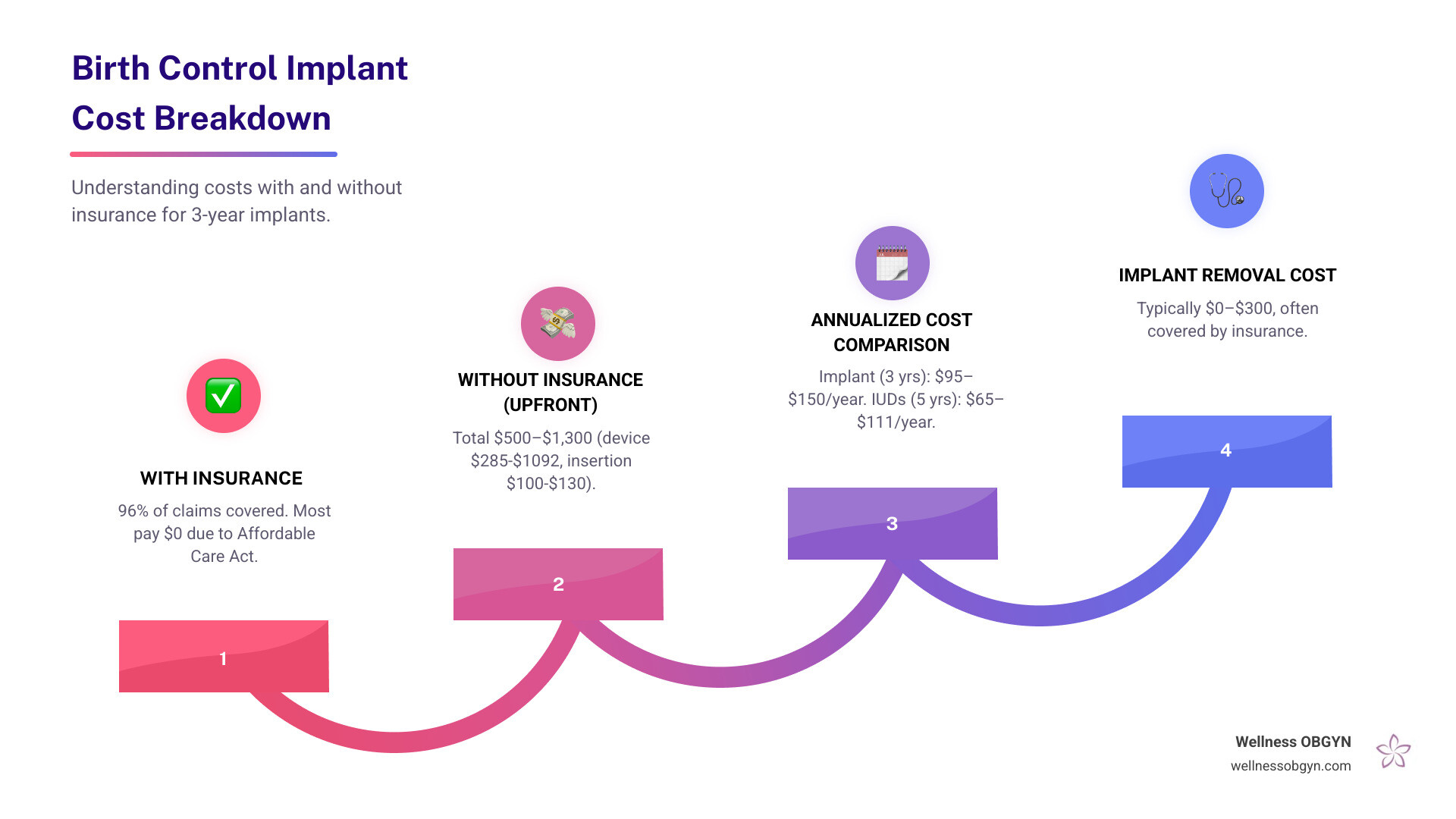
5 year birth control implant cost terms to remember:
What is the Typical 5 Year Birth Control Implant Cost?
When we talk about a 5 year birth control implant cost, it’s important to clarify what’s currently available. In the United States, the most common and indeed, the only contraceptive implant available, is Nexplanon. This implant is highly effective and provides contraception for up to three years, not five. So, while you might be searching for a 5 year birth control implant cost, we’ll primarily discuss the 3-year Nexplanon, and then compare it to other long-acting reversible contraceptives (LARCs) like IUDs, which can offer 5 to 10 years of protection.
The typical cost of a birth control implant like Nexplanon can vary significantly based on several factors, including whether you have insurance, your specific plan, and where you receive the service.
The overall cost includes a few key components:
- Upfront Price: This is the cost of the implant device itself. For Nexplanon, the list price without any discounts or insurance can be around $1,092.48 as of June 2023.
- Device Cost: This is the specific charge for the physical implant that will be inserted into your arm.
- Insertion Fees: Beyond the device, there’s a professional fee for the healthcare provider to insert the implant. This typically involves a consultation, local anesthetic, and the procedure itself.
- Removal Fees: Eventually, the implant will need to be removed. This is a separate procedure with its own costs, which can range from $0 to $300. If you’re replacing an old implant with a new one, sometimes the removal and insertion can be done in the same appointment.
Considering its duration of effectiveness (3 years), the implant is considered one of the most effective birth control options available, with over 99% effectiveness. This means that if 1000 people use the implant for one year, only 1 is expected to get pregnant. For more detailed information on contraceptive implant effectiveness, you can refer to latest research on contraceptive implant effectiveness.
We believe in providing all our patients with comprehensive information about their options. For a broader look at birth control services, visit our page on more info about birth control services.
Understanding the 5 Year Birth Control Implant Cost Without Insurance
If you don’t have health insurance, the 5 year birth control implant cost (or rather, the 3-year implant cost) can seem substantial upfront. In the United States, the total cost for the device and its insertion can range from $500 to $1,300. This includes the list price of the device itself, which, as mentioned, can be around $1,092.48, plus the consultation fee and the insertion procedure.
For someone without insurance, paying this out-of-pocket can be a significant financial burden. However, it’s crucial to remember that this is a one-time cost for a method that provides three years of continuous, highly effective pregnancy prevention. When we consider the annualized cost, it often becomes much more affordable than many monthly methods. We’ll dive into that comparison later.
Even if you’re uninsured, there are often ways to reduce this cost, such as through community health clinics, sliding fee scales, or patient assistance programs. We strive to help our patients in Honolulu find the most affordable options available.
Average Out-of-Pocket Expenses with Private Insurance
For most individuals with health insurance, the 5 year birth control implant cost (or the 3-year implant cost) is significantly lower, often $0. This is largely due to the Affordable Care Act (ACA), which mandates that most insurance plans cover contraceptive methods, including the birth control implant, without requiring co-payments or coinsurance.
According to the manufacturer of Nexplanon, an impressive 96% of patient claims for the device had coverage in a recent analysis of commercial claims data. This means that for the vast majority of insured individuals, the device itself comes at no cost.
However, it’s important to understand that while the device might be free, there could still be some out-of-pocket expenses related to the insertion and removal procedures. These fees might be subject to your plan’s deductible or co-payment requirements, though many plans cover these services as part of preventive care. We always recommend contacting your insurance provider directly to understand your specific benefits and any potential out-of-pocket costs before your appointment. This way, there are no surprises!
Regular check-ups and discussions about your reproductive health are vital. Learn more about what to expect during your annual visits on our more info about annual exams page.
Factors Influencing the Price of Long-Term Contraception
The price you pay for any long-term contraceptive, including the birth control implant, can be influenced by several factors unique to your situation and location.
- Geographic Location: Costs for medical services can vary widely from one region to another. While we’re focused on Honolulu, HI, it’s worth noting that healthcare costs, including those for contraceptive devices and procedures, can differ even within a state.
- Healthcare Provider: The type of facility or provider you choose can impact the cost. For example, a procedure at a hospital might be priced differently than one at a specialized clinic or a private OBGYN office like ours.
- Brand Name: For implants, Nexplanon is currently the only brand available in the US. However, for other LARCs like IUDs, there are different brands (e.g., Mirena, Kyleena, Paragard) that may have varying device costs.
- Follow-up Visits: The initial cost often covers the device and insertion, but you may have follow-up visits to ensure the implant is in place and to discuss any side effects. These visits might incur additional co-pays or charges depending on your insurance.
Understanding these factors is crucial for navigating the healthcare system. The idea of universal access to contraception, as explored in scientific research on universal access to contraception, highlights how policy can influence affordability and accessibility, even if the specific programs discussed are not directly applicable to our Honolulu patients.
The 5 Year Birth Control Implant Cost vs. IUDs
Since the birth control implant (Nexplanon) provides 3 years of protection, if you’re looking for a true 5 year birth control implant cost equivalent, we should definitely look at IUDs. Intrauterine Devices (IUDs) are another highly effective LARC option, with some offering protection for 5 years or even longer. Let’s compare their costs and annualized savings.
| Method | Upfront Device Cost (without insurance) | Insertion Fee (without insurance) | Total Upfront (without insurance) | Duration | Annualized Cost (approx.) |
|---|---|---|---|---|---|
| Nexplanon (Implant) | ~$350 – $450 | ~$100 – $130 | ~$500 – $1,300 | 3 years | ~$95 – $150 |
| Hormonal IUD (e.g., Mirena, Kyleena) | ~$350 – $425 | ~$100 – $130 | ~$1,000 | 5-8 years | ~$56 – $111 |
| Copper IUD (e.g., Paragard) | ~$50 – $100 | ~$100 – $130 | ~$1,000 | 5-10 years | ~$15 – $46 |
Note: These figures are estimates for out-of-pocket costs without insurance and can vary.
As you can see, while the upfront cost for IUDs can be similar to or even higher than the implant without insurance (often around $1,000 for both the device and insertion), their longer duration often leads to lower annualized costs. A copper IUD, lasting up to 10 years, can be incredibly cost-effective over its lifespan, averaging as low as $15-$46 per year. Hormonal IUDs, effective for 5-8 years, also offer excellent annualized savings.
The choice between an implant and an IUD often comes down to individual preference, medical suitability, and what feels right for your body. We’re here to discuss all these options with you.
Government Programs and Financial Assistance
Navigating the 5 year birth control implant cost (or 3-year implant cost) can be less daunting with the help of government programs and financial assistance. These resources aim to make contraception accessible to everyone, regardless of their income or insurance status.
- Medicaid: If you qualify for Medicaid, birth control, including implants and IUDs, is typically covered with little to no out-of-pocket cost. The manufacturer of Nexplanon states that 99% of people with Medicaid pay nothing for the device.
- Medicare Part D: While Medicare generally focuses on individuals aged 65 and older and doesn’t typically cover birth control for pregnancy prevention, some Medicare Part D prescription drug plans might cover contraceptives if they are deemed medically necessary for a condition other than preventing pregnancy. It’s always best to check with your specific plan.
- Sliding Fee Scales: Many community health clinics, including Planned Parenthood centers, offer services on a sliding fee scale. This means the cost of your implant or other birth control method is adjusted based on your income, making it more affordable for those without insurance or with limited financial resources.
- Manufacturer Coupons and Patient Assistance Programs: While the research indicates there are currently no manufacturer savings programs specifically for Nexplanon, these types of programs can change, and it’s always worth checking. For other medications, manufacturers sometimes offer assistance to help reduce costs.
We are committed to helping our patients in Honolulu find the care they need. We understand that personalized care extends to helping you understand and access affordable options. For more information on how we tailor healthcare to your individual needs, explore our more info about personalized healthcare page.
How to Obtain a Low-Cost or Free Birth Control Implant

Finding a low-cost or free birth control implant in Honolulu, HI, is possible, even if you don’t have insurance or are underinsured. Our goal at Wellness OBGYN is to ensure everyone has access to the reproductive healthcare they need.
Here’s where you can look for affordable options:
- Local Health Clinics: Hawaii has various local health clinics that may offer reproductive health services, including birth control implants, at reduced rates. These clinics often receive state or federal funding to serve low-income or uninsured individuals.
- Sexual Health Clinics: Dedicated sexual health clinics frequently provide a range of contraceptive methods, including implants, often at a lower cost than private practices. They may also offer counseling and other related services.
- Planned Parenthood: Planned Parenthood is a national organization that provides reproductive healthcare services, including birth control implants, on a sliding fee scale based on your income. They are an excellent resource for those without insurance or who need financial assistance. You can contact your local Planned Parenthood office in Hawaii for specific coverage information and options.
- Title X Clinics: Title X is a federal program that provides family planning and related preventive health services to low-income and uninsured individuals. Clinics that receive Title X funding offer services on a sliding fee scale or for free. You can search for Title X clinics in Hawaii.
- Public Health Cards: If you have a state-issued public health card (like Medicaid in Hawaii), your birth control implant will likely be fully covered.
We encourage you to reach out to these resources or discuss your financial concerns with us. We can help guide you toward the best options for your situation.
Comparing the 5 Year Birth Control Implant Cost to Short-Term Methods
When considering the 5 year birth control implant cost (or 3-year cost of Nexplanon), it’s illuminating to compare it with the costs of short-term birth control methods. While the upfront cost of an implant or IUD might seem high, their long-term, annualized cost often reveals them to be much more economical.
Let’s look at some common short-term methods and their typical out-of-pocket costs without insurance:
- Oral Pills (Combined or Progestin-Only): These typically cost $30–$70 per month. Over a year, this amounts to $360–$840.
- Birth Control Patch (e.g., Ortho Evra): The patch can cost around $40–$70 per patch, and you use one per week. This can quickly add up to an estimated $2,080–$3,640 annually.
- Vaginal Ring (e.g., NuvaRing): Similar to the patch, a vaginal ring can cost $30–$60 per ring, used monthly. A year’s supply can be $360–$720.
- Injectable Shots (e.g., Depo-Provera): This method costs about $40–$70 per injection, administered every three months. Annually, this is approximately $160–$280.
Compare these to the annualized cost of a 3-year implant (around $95–$150) or a 5-10 year IUD (as low as $15–$111). It becomes clear that while monthly or quarterly methods have lower per-unit costs, their recurring nature makes them significantly more expensive over time. The “set it and forget it” nature of LARCs like implants and IUDs not only offers convenience and high effectiveness but also substantial financial savings in the long run.
Understanding these comparisons can help you make a financially savvy decision about your birth control. For more insights into female reproductive health issues and how different methods might fit, please visit our more info about reproductive health issues page.
Frequently Asked Questions about Implant Costs
We often hear similar questions from our patients in Honolulu regarding the costs associated with birth control implants. Here are some of the most common ones we address:
Is the birth control implant covered by insurance?
Yes, in most cases, the birth control implant (Nexplanon) is covered by insurance. Thanks to the Affordable Care Act (ACA), most private insurance plans are required to cover all FDA-approved birth control methods, including the implant, without co-payments or coinsurance. This means that for many patients, the device itself is free.
However, while the device may be covered at 100%, some plans might still apply deductibles or co-payments to the insertion and removal procedures. Our research indicates that 96% of patients with commercial insurance and 99% of those with Medicaid typically pay nothing out-of-pocket for the device. We always advise our patients to contact their specific insurance provider to confirm coverage details for both the implant and the associated procedures.
What is the cost of removing the birth control implant?
The cost of removing a birth control implant can range from $0 to $300. Similar to insertion, whether you pay for removal depends largely on your insurance coverage. If your insurance plan covers birth control as part of preventive care under the ACA, the removal procedure may also be fully covered.
If you are uninsured or your plan does not cover removal, you would pay out-of-pocket. Some clinics, especially those offering sliding fee scales like Planned Parenthood, may provide removal at a reduced cost based on your income. If you’re having an old implant removed and a new one inserted in the same visit, the costs might be bundled, potentially reducing the overall expense.
How does the annualized cost of the implant compare to the pill?
When we look at the 5 year birth control implant cost (or 3-year Nexplanon cost) on an annualized basis, it generally comes out to be significantly more affordable than the birth control pill.
- Birth Control Pills: As we discussed, oral birth control pills can cost anywhere from $30 to $70 per month without insurance. This translates to an annual cost of $360 to $840.
- Birth Control Implant (Nexplanon): The upfront cost for the device and insertion without insurance can range from $500 to $1,300. When we spread this cost over the three years of effectiveness, the annualized cost is roughly $95 to $150 per year.
This comparison clearly illustrates the long-term financial benefits of choosing a LARC like the implant. While the initial payment for the implant may be higher if you’re uninsured, the continuous protection and lower annual expense often make it a more economical choice over time. Plus, the convenience of not having to remember a daily pill is a huge bonus for many of our patients!
Conclusion
Understanding the 5 year birth control implant cost can feel complex, especially with the nuances of insurance coverage and the difference between a 3-year implant and longer-lasting IUDs. However, our aim at Wellness OBGYN in Honolulu is to simplify this for you. We want to empower you with all the information you need to make the best decision for your health and your wallet.
Whether you’re considering the 3-year birth control implant (Nexplanon) or a 5-year IUD, we’ve seen how these long-acting reversible contraceptives can provide peace of mind and significant long-term savings. While the initial investment might seem daunting without insurance, various programs and clinics are dedicated to making these effective methods accessible to everyone.
At Wellness OBGYN, we are committed to providing personalized women’s healthcare, emphasizing patient-centered care and shared decision-making. We believe that when you have all the facts, you can confidently choose the contraceptive method that best fits your lifestyle, health needs, and financial situation. Don’t hesitate to reach out to us to discuss your options and explore how we can support your family planning journey. For more information on our comprehensive family planning services, please visit our more info about family planning services page.