
Why Family Planning Benefit Programs Matter for Your Health Journey
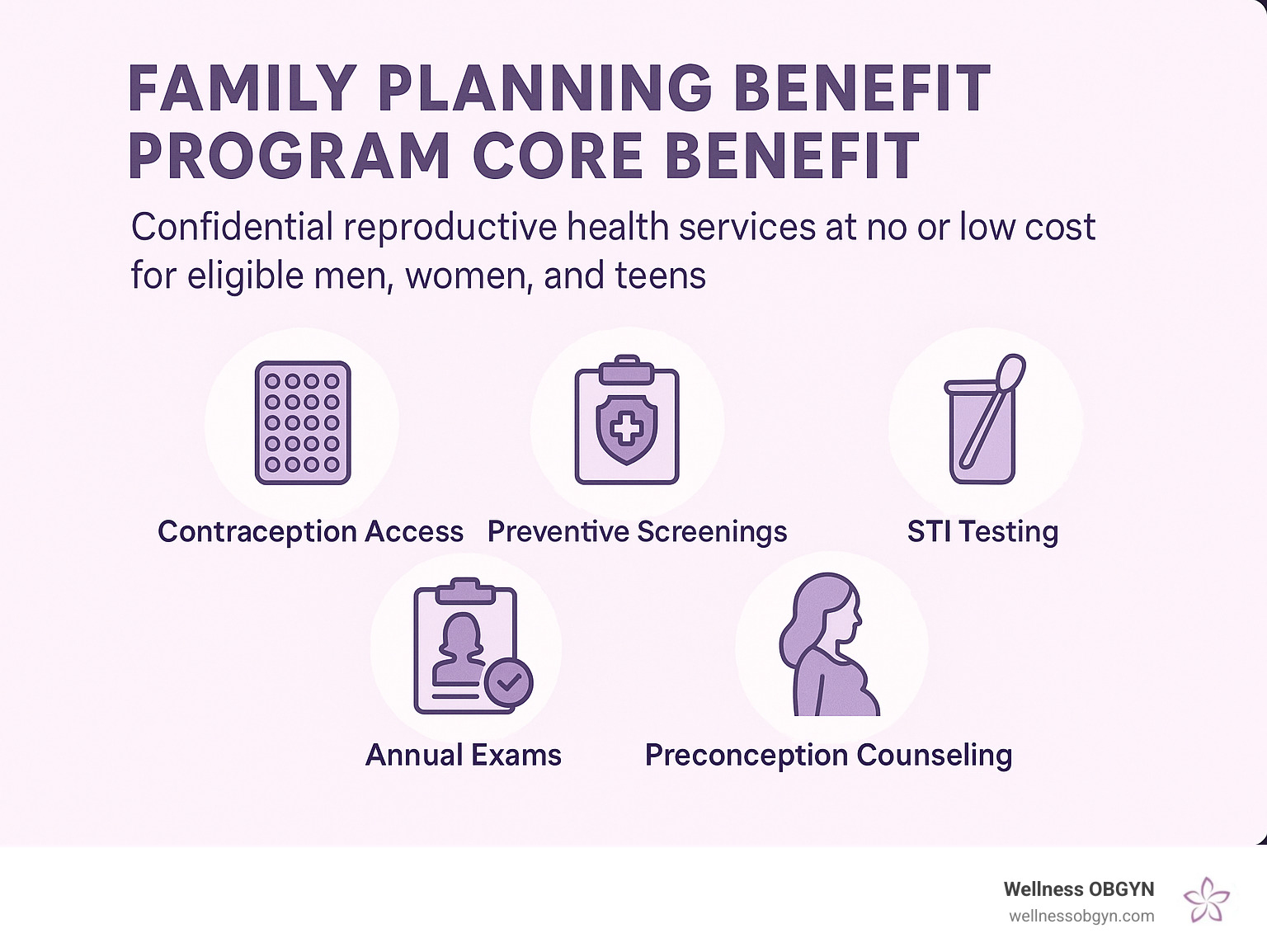
A family planning benefit program is a state-funded public health insurance initiative that provides free or low-cost reproductive health services to eligible residents. These programs help individuals access contraception, preventive screenings, and family planning counseling without the burden of high costs or insurance complications.
Key Program Features:
- Free or low-cost services with no premiums or co-pays
- Confidential care that protects your privacy
- Available to men, women, and teens of childbearing age
- Accessible even if you have other health insurance
- Income-based eligibility (typically up to 200-223% of Federal Poverty Level)
- Wide range of services including birth control, STI testing, and annual exams
These programs exist in many states under different names – New York calls it the Family Planning Benefit Program (FPBP), California has Family PACT, and Georgia offers Planning for Healthy Babies (P4HB). Each program serves residents who need reproductive health services but may not qualify for full Medicaid coverage.
The goal is simple: increase access to confidential family planning services and help people prevent unintended pregnancies while maintaining their reproductive health. Whether you’re a college student, working adult, or teen, these programs provide a safety net for essential care.
As Dr. Cheryl Twu, a board-certified obstetrician-gynecologist with over a decade of experience in women’s health, I’ve seen how family planning benefit programs transform lives by removing financial barriers to essential reproductive care. My work at Wellness OBGYN focuses on providing comprehensive, culturally sensitive care that empowers women to make informed decisions about their health journey.
What is a Family Planning Benefit Program (FPBP)?
Think of a family planning benefit program as your personal safety net for reproductive health. It’s a specialized type of public health insurance that focuses entirely on helping you access the care you need to make informed decisions about your family planning journey.
Unlike regular health insurance that covers everything from broken bones to heart surgery, these programs zero in on what matters most for your reproductive wellness. They’re designed with one clear mission: preventing unintended pregnancies and making sure everyone has access to quality family planning services, regardless of their financial situation.
The beauty of these programs lies in their simplicity. They remove the barriers that often keep people from getting the care they need. No complicated approval processes. No wondering if you can afford your next appointment. Just straightforward access to essential reproductive health services.
Take New York’s Family Planning Benefit Program as an example. It provides free family planning services to residents who might not otherwise be able to afford them. Similar programs exist across the country – each state puts its own spin on the concept, but they all share the same goal of increasing access to confidential, affordable care.
These aren’t just programs for people without insurance. They’re designed to fill gaps that even good insurance plans sometimes miss. Whether you’re concerned about confidentiality, dealing with high deductibles, or simply need services that aren’t fully covered by your current plan, these programs step in to help.
At Wellness OBGYN, we understand how important it is to have comprehensive support for your reproductive health decisions. That’s why we believe in connecting you with every resource available, including our holistic approach to women’s health.
Key Benefits and Features
What makes family planning benefit programs so special? It’s all about removing the obstacles that might prevent you from getting the care you deserve.
Confidentiality is perhaps the most important feature. Your privacy is completely protected. You can request that mail be sent to a different address, and your primary insurance company doesn’t need to know about the services you receive. This is especially valuable for teens who need privacy from their parents or anyone who prefers to keep their reproductive health decisions confidential.
No premiums or co-pays means you won’t face surprise bills or monthly payments. For eligible individuals, covered services are completely free. This removes the financial stress that often forces people to delay or skip important care.
The programs are available even if you have other health insurance. This might sound confusing at first, but it’s actually brilliant. Maybe your regular insurance has high deductibles for certain services, or maybe you want the extra confidentiality these programs provide. You can use both your regular insurance and the family planning program to get the best possible care.
Who These Programs Serve
Family planning benefit programs welcome a diverse group of people, all united by the need for accessible reproductive healthcare.
Men often don’t realize these programs are for them too. Whether you need STI testing, want to discuss contraception options, or are considering vasectomy, these programs provide confidential care for men of all ages.
Women make up a large portion of program participants, accessing everything from annual exams to birth control consultations. The programs recognize that women’s reproductive health needs change throughout their lives.
Teens can access services confidentially, which is crucial during these formative years. The programs understand that young people need accurate information and access to contraception to make responsible decisions about their sexual health.
College students often find these programs particularly helpful. Between tight budgets and the transition to independence, having access to free or low-cost reproductive health services can make a huge difference in their overall well-being.
Low-income residents are a primary focus of these programs. They ensure that financial constraints don’t prevent anyone from accessing essential family planning services.
Individuals of childbearing age who don’t qualify for full Medicaid but still need support can often find help through these specialized programs. The income limits are typically higher than regular Medicaid, making services available to more people who need them.
Are You Eligible? Key Requirements Explained

Wondering if you qualify for a family planning benefit program? The good news is these programs are designed to be accessible to a wide range of people who need reproductive health services. While each state has its own specific rules, most programs share similar basic requirements.
The eligibility process isn’t meant to be complicated or intimidating. These programs exist to help people get the care they need, so the requirements focus on making sure you’re in the right state and truly need the financial assistance.
Most family planning benefit programs require that you’re a state resident where you’re applying. This makes sense – New York’s program serves New Yorkers, California’s serves Californians, and so on. You’ll also need to show citizenship or satisfactory immigration status, which typically means being a U.S. citizen, national, Native American, or having lawful immigration status.
Here’s something important: you generally cannot be enrolled in full Medicaid to qualify for these programs. This isn’t meant to exclude people – it’s because full Medicaid already covers family planning services. These benefit programs fill the gap for people who don’t qualify for comprehensive Medicaid but still need help paying for reproductive health care.
Age requirements vary by state, but most programs welcome anyone of childbearing age. Some states specifically include teens, recognizing how crucial confidential access to care is for young people making important health decisions.
How Income Eligibility is Determined for the family planning benefit program
Income eligibility might sound scary, but it’s actually pretty straightforward. These programs use the Federal Poverty Level (FPL) as their measuring stick – a national standard that gets updated each year to reflect the real cost of living.
Your household size matters a lot in this calculation. A single person has different income limits than a family of four, which makes perfect sense. The programs look at your gross income – that’s your pay before taxes and other deductions are taken out.
Most states set their income limits between 200% and 250% of the Federal Poverty Level. New York’s program uses 223% of FPL, which means more people can qualify for help. For 2026, that translates to about $2,799 per month for a single person, $3,799 for two people, and it goes up by roughly $1,000 for each additional household member.
Don’t worry if math isn’t your strong suit – when you apply, the staff will help you figure out if your income qualifies. They’re there to help, not to make things harder for you.
What if I Already Have Health Insurance?
This is probably the most common question we hear, and it’s a great one! Having health insurance doesn’t automatically disqualify you from a family planning benefit program. In fact, these programs can work beautifully alongside your existing coverage.
Confidentiality is one of the biggest reasons people with insurance still use these programs. Maybe you’re on your parents’ insurance but want to keep your family planning decisions private. Or perhaps you’re married but want confidential access to certain services. These programs respect your privacy completely.
Even good insurance can leave you with co-pays and deductibles that add up quickly. A routine visit here, a prescription there – suddenly you’re looking at hundreds of dollars in out-of-pocket costs. Family planning benefit programs can cover these expenses, making your care truly free.
Sometimes your private insurance might not cover everything you need. Certain types of birth control, specific tests, or newer treatments might not be fully covered. The family planning benefit program can fill these gaps, ensuring you get comprehensive care without surprise bills.
Think of it this way – you’re not cheating the system or being greedy by using both. You’re being smart about accessing all the resources available to protect your health and financial well-being.
Comprehensive Care: What Services Are Covered?
One of the most reassuring aspects of a family planning benefit program is just how comprehensive the care really is. These programs go far beyond just handing out birth control – they’re designed to support your entire reproductive health journey with a wide range of services that address everything from prevention to wellness screenings.
The scope of covered services is genuinely impressive. You’ll find access to most FDA-approved birth control methods, including pills, condoms, IUDs, patches, diaphragms, implants, and shots. Beyond contraception, programs typically cover emergency contraception, male and female sterilization, preconception counseling for those planning healthy pregnancies, and pregnancy testing when it’s part of your family planning care.
Your preventive care is well-covered too. This includes gynecological exams and Pap smears, cervical cancer screening, STI and STD screening and treatment, and HIV counseling and testing. Many programs also provide counseling and health education related to family planning, and some even offer transportation to appointments or retroactive coverage for up to three months if you’re eligible.
The beauty of these programs lies in their understanding that reproductive health isn’t just about preventing pregnancy – it’s about giving you the tools and information to make the best decisions for your unique situation.
Contraception and Prevention
When it comes to birth control options, a family planning benefit program truly shines. These programs recognize that there’s no one-size-fits-all approach to contraception, which is why they cover such a diverse range of methods.
Hormonal options include birth control pills, patches you apply to your skin, and injectable contraception like Depo-Provera. For those seeking longer-term solutions, IUDs (intrauterine devices) – both hormonal and non-hormonal varieties – offer years of protection, while hormonal implants inserted under the skin provide another long-acting option.
Barrier methods like male and female condoms serve double duty, preventing both pregnancy and sexually transmitted infections. Diaphragms used with spermicide offer another barrier option for those who prefer non-hormonal methods.
For unexpected situations, emergency contraception (often called the morning-after pill) provides crucial backup protection after unprotected sex. And for individuals who’ve decided their family is complete, both male and female sterilization procedures are typically covered.
One service that’s particularly valuable but often overlooked is preconception counseling. This isn’t just for people trying to get pregnant right now – it’s for anyone who might want children someday. This counseling helps you prepare your body and lifestyle for a healthy future pregnancy, covering important topics like nutrition, managing chronic conditions, and understanding genetic factors.
Screenings and Wellness Visits
Prevention and early detection form the backbone of good reproductive health care, and family planning benefit programs take this seriously. Your Annual OBGYN Visit becomes not just accessible but truly comprehensive under these programs.
Regular Pap smears and cervical cancer screenings are essential services that can literally save lives through early detection. These routine tests can spot abnormal cervical cells long before they become problematic, dramatically reducing your risk of cervical cancer.
STI and STD screening and treatment represents another crucial component of preventive care. Early detection and treatment of sexually transmitted infections protects not only your health but also prevents transmission to partners. These programs typically cover testing for the most common STIs and provide necessary treatment when infections are found.
HIV counseling and testing rounds out the comprehensive screening approach. This includes both education about HIV prevention and access to confidential testing, providing you with vital information and peace of mind about your health status.
Advanced Reproductive and Sexual Wellness
Your sexual health and overall quality of life matter deeply, which is why comprehensive care extends beyond basic reproductive services. Sexual health counseling addresses the more nuanced aspects of intimacy and wellness that can significantly impact your daily life.
Issues like painful sex or low libido are more common than many people realize, and they deserve professional attention. These concerns can stem from various physical or emotional factors, and addressing them properly can transform your overall well-being and relationships.
Your Step-by-Step Guide to Applying

Applying for a family planning benefit program doesn’t have to feel overwhelming. Think of it as taking the first step toward accessible, confidential healthcare that fits your needs and budget. The process is designed to be straightforward, and most providers are experienced in helping people steer the application quickly and efficiently.
The beauty of these programs lies in their presumptive eligibility feature. This means that many providers can assess your eligibility on the spot and start providing covered services immediately while your formal application is being processed. It’s like getting a green light to start your care right away, which can be incredibly reassuring if you need services urgently.
Most applications need to be completed in person at an approved provider location. While this might seem less convenient than filling out forms online, it actually works in your favor. The staff at these locations are trained to help you through the paperwork, answer questions, and ensure you don’t miss any important details that could delay your coverage.
Finding a Provider
The good news is that family planning benefit programs partner with a wide variety of healthcare facilities, making it easier to find convenient care in your community. You can typically apply at hospital-based clinics, free-standing family planning clinics, county health departments, or private OB/GYN offices like ours at Wellness OBGYN.
Federally Qualified Health Centers (FQHCs) and rural health centers also participate in these programs, ensuring that even in underserved areas, people can access the care they need. Many licensed midwives and nurse practitioners are also approved providers, giving you flexibility in choosing the type of healthcare professional you’re most comfortable with.
Finding the right provider is easier than you might think. Most state health departments offer online provider locators or dedicated phone lines to help you find approved providers in your area. For example, you can find a list of NY family planning providers through their state website. These tools let you search by location, services offered, and even language preferences.
What Documentation is Needed to Apply for the family planning benefit program?
Gathering your documents ahead of time will make your application appointment smooth and stress-free. Think of it as preparing for any important healthcare visit – having everything organized shows you’re serious about getting the care you need.
You’ll need proof of identity, which can be as simple as bringing your driver’s license, student ID, or passport. Proof of residency helps verify that you live in the state where you’re applying – a utility bill, lease agreement, or even mail with your current address will work perfectly.
Income verification is crucial since these programs are income-based. Recent pay stubs from the last month, tax returns, or other documentation of your earnings will help staff determine your eligibility quickly. The good news? They typically only consider the income of the person applying, not your entire household, and they don’t usually count resources like bank accounts.
If you’re a U.S. citizen, your original birth certificate or U.S. passport will verify your citizenship status. If you have satisfactory immigration status, bring the appropriate documentation. Your Social Security Number is also needed if you have one.
Don’t forget to bring information about any existing health insurance you might have. Even if you have coverage through work or a parent’s plan, you may still be eligible for the family planning benefit program for confidentiality reasons or to cover services not fully covered by your primary insurance.
Having these documents ready means you can focus on discussing your healthcare needs rather than scrambling to find paperwork. It’s one less thing to worry about on your path to getting the reproductive healthcare you deserve.
FPBP vs. Full Medicaid: Understanding the Differences
It’s easy to confuse a family planning benefit program with full Medicaid, as both offer public health assistance. However, there are key distinctions that we want to clarify. Think of FPBP as a specialized tool, while Medicaid is a comprehensive toolbox.
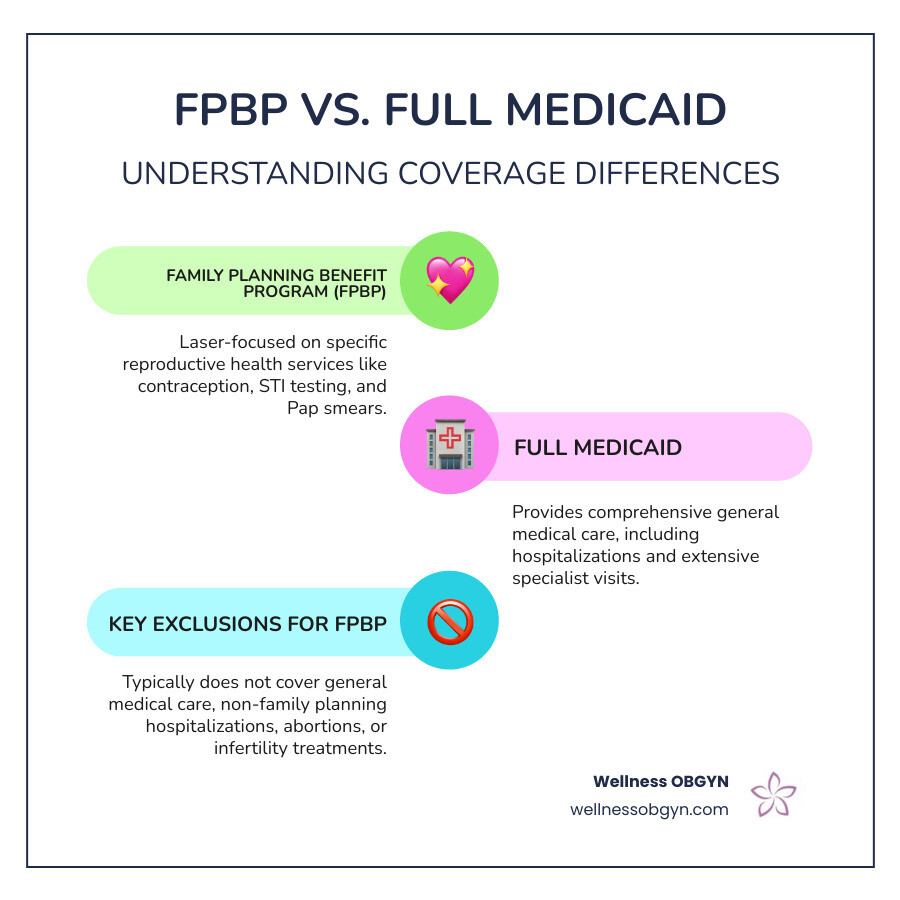
Understanding these differences can help you choose the right program for your needs. If you’re primarily seeking reproductive health services, a family planning benefit program might be your perfect fit. But if you need broader healthcare coverage, full Medicaid could be the better option.
The key thing to remember is that these programs serve different purposes. One isn’t necessarily better than the other – they’re designed for different situations and needs. Let’s break down exactly how they differ.
Scope of Coverage
The most significant difference lies in what each program covers, and this is where the “specialized tool versus comprehensive toolbox” analogy really shines.
FPBP is limited to family planning services – and that’s by design. A family planning benefit program focuses like a laser on reproductive health. It covers contraception, STI testing, Pap smears, sterilization procedures, and preconception counseling. But it doesn’t extend to general medical care, hospital stays for non-reproductive issues, or visits to specialists for conditions unrelated to family planning.
Think of it this way: if you break your arm, FPBP won’t help. But if you need birth control, annual gynecological care, or STI screening, it’s got you completely covered.
Medicaid provides comprehensive health coverage that’s much broader in scope. It’s designed to be your complete healthcare safety net, covering primary care visits, specialist appointments, hospital stays, mental health services, prescription medications, and often dental and vision care too. Family planning services are just one small piece of Medicaid’s extensive coverage puzzle.
The trade-off is clear: FPBP gives you focused, specialized care for reproductive health, while Medicaid gives you everything but often with more complex eligibility requirements.
Eligibility and Enrollment
The pathways to qualifying and enrolling reveal another crucial difference between these programs.
FPBP often has higher income limits because it serves a more specific purpose. Since the program is narrowly focused on family planning, states can afford to be more generous with income thresholds. This creates a vital bridge for people who earn too much to qualify for comprehensive Medicaid but still need help affording reproductive healthcare.
For example, New York’s FPBP accepts individuals up to 223% of the Federal Poverty Level, while full Medicaid typically has lower income cutoffs. This means a college student or young professional might not qualify for full Medicaid but could easily access family planning services through FPBP.
Medicaid has stricter income rules by necessity. Since it covers such a broad range of healthcare services, the program must be more selective about who qualifies. The income and resource requirements are typically more stringent, designed specifically for individuals and families with very low incomes.
FPBP enrollment is separate from general health insurance plans, which is actually a huge advantage for many people. Even though FPBP is often funded through Medicaid dollars, enrolling in it doesn’t mean you’re enrolled in full Medicaid. You receive a specific benefit card for family planning services, and you’re typically exempt from the managed care health insurance plan enrollment that comes with full Medicaid.
This separation allows for focused, confidential access to reproductive health services without the complexities of navigating a broader health insurance plan. It’s streamlined, private, and designed specifically for your reproductive health needs.
The bottom line? If your primary need is confidential, affordable access to family planning services, a family planning benefit program is your go-to option. If you require comprehensive healthcare beyond reproductive services, full Medicaid is the program worth exploring.
Frequently Asked Questions
We know you might have more questions about family planning benefit programs, and we’re here to help! These are some of the most common concerns we hear from our patients and community members. Let’s clear up any confusion and help you feel confident about accessing the care you deserve.
Are services from a family planning benefit program truly confidential?
Absolutely, yes! Confidentiality is the backbone of these programs, and we can’t stress this enough. These programs were specifically designed with your privacy as a top priority, recognizing that reproductive health decisions are deeply personal.
Here’s how your privacy is protected: You can request mail be sent to a different address if you’re concerned about sensitive information arriving at your home. Whether you’re a teen living with parents or an adult who shares mail with family members, you have options to keep your healthcare information private.
Even better, you can use the program without notifying your primary insurance provider. This means if you have insurance through your parents or employer but want to keep your family planning services confidential, the FPBP can bill directly without involving your main insurance company. Your insurance company won’t receive any explanation of benefits or notifications about your visits.
We believe that feeling safe and secure about your privacy empowers you to seek the care you need without hesitation or worry. Your reproductive health decisions are yours alone to make.
What services are typically NOT covered?
While family planning benefit programs offer comprehensive reproductive health services, it’s important to understand their specific scope. These programs focus on preventing unintended pregnancies and maintaining reproductive health, so some services fall outside their mission.
Infertility treatments beyond basic counseling are typically not covered. While you can receive preconception counseling to prepare for a healthy pregnancy, extensive diagnostic testing or treatments like IVF usually require different coverage. The program’s focus is on family planning rather than fertility improvement.
Abortion services are generally not included in these programs. The emphasis is on prevention through contraception and education rather than pregnancy termination.
Follow-up care not directly related to family planning also falls outside the program’s scope. If you develop a health issue during your visit that’s unrelated to reproductive health – like a cold, injury, or chronic condition – those services would need to be addressed through other healthcare coverage.
Think of it this way: if the service directly relates to planning your family, preventing pregnancy, or maintaining your reproductive health, it’s likely covered. Everything else probably isn’t.
Can I apply if I’m a college student or a teen?
Yes, absolutely! Family planning benefit programs are designed to be accessible to individuals of all childbearing ages, and that specifically includes teens and college students. In fact, these groups often benefit the most from these programs.
Teens have special protection under these programs. We recognize that young people need confidential access to contraception, STI testing, and counseling to make responsible decisions about their sexual health. These programs provide that safety net without requiring parental involvement or notification in most cases.
College students are ideal candidates for these programs. You’re often managing tight budgets, may be covered under your parents’ insurance (which you might not want to use for privacy reasons), and need access to affordable reproductive healthcare. As long as you meet your state’s residency and income requirements, you can benefit greatly from these services.
We strongly encourage young adults to explore these options. Taking control of your reproductive health is an important step in personal empowerment, and these programs exist specifically to support you during this crucial time in your life. Don’t let age or student status stop you from getting the care you need – these programs are here for you.
Conclusion: Take Control of Your Reproductive Health
Your reproductive health journey is uniquely yours, and understanding how a family planning benefit program can support you is an important step toward making informed decisions about your body and future. Throughout this guide, we’ve explored how these state-funded programs serve as a bridge to essential care, removing financial barriers and protecting your privacy when you need it most.
The beauty of these programs lies in their core promise: making quality reproductive healthcare accessible to everyone. When cost becomes a barrier to getting the contraception you need, the annual exam you’ve been putting off, or the confidential STI testing that gives you peace of mind, a family planning benefit program steps in to help.
Affordability means never having to choose between paying rent and getting birth control. These programs eliminate premiums, reduce or eliminate co-pays, and ensure that your income level doesn’t dictate your access to essential care. Confidentiality gives you the freedom to make personal health decisions without worrying about privacy breaches or unwanted family discussions. Comprehensive care ensures you’re getting everything from routine screenings to emergency contraception under one supportive umbrella.
Most importantly, these programs offer empowerment. They put the power back in your hands to prevent unintended pregnancies, plan your family timeline, and maintain your sexual health on your own terms. Whether you’re 16 or 44, a college student managing a tight budget, or someone seeking care outside your primary insurance for privacy reasons, these programs recognize that everyone deserves access to quality reproductive healthcare.
Taking that first step to explore your state’s family planning benefit program might feel overwhelming, but the application process is designed to be straightforward. The providers who participate in these programs understand the importance of making you feel comfortable and supported throughout your care.
At Wellness OBGYN, we believe deeply in providing expert, compassionate, and personalized care that honors your individual needs and circumstances. Our approach to women’s healthcare recognizes that every patient’s journey is different, and we’re here to support you with the respect and understanding you deserve.
Your reproductive health is an integral part of your overall well-being, and you don’t have to steer it alone. For a supportive approach to your reproductive health, learn more about managing Female Reproductive Health Issues.
The path to taking control starts with knowing your options. We encourage you to reach out, ask questions, and explore how a family planning benefit program might fit into your healthcare journey.