
Why Gynecologic Cancer Screening Can Save Your Life
Gynecologic cancer screening is the use of tests and exams to find cancer — or signs that cancer may develop — in the reproductive organs, before symptoms appear.
Here is a quick overview of what screening is available for each type:
| Cancer Type | Routine Screening Available? | Primary Method |
|---|---|---|
| Cervical | Yes | Pap test, HPV test, or co-test |
| Uterine/Endometrial | No (for average risk) | Symptom awareness; biopsy if high risk |
| Ovarian | No | Symptom awareness; genetic testing if high risk |
| Vaginal | No | Symptom awareness; Pap test may detect incidentally |
| Vulvar | No | Symptom awareness; clinical exam |
The key takeaway: cervical cancer is the only gynecologic cancer with a proven, routine screening test. For the others, knowing your risk factors and reporting symptoms early is your most powerful tool.
Around 100,000 women in the United States are diagnosed with a gynecologic cancer every year. Many of these cases are found late — not because detection is impossible, but because women don’t know what to watch for or when to get checked.
The good news? With the right screening schedule, the HPV vaccine, and awareness of your own body, many gynecologic cancers can be caught early or even prevented entirely.
I’m Dr. Cheryl Twu, a board-certified OB-GYN and founder of Wellness OBGYN in Honolulu, and gynecologic cancer screening has been a cornerstone of my preventive care practice across more than a decade of women’s health work in high-volume clinical settings. In this guide, I’ll walk you through everything you need to know — from cervical screening schedules to high-risk genetic protocols — so you can make confident, informed decisions about your health.
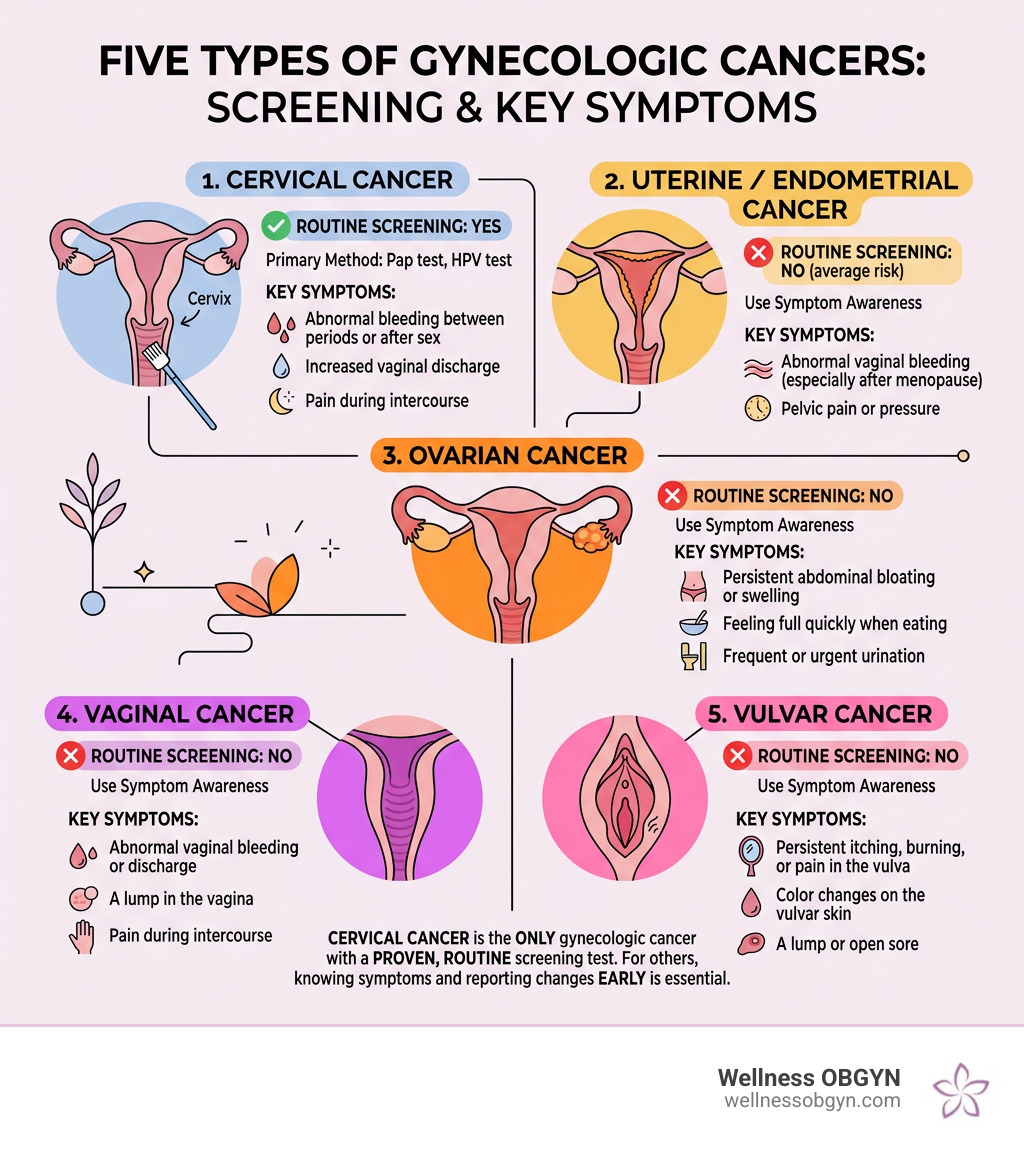
Gynecologic cancer screening terms explained:
Understanding the Main Types of Gynecologic Cancers
When we talk about gynecologic cancers, we are referring to any cancer that starts in a woman’s reproductive organs. While they are often grouped together, each type is unique in its risk factors, symptoms, and how we look for it.

- Cervical Cancer: This starts in the cervix, the lower part of the uterus. Almost all cases are caused by the Human Papillomavirus (HPV). It is highly preventable because we have excellent gynecologic cancer screening tools to find precancerous changes.
- Uterine (Endometrial) Cancer: This is the most common gynecologic cancer in the U.S., and the number of cases is rising, partly due to increasing obesity rates. It usually starts in the lining of the uterus (the endometrium).
- Ovarian Cancer: This is often called the “whispering disease” because symptoms can be subtle. It causes more deaths than any other gynecologic cancer because it is frequently diagnosed in late stages.
- Vaginal and Vulvar Cancers: These are rare, accounting for only about 1-2% of gynecologic cancers. Like cervical cancer, they are often linked to HPV infection.
At Wellness OBGYN, we emphasize the importance of the annual OBGYN visit as the first line of defense. During these visits, we perform a pelvic exam to check the size and shape of the uterus and ovaries. While a pelvic exam alone isn’t a “screening test” for all cancers, it allows us to feel for lumps or abnormalities.
The statistics can be sobering. For instance, the survival of women with cancers of genital organs varies significantly based on how early the disease is caught. Ovarian cancer has a five-year survival rate of about 30% overall because 2/3 of cases are diagnosed late. In contrast, uterine cancer has an 80% five-year survival rate because it often causes early symptoms like abnormal bleeding.
Current Guidelines for Cervical Gynecologic Cancer Screening
Cervical cancer is the “success story” of gynecologic oncology. Because of regular screening, the number of cases and deaths has dropped significantly over the last several decades.
The cervical sampling process is quick. During a pelvic exam, we use a speculum to see the cervix and a small brush to collect cells. These cells are then tested in a lab.
There are three main ways we screen:
- Pap Test (Cytology): Looks for abnormal cell changes on the cervix.
- HPV DNA Test: Looks for the high-risk types of HPV that cause these cell changes.
- Co-testing: Performing both tests at the same time on the same sample.
| Test Type | Sensitivity for High-Grade Lesions (CIN2+) |
|---|---|
| Pap Smear | 61.1% |
| HPV DNA Test | 94.1% |
As you can see, the HPV test is significantly more sensitive, which is why modern guidelines are shifting toward using it more frequently.
The Role of HPV Testing in Gynecologic Cancer Screening
The HPV test doesn’t just look for the virus; it looks for “high-risk” strains. Research shows that HPV E6/E7 mRNA detection is a highly specific way to identify oncogenic activity. In simple terms, it tells us not just if the virus is present, but if it is actively trying to turn your cells into cancer. This helps us avoid over-treating infections that the body might clear on its own.
Screening Recommendations by Age Group
In Honolulu, we follow the consensus guidelines from major health organizations. If you’ve had an abnormal Pap follow-up in the past, your schedule may be more frequent. For average-risk individuals, the typical schedule is:
- Ages 21–29: Pap test every 3 years. HPV testing is generally not recommended in this age group because HPV infections are very common and usually clear on their own.
- Ages 30–65: You have three choices:
- A Pap test every 3 years.
- An HPV test every 5 years (Primary HPV testing).
- A Pap and HPV co-test every 5 years.
- Over Age 65: You may be able to stop screening if you have had regular normal results for the past 10 years and no history of high-grade precancer.
Screening for Ovarian, Uterine, and Rare Cancers
One of the most common questions we get is, “Does my Pap smear check for ovarian cancer?” Unfortunately, the answer is no. Currently, there is no standard, effective gynecologic cancer screening test for ovarian or uterine cancer in women who have no symptoms and are at average risk.
However, if you have symptoms or a high-risk family history, we use other tools:
- Transvaginal Ultrasound (TVUS): Uses sound waves to look at the uterus and ovaries. In postmenopausal women, we look for “endometrial thickness.” Research on ultrasound sensitivity70268-0) shows that a thickness cutoff of 5mm has about 80% sensitivity for detecting endometrial cancer.
- CA-125 Blood Test: Measures a protein in the blood. While not a good screening tool for the general public (it can be elevated by many non-cancerous conditions), it is helpful for monitoring women already diagnosed or those at very high risk.
The most important “test” for these cancers is your own awareness. During your annual health exam, tell us if you experience bloating, pelvic pain, or feeling full quickly for more than two weeks. For uterine cancer, the “red flag” is abnormal bleeding, especially any bleeding after menopause.
High-Risk Protocols for Genetic Mutations
For some women, the risk is higher due to genetics. About 10-15% of ovarian cancers are linked to hereditary mutations like BRCA1 or BRCA2. Another condition, Lynch syndrome, significantly increases the risk for both uterine and colon cancers.
If you have a strong family history, genetic testing can be a lifesaver. Women with these mutations may need:
- Annual transvaginal ultrasounds and CA-125 tests starting at age 30 or 35.
- Annual endometrial biopsies.
- Discussion of “prophylactic” (preventive) surgery to remove the ovaries or uterus once childbearing is complete.
Prevention, Genetics, and Sexual Wellness
Prevention is always better than cure. The HPV vaccine is a landmark achievement in cancer prevention. A landmark study on the HPV vaccine found that it reduced HPV rates by 63% in teenage girls. It protects against the types of HPV that cause most cervical, vaginal, and vulvar cancers. It is recommended for everyone through age 26, and some adults up to age 45 can benefit.
Lifestyle also plays a massive role. Obesity is a major risk factor for uterine cancer because fat tissue produces estrogen, which can overstimulate the uterine lining. Maintaining a healthy weight through diet and exercise is a proven way to lower your risk.
Looking to the future, research on liquid biopsies is very promising. These are blood tests that look for tiny pieces of tumor DNA. One day, we may be able to screen for ovarian and uterine cancers with a simple blood draw.
Frequently Asked Questions about Gynecologic Cancer Screening
What do abnormal Pap or HPV test results mean?
An abnormal result does not mean you have cancer. Most of the time, it means you have an HPV infection or minor cell changes that need to be watched. Following the next steps after an abnormal test is crucial. We might recommend:
- Colposcopy: A closer look at the cervix using a magnifying lens.
- Biopsy: Taking a tiny sample of tissue to check for precancer.
- LEEP: A procedure to remove abnormal cells before they can turn into cancer.
When to stop routine gynecologic cancer screening?
Most women can stop cervical cancer screening at age 65 if they have a “normal” history (three consecutive negative Pap tests or two negative HPV tests in the last 10 years). If you have had a total hysterectomy (removal of the uterus and cervix) for a non-cancerous reason, you usually do not need Pap tests anymore.
Are there free or low-cost screening resources available?
Yes! Everyone deserves access to life-saving screenings.
- The BCCCP (Breast and Cervical Cancer Control Program) provides free screenings to low-income, uninsured women.
- Veterans can access comprehensive gynecologic care through the VA health care system. Women veterans can use tools like MyHealtheVet to schedule appointments and track their results.
Conclusion
At Wellness OBGYN in Honolulu, we believe that healthcare should be a partnership. We provide personalized care from adolescence through menopause, specializing in shared decision-making. Whether you are coming in for your first Pap test or discussing genetic testing due to family history, we provide expert, compassionate care tailored to your individual needs.
Don’t wait for symptoms to appear. Early detection through regular gynecologic cancer screening is the best way to ensure a long, healthy life.
Visit our services page to schedule your screening today and take the first step toward proactive health.