
Why a Female Sexual Health Symptom Checker Matters for Your Wellness
A female sexual health symptom checker can help you quickly identify whether changes in your body—like unusual discharge, pelvic pain, or genital skin changes—warrant medical attention. Here’s what to look for:
| Symptom | Normal | Seek Care If |
|---|---|---|
| Vaginal Discharge | Clear or white, no strong odor, varies with cycle | Strong fishy smell, green/gray color, itching, thick lumpy texture |
| Pelvic Pain | Mild cramping during menstruation | Sudden intense pain, pain with fever, pain during sex that persists |
| Pain When Peeing | None | Burning sensation, accompanied by blisters or sores |
| Genital Skin Changes | Normal variations in texture | New lumps that grow, painful blisters, sores that don’t heal |
| Bleeding | Regular menstrual cycle | Bleeding after sex, between periods, or after menopause |
Getting a diagnosis for female health conditions like PCOS, endometriosis, or fibroids can take up to 12 years. Meanwhile, about 20 million new cases of STIs are diagnosed each year in the United States. The sooner you recognize symptoms and seek testing, the better your outcomes.
Vaginal discharge is normal—most women and girls have it. It keeps the vagina clean and protected from infection. But changes in texture, smell, amount, or color can signal infections like bacterial vaginosis, thrush, chlamydia, or gonorrhoea.
Sudden, intense pelvic pain is a medical emergency. It could mean ectopic pregnancy or pelvic inflammatory disease (PID), both of which require immediate care.
Genital skin changes—such as painless lumps, fluid-filled blisters, or sores—may indicate STIs like genital warts, herpes, or syphilis. Syphilis often has no symptoms but can mimic almost any skin condition, making testing essential.
I’m Dr. Cheryl Twu, a board-certified obstetrician-gynecologist who has spent more than a decade helping women navigate sexual health concerns from adolescence through menopause. My experience with a female sexual health symptom checker approach and advanced diagnostics helps patients understand their symptoms and access timely, compassionate care at Wellness OBGYN in Honolulu.
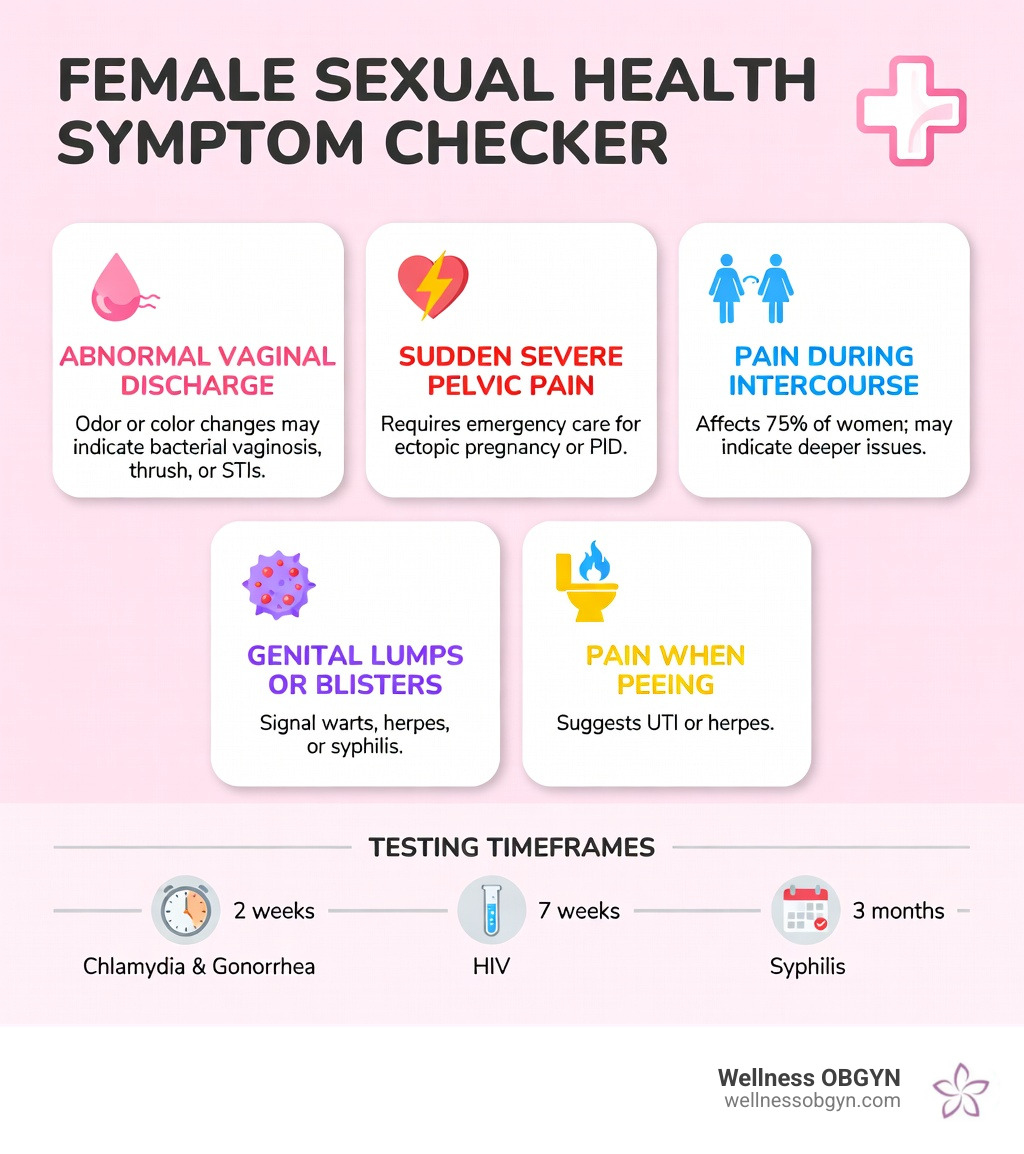
Basic female sexual health symptom checker glossary:
The Female Sexual Health Symptom Checker: Decoding Discharge and Pain

When we talk about a female sexual health symptom checker, we aren’t just talking about a digital tool; we’re talking about your own internal radar. Your body is incredibly communicative, but sometimes it speaks in a language that feels like a riddle. Is that discharge “normal cycle stuff” or a sign of Bacterial Vaginosis (BV)? Is that twinge in your side a pulled muscle or female reproductive health issues like endometriosis?
Understanding the nuances of your body is the first step toward proactive wellness. Research shows that getting a diagnosis for conditions like endometriosis can take up to 12 years. That is over a decade of wondering, worrying, and potentially suffering in silence. We want to close that gap. By using a systematic approach to check your symptoms, you can walk into our Honolulu office feeling empowered and ready for a productive conversation.
Understanding Normal vs. Abnormal Discharge
Let’s get one thing straight: Vaginal discharge is your friend. It is a natural fluid produced by the cervix and vaginal walls to keep the environment clean, moist, and protected from infection. However, “normal” is a moving target. It changes based on where you are in your menstrual cycle, whether you are pregnant, if you’re on birth control, or even how much water you’ve had to drink today.
- Normal Discharge: Usually clear or white. It might be thick and sticky (post-ovulation) or slippery and wet (during ovulation). It shouldn’t have a strong or offensive odor.
- Bacterial Vaginosis (BV): This is an imbalance of the natural bacteria in the vagina. The hallmark sign is a thin, gray or white discharge with a strong, fishy smell, particularly after sex.
- Thrush (Yeast Infection): Think “cottage cheese.” This discharge is typically thick, white, and lumpy. It usually comes with intense itching and redness.
- STIs (Chlamydia and Gonorrhoea): These often cause discharge that is yellow or green, sometimes accompanied by a strong odor or pain during urination.
Taking a holistic approach to womens health means looking at these symptoms not just as isolated “germs,” but as signals of your body’s overall balance.
How to use a female sexual health symptom checker effectively
In the age of AI, many women turn to online tools first. While these can be helpful for triage, they have limitations. An AI can’t perform a physical exam or look at a swab under a microscope.
To use a female sexual health symptom checker effectively, treat it as a diary. Note the date your symptoms started, any changes in your routine (new soaps, new partners, or starting a new medication), and how the symptoms evolve. This data is gold for your gynecologist Honolulu. If a tool tells you that your symptoms “might” be an STI, don’t spiral into a panic—use that information to book a test and get a definitive answer. Self-assessment is the beginning of the journey, not the destination.
Warning Signs You Should Never Ignore: Pelvic Pain and Bleeding
Pelvic pain is a tricky symptom because the pelvis is “expensive real estate”—it houses your reproductive organs, your bladder, and your bowels. Interestingly, only about 20% of pelvic pain is actually caused by gynecological issues. The rest might be related to urinary or bowel problems. However, when that pain is gynecological, it demands your attention.
The 12-year average for female health diagnoses is often due to women dismissing their own pain as “just part of being a woman.” We are here to tell you that chronic, life-disrupting pain is not normal.
When pelvic pain becomes an emergency
Most of the time, pelvic pain can wait for a scheduled appointment. But there are two major “red flags” that require an immediate trip to the Emergency Department:
- Ectopic Pregnancy: This occurs when a fertilized egg implants outside the uterus, usually in the fallopian tube. If the tube ruptures, it can cause life-threatening internal bleeding. Symptoms include sudden, intense pain on one side, fainting, or shoulder tip pain.
- Pelvic Inflammatory Disease (PID): This is an infection of the womb and surrounding tissues, often caused by untreated STIs like chlamydia. If you have pelvic pain combined with a fever, chills, or unusual discharge, you need medical intervention immediately to prevent long-term scarring and infertility.
If you are experiencing these, please visit our center for womens wellness or your nearest ER immediately.
Identifying causes of pain during intercourse
Pain during sex (dyspareunia) is incredibly common, affecting 75% of women at some point in their lives. It is especially prevalent after menopause due to declining estrogen levels, which can lead to vaginal atrophy and dryness. However, it can also affect younger women due to infections, endometriosis, or pelvic floor tension.
Genital Skin Changes: Identifying Lumps, Bumps, and Blisters
Finding a new lump or bump “down there” can be terrifying. Your mind might immediately jump to the worst-case scenario. However, many genital skin changes are benign. Blocked hair follicles, skin tags, or “cysts” are common. But because about 20 million new STDs are diagnosed annually in the U.S., we must be diligent.
Recognizing the signs of common STIs
When using a female sexual health symptom checker for skin changes, look for these specific characteristics:
- Genital Warts: These are usually painless, flesh-colored lumps that may look like small cauliflowers. They can appear alone or in clusters.
- Genital Herpes: This typically starts with a tingling or itching sensation, followed by small, painful, fluid-filled blisters that eventually burst and form sores.
- Syphilis: This is the “great pretender.” It often starts with a single, painless sore (chancre) that you might not even notice. If left untreated, it can mimic rashes all over the body. Because it can be asymptomatic, a blood test is the only way to be sure.
If you notice any of these, visit our womens health center honolulu for a professional evaluation.
Using a female sexual health symptom checker for skin irregularities
When you examine yourself, ask these questions:
- Is it painful? (Herpes usually is; warts and syphilis chancres usually aren’t).
- Has the texture changed? (Is it hard, soft, or fluid-filled?)
- How long has it been there? (Simple skin irritations from shaving usually resolve in a few days).
A visual check is a vital part of your womens health annual exam. If something looks “off” to you, it’s worth a five-minute check-up with us to put your mind at ease.
When to consult a professional after using a female sexual health symptom checker
You should book an appointment with a gynecologist Honolulu if:
- Your symptoms persist for more than a few days.
- This is your first time experiencing symptoms like thrush or BV.
- You are pregnant and notice any change in discharge or pain.
- You have had unprotected sex with a new partner.
- You have “non-negotiable” symptoms like bleeding after sex or between periods.
Frequently Asked Questions about Female Sexual Health
How long should I wait to test for an STI after unprotected sex?
For the most accurate results, wait 2 weeks for chlamydia and gonorrhoea. For HIV, the window is generally 7 weeks. Syphilis and Hepatitis B can take up to 3 months to show up on a test. If you have active symptoms (like blisters or discharge), come in immediately.
Can a UTI be caused by sexual activity?
Yes! While a Urinary Tract Infection (UTI) is not a sexually transmitted infection, sex can push bacteria into the urethra, triggering an infection. This is why we always recommend “peeing after sex” to help flush out any unwanted hitchhikers.
Is it normal to have some vaginal discharge every day?
Absolutely. Most women have a small amount of discharge daily. It’s your body’s way of self-cleaning. As long as it isn’t accompanied by a foul odor, itching, or a strange color (like green or gray), it’s likely just your body doing its job.
Conclusion
We provide personalized care from adolescence through menopause, emphasizing shared decision-making and a warm, supportive environment. Don’t let a “wait and see” attitude or a 12-year diagnosis delay define your health. Take control of your well-being today.