
Understanding Your Contraceptive Options
Different birth control methods offer a wide range of choices for managing reproductive health. Whether you seek long-term protection, hormone-free options, or added health benefits, understanding your choices is the first step toward an informed decision.
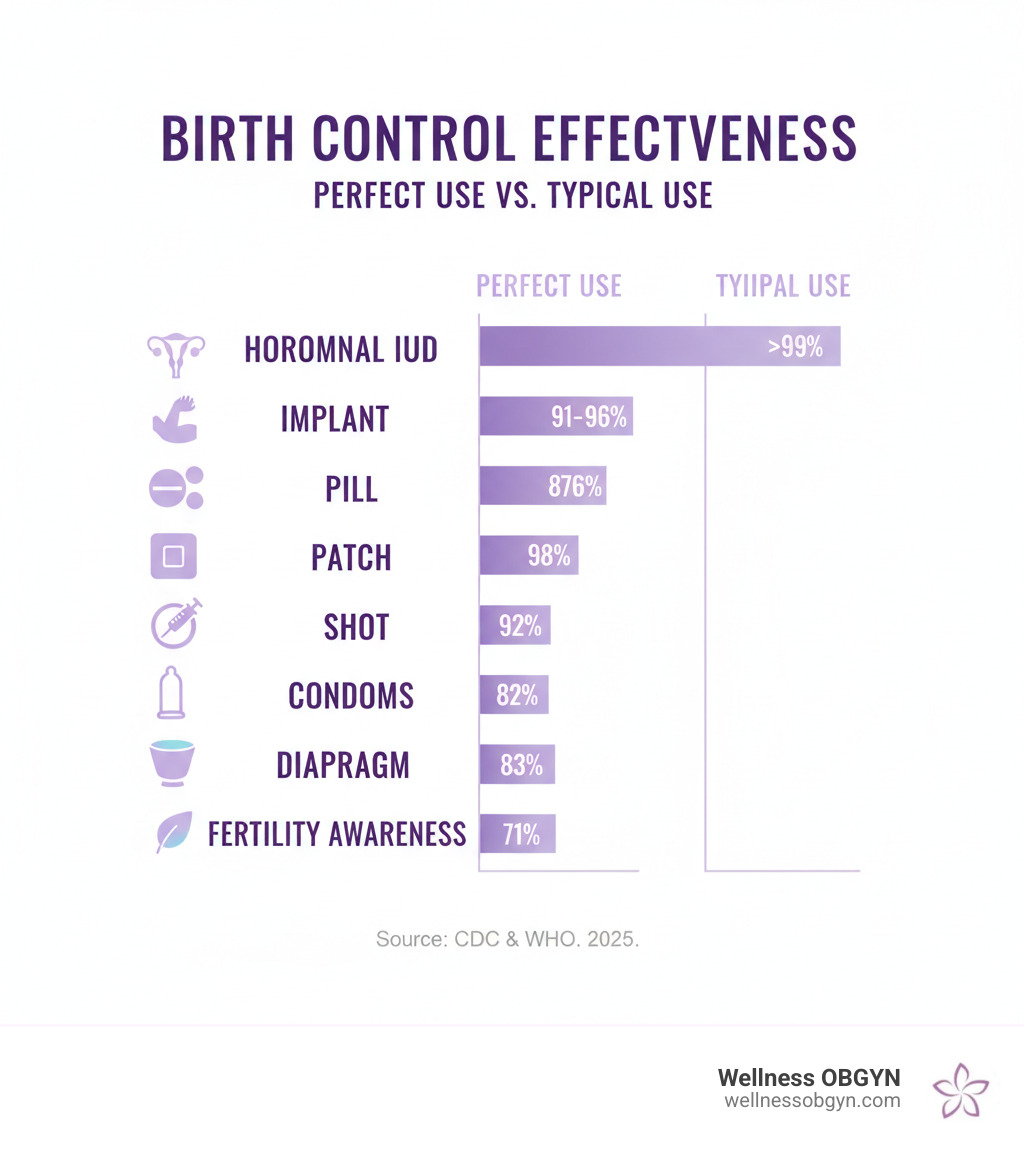
Most Effective Methods (>99% effectiveness):
- Hormonal IUD (Mirena, Kyleena) – lasts 3-8 years
- Copper IUD – lasts up to 12 years
- Contraceptive implant (Nexplanon) – lasts 3 years
- Sterilization – permanent
Moderately Effective Methods (91-96% typical use):
- Birth control pills – daily use
- Birth control patch – weekly replacement
- Vaginal ring – monthly replacement
- Birth control shot – every 3 months
Less Effective Methods (71-88% typical use):
- Condoms (male and female) – also prevent STIs
- Diaphragm – inserted before sex
- Fertility awareness methods – tracking cycles
Successful contraception means finding a method that fits your lifestyle, health, and preferences. Effectiveness rates vary between perfect and typical use, so choose a method you can use consistently.
As Dr. Cheryl Twu, I’ve helped women steer different birth control methods for over a decade, now at Wellness OBGYN in Honolulu. My experience confirms that the best choice is deeply personal and requires considering your health, lifestyle, and reproductive goals.
How to Choose: Key Factors for Your Birth Control Decision
Choosing the right different birth control methods is a personal journey. At Wellness OBGYN, we help you understand your unique needs to find the best fit. Consider these key factors:
Effectiveness rates: There’s a difference between perfect use (following instructions exactly) and typical use (real-world scenarios). Methods like IUDs and implants are over 99% effective in both cases. Pills, patches, and rings can be 99% effective with perfect use but drop to 91-97% with typical use if doses are missed.
Your health history and age: Certain conditions, like migraines with aura or a history of blood clots, may rule out some hormonal options. If you’re over 35 and smoke, combined hormonal methods are generally not recommended. We review your medical history to ensure your choice is safe.
Lifestyle and convenience: Do you prefer a daily routine (pills) or a “set it and forget it” approach (IUDs, implants)? Your schedule, activities, and privacy preferences all play a role in finding a method you can use successfully.
Potential side effects: Hormonal methods may cause mood changes or irregular bleeding, while the copper IUD can lead to heavier periods. It’s important to understand what to expect and what you’re comfortable managing.
Cost and insurance coverage: Most insurance plans cover birth control, but coverage varies. While some long-acting methods have higher upfront costs, they can save money over time. We can help you steer your benefits in Honolulu.
Non-contraceptive benefits: Many different birth control methods offer perks beyond pregnancy prevention. Hormonal options can help with heavy periods, cramps, acne, and conditions like PCOS.
Partner involvement: Open communication with your partner about your chosen method can strengthen your relationship and improve contraceptive success.
Future family plans: Your timeline for wanting children influences your choice. Methods like pills are easily reversible, while IUDs offer long-term but reversible protection. Sterilization is a permanent option. Fertility can take several months to return after stopping the birth control shot.
Understanding these factors helps you make a choice that fits your life. For more insights, see Family Planning Made Easy: Tips for Conception and Reproductive Health. A personalized consultation is the best way to find the method that gives you peace of mind.
A Comparison of Different Birth Control Methods
Contraceptive methods fall into two main camps: hormonal and non-hormonal. Each offers unique benefits, and the best choice depends on your body, lifestyle, and goals.
Hormonal methods use hormones to prevent ovulation and change cervical mucus. Many also offer non-contraceptive benefits like lighter periods.
Non-hormonal methods use physical barriers or create an environment hostile to sperm. Barrier methods like condoms are unique in that they also protect against STIs.
Effectiveness depends on consistent and correct use, which is why we discuss both “perfect use” and “typical use” rates. Let’s explore these options to find the one you can use confidently.
Hormonal Options: A Look at different birth control methods with hormones
Hormonal different birth control methods use synthetic hormones (estrogen and progestin, or progestin-only) to prevent pregnancy. They primarily work by stopping ovulation, thickening cervical mucus to block sperm, and thinning the uterine lining.
A major appeal is their non-contraceptive benefits. These methods often provide relief from heavy, painful periods, help clear acne, and can manage conditions like PCOS. For more details, see our guide on Best Hormonal Birth Control.
Long-Acting Reversible Contraception (LARCs)
Known as “set it and forget it” methods, LARCs are over 99% effective because they remove the chance of user error.
Hormonal IUDs (Mirena, Kyleena) are small, T-shaped devices placed in your uterus during a brief office visit. They release progestin-only hormones and last for 3 to 8 years. Many users experience lighter periods or no periods at all.
The contraceptive implant (Nexplanon) is a small, flexible rod placed under the skin of your upper arm, providing 3 to 5 years of protection. It releases progestin to prevent ovulation. At over 99% effectiveness, it’s one of the most reliable methods. Some women experience irregular bleeding, which often settles over time.
Both LARCs are completely reversible, with fertility returning quickly after removal.
Short-Acting Hormonal Methods
These methods require more frequent use and have 91-99% effectiveness rates, depending on consistency.
Birth control pills are a popular choice. Combined pills (estrogen and progestin) prevent ovulation and are taken daily. Progestin-only pills (mini-pills) are an option for women who can’t take estrogen but require strict daily timing.
The birth control patch is a weekly alternative. You apply a new patch each week for three weeks, followed by a patch-free week.
The vaginal ring is a soft, flexible ring used monthly. It stays in the vagina for three weeks and is removed for one week.
The birth control shot (Depo-Provera) is a quarterly progestin-only injection. It’s highly effective and private, but fertility can take several months to a year to return after stopping.
Non-Hormonal Options: Exploring different birth control methods without hormones
For those who prefer to avoid hormones, there are several effective different birth control methods. These options work by creating physical barriers or an environment where sperm cannot survive.
The Copper IUD
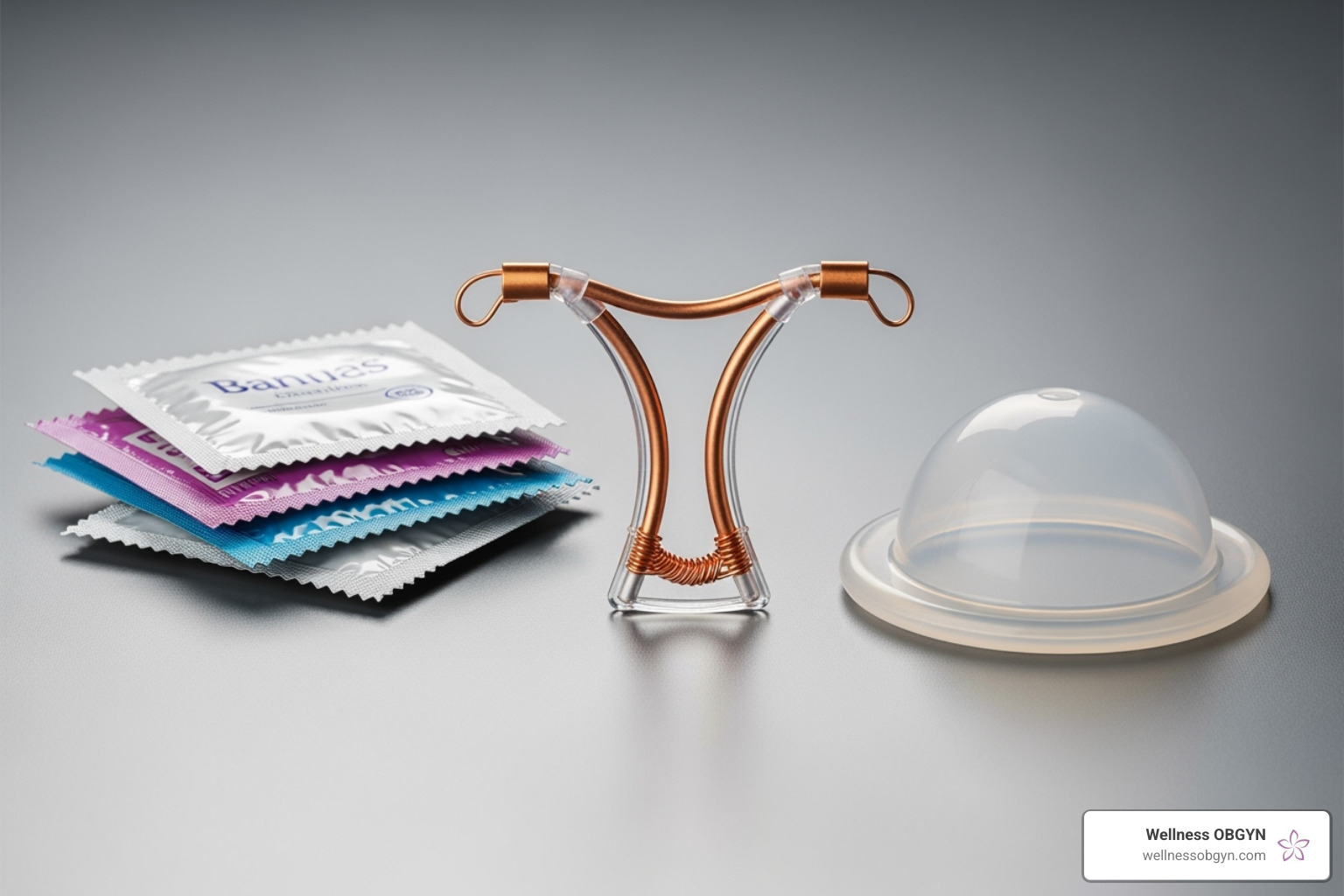
The copper IUD (ParaGard) is a small, T-shaped device placed in your uterus. The copper creates an inflammatory response that is toxic to sperm and eggs, preventing fertilization.
Effectiveness and duration: It is over 99% effective and can last up to 12 years, though it can be removed anytime.
What to expect: Many women experience heavier, longer, and more painful periods, especially initially. The copper IUD can also be used as the most effective form of emergency contraception if inserted within five days of unprotected sex.
Barrier Methods
Barrier methods physically block sperm from reaching an egg and are used on-demand.
External and internal condoms are the most common barrier methods. Their effectiveness depends on correct and consistent use (86% typical use for external condoms). A key advantage is that condoms are the only method that also provides STI protection. We often recommend “dual protection”—using condoms with another method for both pregnancy and STI prevention.
Diaphragms, cervical caps, and the contraceptive sponge are other options that cover the cervix to block sperm, often used with spermicide. They require more planning and proper fitting or insertion. Spermicide used alone is not a very effective method.
Fertility Awareness-Based Methods (FAMs)
FAMs involve tracking your body’s fertility signals to know when to avoid sex or use a barrier method. This is done by monitoring your basal body temperature, cervical mucus, or using a calendar to predict fertile days.
Effectiveness varies dramatically (77-98%) and requires significant diligence and regular cycles. While FAMs have no side effects and are low-cost, they demand consistent tracking and do not protect against STIs. At Wellness OBGYN, we can teach you proper techniques but also discuss the limitations and need for backup plans.
Special Considerations: Permanent and Emergency Contraception
Conversations about different birth control methods sometimes include permanent solutions or options for urgent situations.
Permanent Birth Control: Sterilization
For those certain they do not want children in the future, sterilization offers permanent, >99% effective protection.
Tubal ligation (“getting your tubes tied”) is the option for women. This surgical procedure blocks or removes the fallopian tubes to prevent eggs from reaching the uterus.
Vasectomy is the simpler male sterilization option. This outpatient procedure cuts or seals the tubes that carry sperm. It takes about three months to become fully effective, requiring a backup method during that time.
These procedures are considered irreversible and do not protect against STIs. The decision requires careful thought and counseling.
Emergency Contraception (EC)
EC is a backup plan for when primary birth control fails or isn’t used. It is not for regular use.
Emergency contraceptive pills (the “morning-after pill”) work by delaying ovulation. They are most effective when taken as soon as possible after unprotected sex (up to 5 days, depending on the type). Options include levonorgestrel (like Plan B, over-the-counter) and ulipristal acetate (Ella, prescription-only).
The copper IUD is the most effective EC option. When inserted within five days of unprotected sex, it is over 99% effective. A major benefit is that it then provides highly effective, long-term contraception for up to 12 years.
Time is critical with EC. For more information, see the CDC guidance on emergency contraception.
Frequently Asked Questions About Birth Control
During consultations at Wellness OBGYN, certain questions about different birth control methods come up frequently. Here are some concise answers.
Which birth control method is the most effective at preventing pregnancy?
The most reliable methods are those that eliminate user error. Implants and IUDs (hormonal and copper) are over 99% effective because they work continuously once in place. Sterilization (vasectomy and tubal ligation) is also over 99% effective but is a permanent decision. These “set it and forget it” methods are so successful because they don’t require daily attention.
Which birth control methods also protect against sexually transmitted infections (STIs)?
This is a critical distinction: only external (male) and internal (female) condoms offer reliable protection against STIs, including HIV. They create a physical barrier against infectious fluids and skin contact. For this reason, we often recommend “dual protection”—using condoms along with another highly effective contraceptive like an IUD or implant to prevent both pregnancy and STIs.
How quickly can I get pregnant after stopping birth control?
The time it takes for fertility to return varies by method.
- Immediate Return: With barrier methods, pills, the patch, and the vaginal ring, fertility can return almost immediately or within one to three months. The same is true after removing an IUD or implant.
- Delayed Return: The birth control shot (Depo-Provera) is the main exception. It can take anywhere from 3 to 18 months after the last injection for fertility to fully return. We always discuss this delay with patients considering this method.

Conclusion: Making an Informed Choice for Your Health
Choosing from the many different birth control methods is a personal decision. There is no single “best” method for everyone; the right choice depends on your health, lifestyle, and goals. The perfect match is one that fits seamlessly into your life, providing effective protection without stress.
Consulting with a healthcare professional is crucial. At Wellness OBGYN, we take the time to understand your individual situation, discuss your concerns, and review the pros and cons of each option. Your Annual OBGYN Visit is the perfect time for this conversation.
Taking charge of your reproductive health is empowering. Whether you’re new to contraception or considering a change, we provide the expert, compassionate care you deserve.
Ready to find your ideal birth control? Take the next step in managing your female reproductive health issues and schedule a consultation. We’ll help you steer the different birth control methods to find the perfect fit.